Loading cart…
No products in the cart.

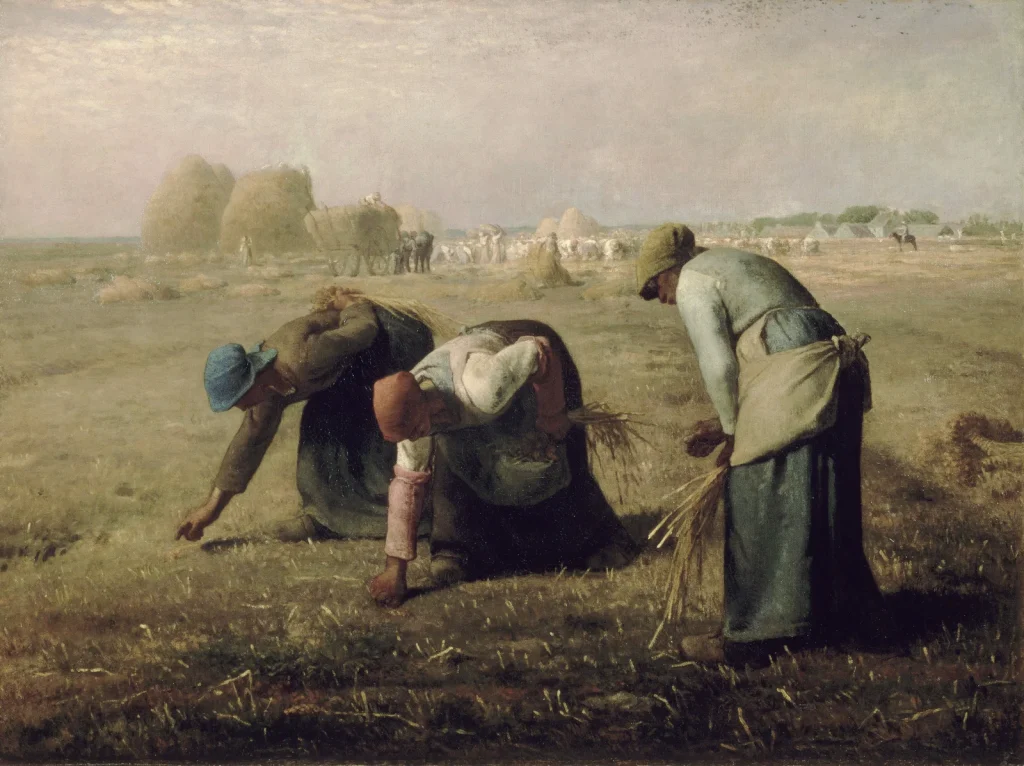
1857 · Oil on canvas · Musée d'Orsay, Paris
Gleaning is the oldest form of charity in the West. When the harvest was in, the poorest people of a village were allowed onto the stubble to pick up whatever the reapers had dropped: single ears of wheat, a handful at a time, bent double from dawn to dusk. The Bible commands it. Ruth, the ancestor of King David, meets her husband gleaning in his field:
Let me now go to the field, and glean ears of corn after him in whose sight I shall find grace.
Book of Ruth, chapter 2
In France the right was written into local law and policed. Gleaners had to be poor, had to wait for the harvest to be cleared, and could take only what lay on the ground. What they gathered in a day might feed a family for two. Millet had grown up on a farm in Normandy and had watched it all his life. In 1857 he painted it at the scale of a history painting, and the Paris Salon did not know where to look.
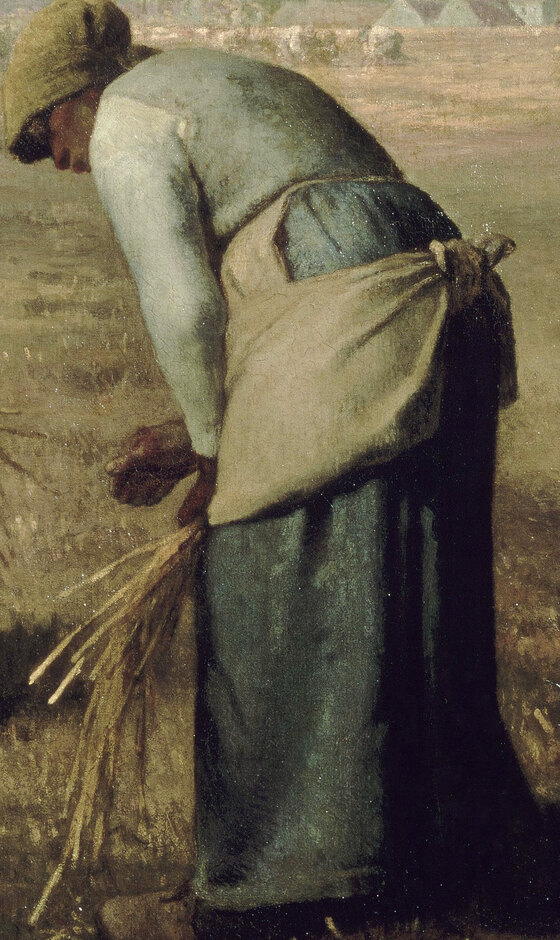
Three women fill the front of the picture. Two are bent almost in half, one hand on the ground and the other holding what they have gathered behind their backs. The third is straightening up, slowly, with a small bundle in her fist, and she has a hand pressed to the small of her back. Anyone who has done a day's work stooping knows that hand.
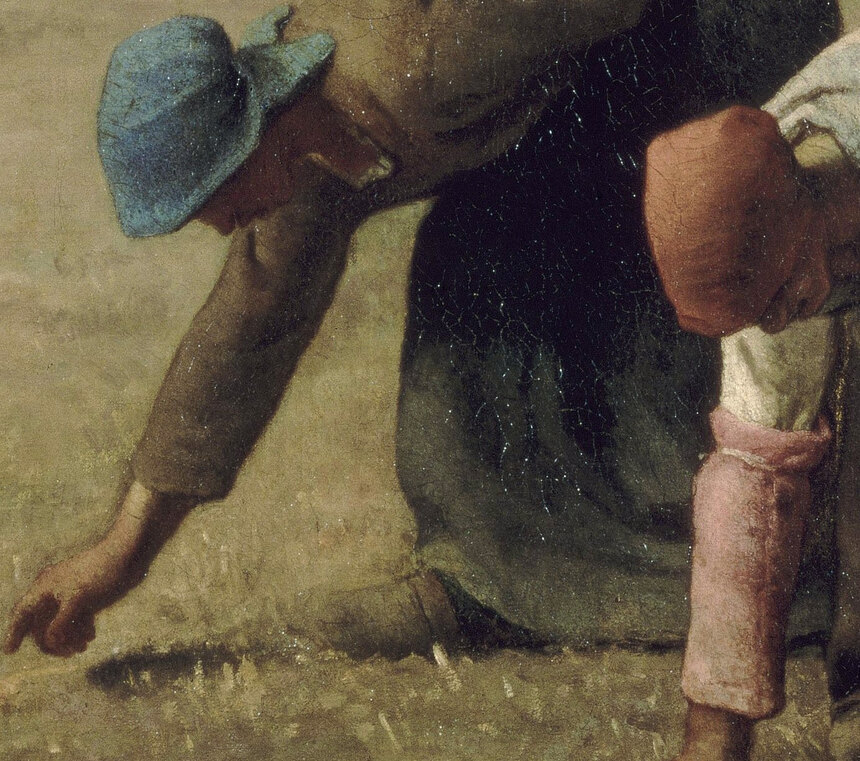
Millet gives them no faces to speak of. The one in the blue cap is turned away; the one in the red cap looks down; the standing one is in shadow under her headscarf. They are not portraits. They are the shape of the work, and the shape is heavy: broad backs, thick arms, feet planted in the dirt, the whole weight of the body pushed toward the ground.
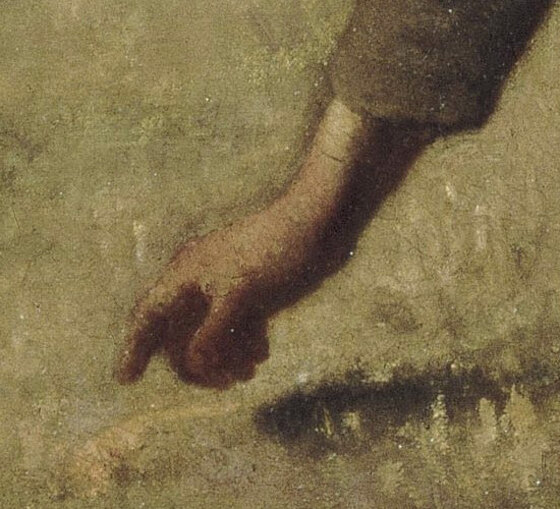
Look at what the hands are picking up. Two ears. Three. The reapers behind have left almost nothing, and what is left is the size of a finger. That is the whole economy of the painting in one detail: the effort is enormous and the reward is tiny, and the women do it anyway because it is what there is.
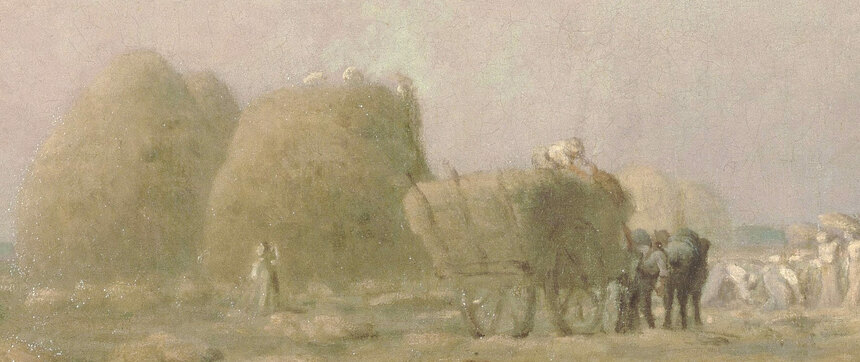
Now look past them. The background is the harvest itself: great golden stacks, a cart piled high, a crowd of reapers, sheaves everywhere, all of it in warm sunlight that never reaches the three women at the front. The farm is rich. The field has produced. And between the plenty at the back and the three figures at the front there is a wide band of empty stubble that Millet has made the real subject of the picture.
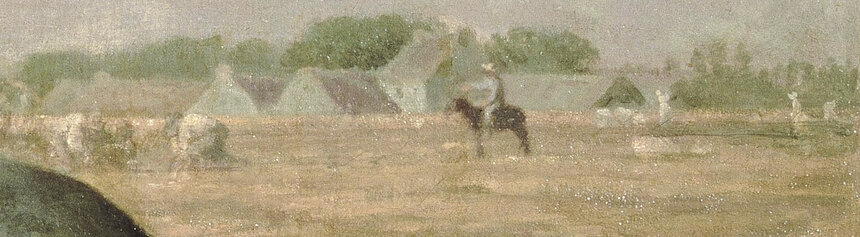
On the far right, small and easy to miss, a man sits on a horse. He is the overseer, the farmer's man, keeping an eye on the work. He is looking the other way. Nobody in the painting who has anything is looking at the women who have nothing. Millet does not say this. He just puts the horseman where you will find him last.
The painting went to the Salon of 1857, nine years after the revolution of 1848 and six after the coup that made Napoleon III emperor. The middle-class Paris that visited the Salon had learned to fear the poor, and here were three of them, painted huge, monumental, with the gravity of saints. The critic Paul de Saint-Victor wrote that Millet's gleaners posed like the three Fates of pauperism. Others saw a socialist tract, a threat, an insult to the pretty peasants of earlier painting.
Millet was baffled. He was not a socialist; he was a farmer's son who painted what he knew and voted, when he voted at all, for order. He wrote to a friend that he had never meant to plead a cause, only to show the human side of country work, its beauty and its weight. But he had painted the poor as if they mattered, at a size reserved for kings and gods, and in 1857 that was a political act whether he meant it or not.
The painting did not sell at the Salon. It went for a modest sum to a private buyer, was left to the Louvre by the champagne widow Madame Pommery in 1890, and is now one of the most visited pictures in the Musée d'Orsay.
The plain reading is the right one, and it has not changed since 1857: this is what poverty looks like next to plenty. Three women bend for scraps in the foreground while the harvest they are excluded from glows in the background. The composition is the argument.
What Millet adds, and what made the painting last, is dignity. The women are not ragged or pathetic. They are strong, patient and absorbed in their work, painted with the calm of a religious picture, and the light that falls on their backs is the same golden light that falls on the stacks. The Bible gave the poor the right to glean; Millet gives them the right to be looked at seriously.
That is why the painting has meant so much to so many people who never gleaned. Van Gogh, who copied Millet more than twenty times, called him the father of everything he was trying to do. Every painting of labour since, from the Realists to Soviet posters to the photographers of the Depression, owes something to three women in a field near Barbizon.
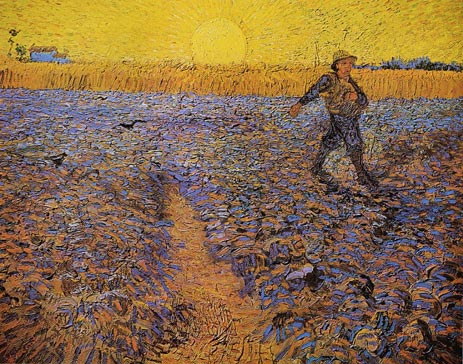
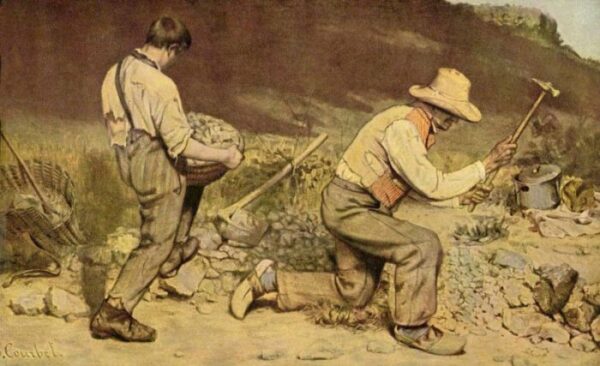
Millet painted the same world again and again from his house in Barbizon on the edge of the forest of Fontainebleau: the sower striding across the field, the couple stopping at dusk for the Angelus, the exhausted man leaning on his hoe. Van Gogh worked from prints of them as a young man, painted his own Sower under a huge sun at Arles in 1888, and in the asylum at Saint-Rémy the next year copied Millet's outright. Courbet, a few years before The Gleaners, had shown two men breaking rocks by a road at the same monumental scale, and the Salon had been outraged by that too.
In the Musée d'Orsay in Paris, on the ground floor, in the room given to Millet, Rousseau and Corot, with The Angelus nearby. It is oil on canvas, 83.5 by 110 centimetres, smaller than its reputation: the women are a little over half life size.
It is a warm, low-toned picture, all ochres and dusty golds with three points of colour in the caps, and it holds a room quietly. People choose it for kitchens, dining rooms and studies, and for anywhere work is respected. Our hand-painted reproduction of The Gleaners is painted in oil on canvas from the Orsay original, and it suits a plain wood frame, oak or walnut, rather than gilt.
More Millet in our Jean-François Millet collection, and the wider Realism archive.
Visible details, documented facts and interpretation are kept separate throughout this article.