Loading cart…
No products in the cart.

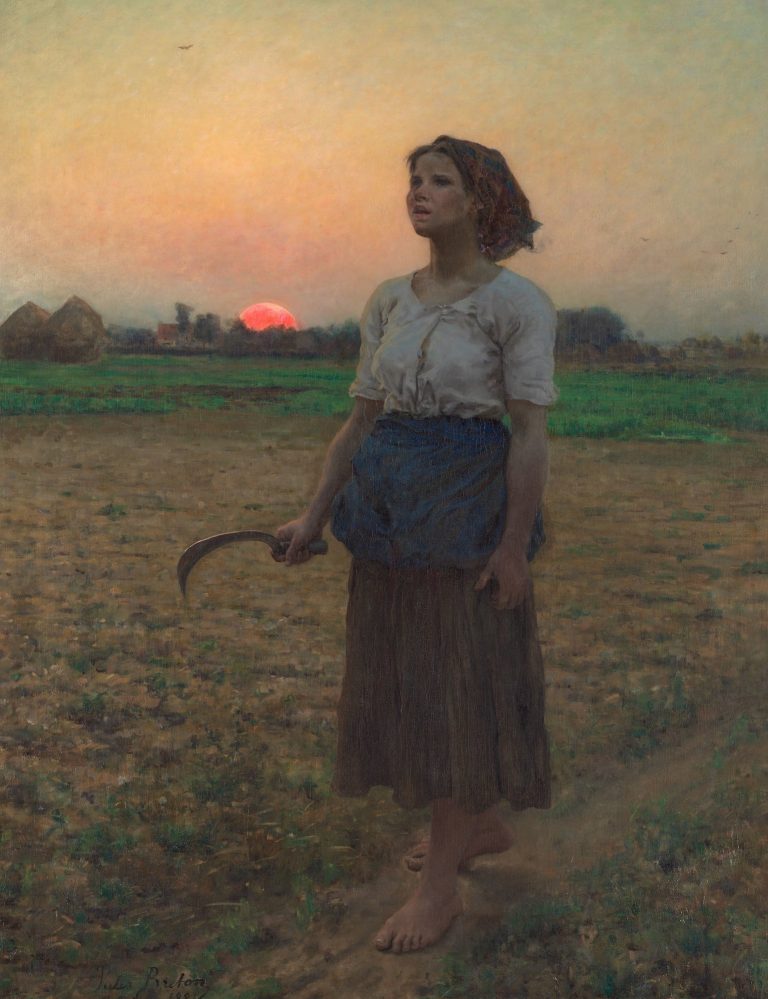
1884 · Oil on canvas · Art Institute of Chicago
Save articles to your collection
Log in or create a free account, and this article will be waiting in your Private Collection.
Log in or sign up Explore the artistJules Breton →
She still holds the sickle, but she has stopped working. Her head lifts, her lips part, and her attention moves away from the field. The sun is rising behind her. Somewhere in that pale sky, a lark is singing.
Jules Breton painted The Song of the Lark in 1884. The scene is small in its action and large in its feeling: a rural worker pauses to listen. Nothing has changed about the work waiting for her, yet for a moment the painting gives us access to something beyond it.
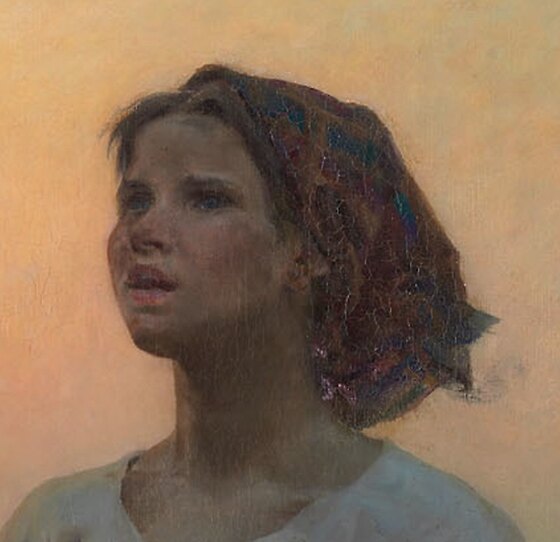
Look closely at the full painting and you can make out tiny bird shapes in the sky, including one high at the left. Breton does not make the bird the main attraction. He makes a person responding to its song the centre of the picture. We cannot hear what she hears, so her expression has to carry the sound.
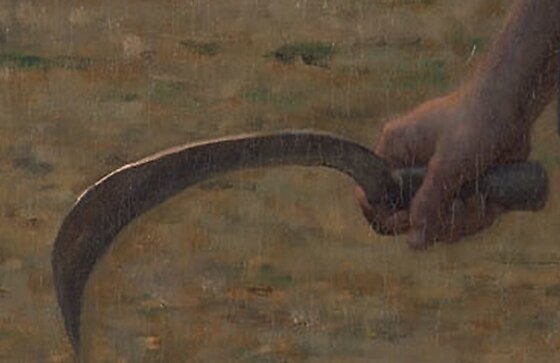
The curved blade identifies her as a worker rather than a visitor admiring the view. Her right hand grips the handle while her other arm hangs loosely. The tool is still present, but it is no longer moving. That contrast between the hand and the face gives the scene its tension: her body belongs to the working day while her attention has gone elsewhere.

The sun is a small, intense red shape. Around it, the sky opens into softer peach, gold and grey-green tones. Below, the earth and clothing remain much darker. The woman is not lit as if she were on a stage; she belongs to the same early light as the land.
Dawn can suggest a beginning, and that association helps explain why viewers find hope here. The sun is still close to the earth, but the space above the woman is already full of light. Her lifted head connects the weight of the figure with that opening sky.

The bare feet, plain blouse, headscarf and work tool establish a life of manual labour. She remains an unnamed worker, recognisable through her clothes, her stance and the way she carries the tool.
Breton worked within the nineteenth-century interest in contemporary rural life associated with Realism and Naturalism. Yet his treatment is also idealised, as the Art Institute of Chicago notes. The figure's dignity and the harmony of the landscape make this more than a neutral record of agricultural work.
A comparison with Jean-François Millet's The Gleaners, painted in 1857, makes the difference visible. Millet bends three women toward the ground. Breton isolates one woman standing upright beneath an open sky. Both give rural workers sustained attention, but their poses direct us toward different experiences of labour.
That distinction matters when reading the painting today. Its beauty can honour a worker's inner life, while also making the conditions around her seem gentler than they may have been. We can recognise both effects without dismissing the person Breton has placed before us. For the broader context, explore our guide to famous Realism paintings.
The painting is dated 1884 and was exhibited at the Paris Salon in 1885. The museum's provenance records its purchase from Breton that year by George A. Lucas for the dealer Samuel P. Avery, followed by its sale to the Chicago collector Henry Field.
After Field's death, it passed to his widow, Florence Lathrop Field. It was transferred to the Art Institute in October 1894 and formally given to the museum in 1916. By the time of the formal gift, Chicago audiences had known the painting for more than twenty years.
Its public reputation grew far beyond the gallery. In 1934, a Chicago Daily News contest named it America's best-loved picture. Eleanor Roosevelt took part in the ceremony and identified it as a personal favourite.
Willa Cather borrowed the painting's title for her 1915 novel The Song of the Lark. Her protagonist, Thea Kronborg, is an aspiring singer who encounters the painting in Chicago. The connection makes sense: Breton's listener gives a visible form to the experience of being moved by music. Cather's novel and Breton's painting are separate works, joined by that encounter.
Bill Murray has also described how seeing the painting helped him through a period of despair early in his acting career. In his account, the sunrise offered the possibility of another chance. The Art Institute includes his response in its own discussion of the work.
The two responses take different paths through the same scene. For Cather's heroine, the painting becomes part of an artistic awakening. For Murray, its sunrise suggested another chance. The woman's attentive pause leaves space for both.
A persuasive reading is that the painting gives attention its own value. The woman is not shown producing something, entertaining an audience or performing a grand action. She is listening. Breton makes that brief experience worthy of a large, carefully painted canvas.
The sickle prevents the scene from becoming pure escape. Work has not disappeared, and the painting does not promise that beauty will remove hardship. It offers a smaller possibility: the working day does not exhaust everything a person can feel.
Her expression can seem hopeful, absorbed, tired or astonished, depending on the viewer. The parted lips might even suggest joining the song, although the picture cannot settle whether she is singing. That uncertainty keeps her from becoming a simple illustration of happiness. She remains a person whose thoughts we cannot fully know.
The original The Song of the Lark belongs to the Art Institute of Chicago, in the Henry Field Memorial Collection, reference number 1894.1033. It is oil on canvas and measures 110.6 by 85.8 centimetres. The museum's collection record traces its provenance and exhibition history.
ByMuseum offers a hand-painted oil reproduction of The Song of the Lark, made to order in several sizes with framing options. The composition depends on quiet relationships of colour: the red sun, cool blue apron, pale blouse and earth beneath the bare feet.
Explore more paintings in the Jules Breton collection and our Realism collection.
The French painter Jules Breton painted it in 1884. It was shown at the Paris Salon in 1885.
She holds a sickle in her right hand, a curved tool used to cut vegetation. It connects her moment of listening with agricultural work.
The scene is dawn. The Art Institute describes the sun as rising behind the woman.
Tiny bird shapes appear in the sky, including one high at the left. The woman occupies much more of the canvas, so the emotional focus is her response to birdsong.
Murray has described finding encouragement in Jules Breton's The Song of the Lark during a difficult period early in his acting career. His account is one part of the painting's later reception.
Yes. Cather used the painting's title for her 1915 novel, and her protagonist, Thea Kronborg, sees the painting at the Art Institute of Chicago.
It is better understood within Breton's Naturalist and Realist interest in rural life, combined with an idealised presentation of the worker and landscape. Its date alone does not make it Impressionist.
The detail images are crops of the original public-domain painting. Descriptions of visible features and interpretations of their effect are distinguished from documented history.
Enjoyed this story?
Save articles to your collection
Log in or create a free account, and this article will be waiting in your Private Collection.
Log in or sign up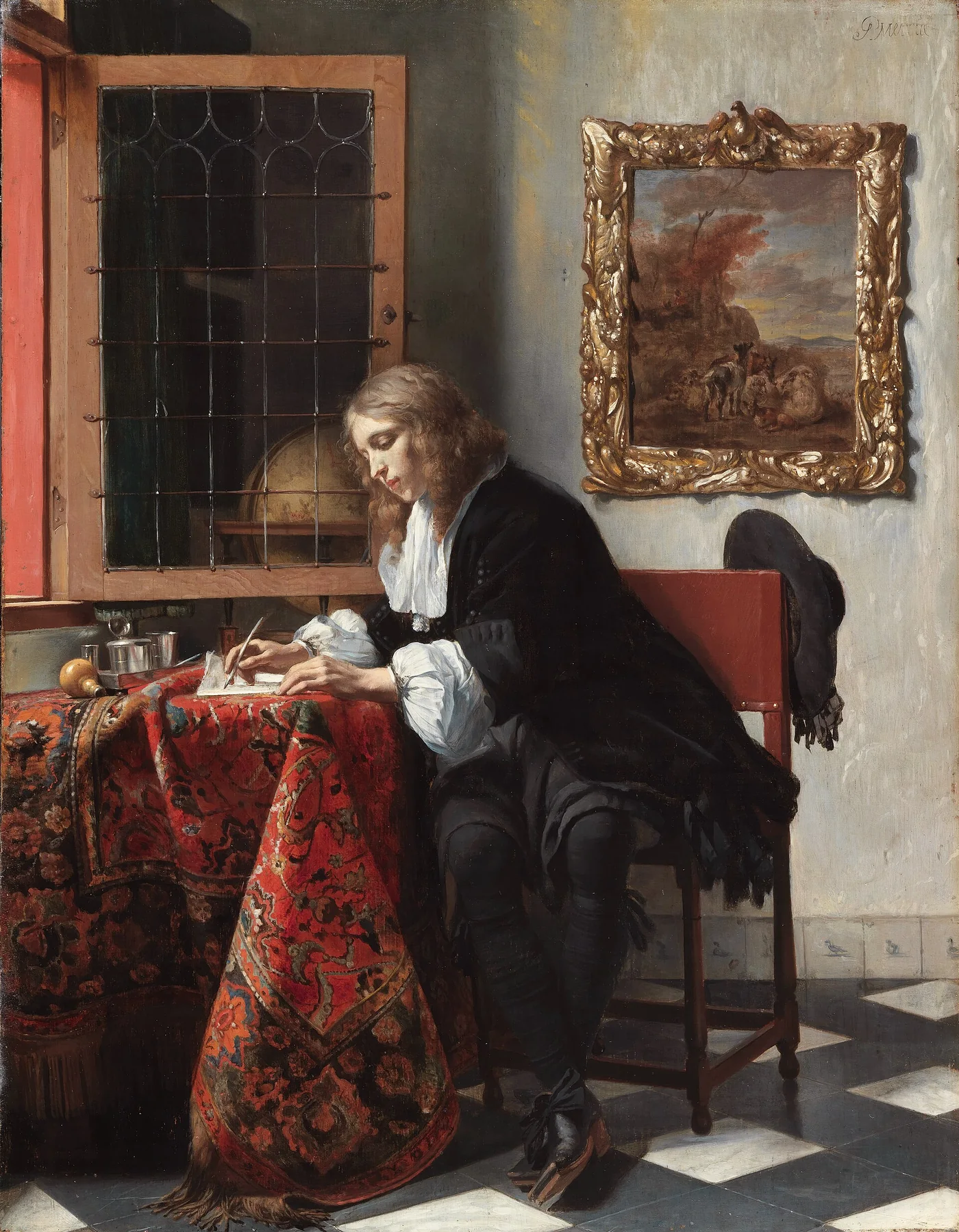
Man Writing a Letter
Gabriel Metsu, c. 1664
The gallery list
Every painting is already 50% off. Join the list and we will send you an extra $15 code, plus first access to new collections.
No spam. Unsubscribe anytime. · Privacy Policy
Welcome
Your $15 code is on its way. Explore the gallery while you wait.