Loading cart…
No products in the cart.

Art Guides · Realism
Save articles to your collection
Log in or create a free account, and this article will be waiting in your Private Collection.
Log in or sign upA woman gathers scraps of wheat. Two men break stones beside a road. A surgeon raises a blood-stained hand. These famous Realism paintings gave ordinary people and contemporary work the attention once reserved for kings, saints and ancient heroes.
This guide begins with French Realism, then follows related approaches in Russia and the United States. Each painting offers a different answer to the same question: whose life deserves to fill a canvas?
Realism is an art movement that emerged in nineteenth-century France and placed contemporary life at the centre of painting. Its artists made workers, rural communities, modern streets and ordinary events worthy of sustained attention. A Realist painting does not have to look like a photograph.
Gustave Courbet challenged the hierarchy that gave grand historical subjects greater prestige than familiar life. Millet concentrated on rural labour; Daumier observed the people and pressures of the modern city. Their approaches differ, but all ask viewers to look seriously at experiences that could otherwise be treated as background.
The movement developed strongly after the French Revolution of 1848. Related forms of Realism flourished elsewhere, and its boundaries overlap with Naturalism and Impressionism. The selection below makes those differences visible rather than treating every lifelike nineteenth-century painting as part of one identical school.
| Painting | Artist | Date |
|---|---|---|
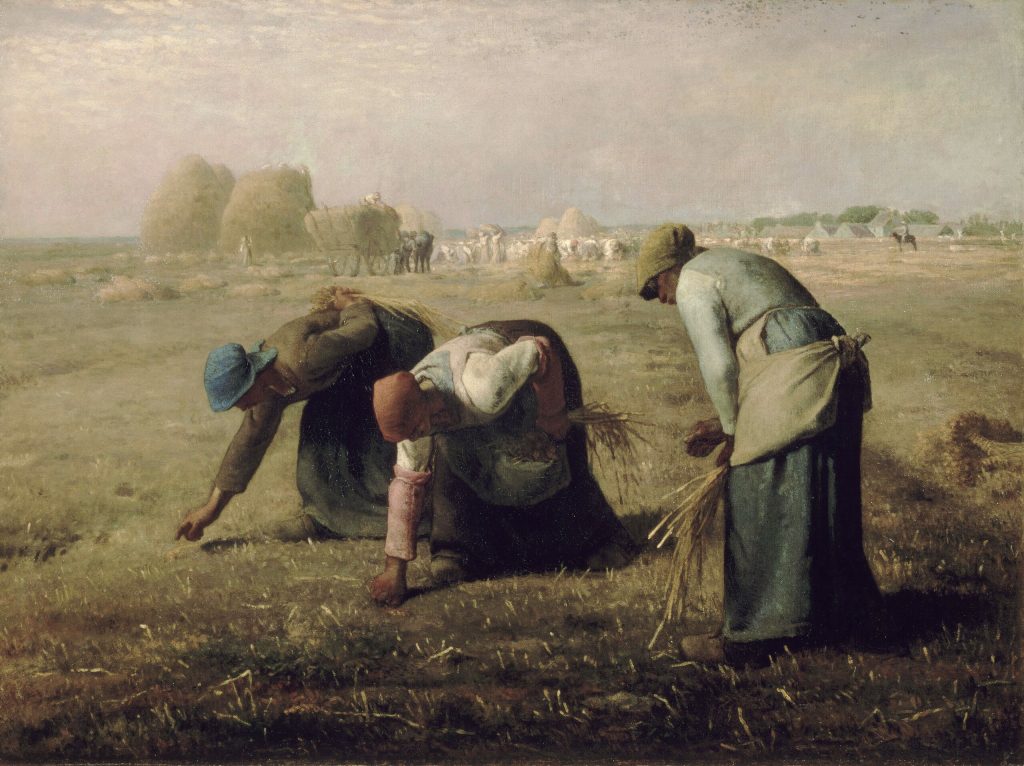
| The Gleaners | Jean-François Millet | 1857 |
| The Stone Breakers | Gustave Courbet | 1849 |
| A Burial at Ornans | Gustave Courbet | 1849 to 1850 |
| Barge Haulers on the Volga | Ilya Repin | 1870 to 1873 |
| The Horse Fair | Rosa Bonheur | 1852 to 1855 |
| The Third-Class Carriage | Honoré Daumier | 1864 |
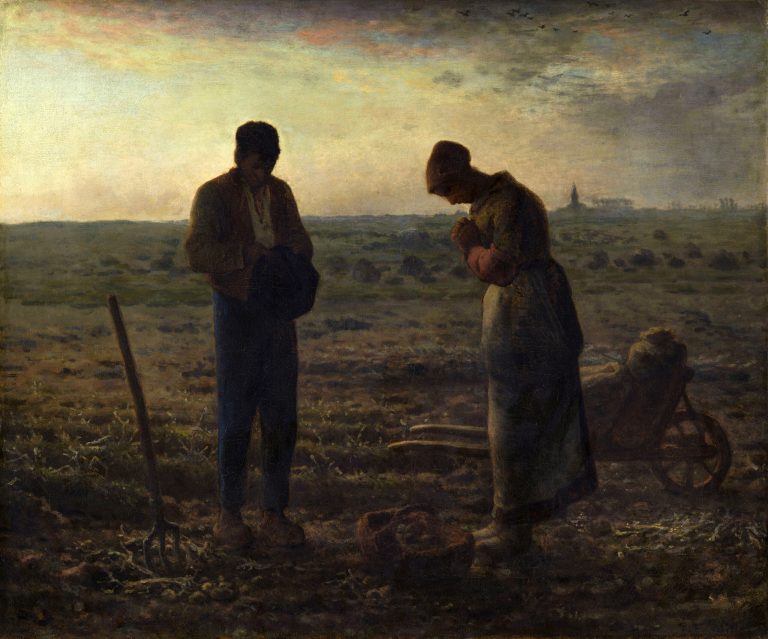
| The Angelus | Jean-François Millet | 1857 to 1859 |
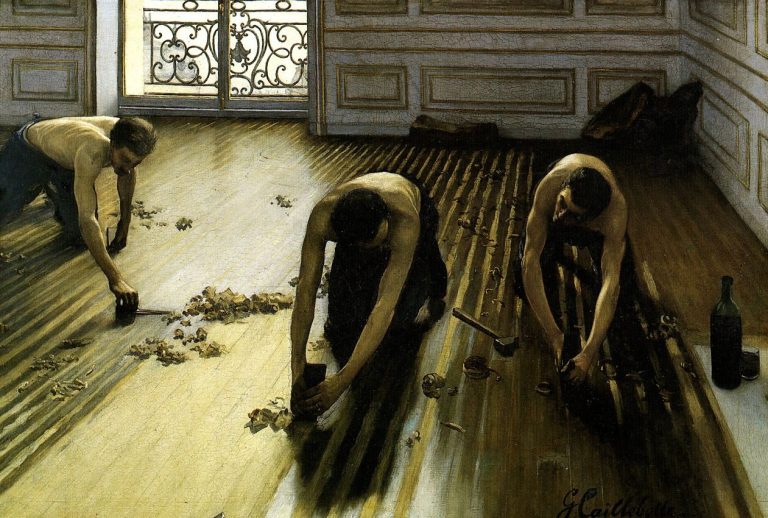
| The Floor Scrapers | Gustave Caillebotte | 1875 |
| The Song of the Lark | Jules Breton | 1884 |
| The Gross Clinic | Thomas Eakins | 1875 |
 Explore the artistJean-François Millet →
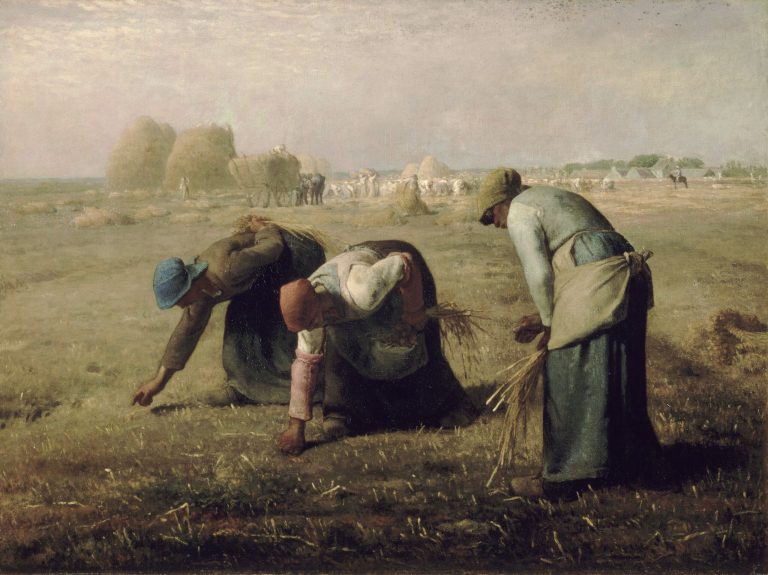
Three women bend close to the ground, searching for the stalks the harvesters have missed. Millet makes their repeated movements the centre of the painting: one reaches, another gathers, and a third begins to rise. Far behind them stand the stacks, carts and workers of a successful harvest. The field is plentiful. The gleaners live on what remains.
That contrast gives the picture its force. Gleaning was a way for poor rural people to obtain food after the main crop had been collected. Millet gives these women a weight and dignity that make their work impossible to dismiss. He does not provide a dramatic rescue or a sentimental conclusion. Their bodies tell us how the day is spent.
Look for the mounted figure on the right, identified by the Musée d’Orsay as probably a steward. His small presence connects the quiet field to ownership and supervision. The painting’s social argument emerges through distance, posture and the difference between abundance and leftovers.
Collection reference: Musée d’Orsay, Paris.
Read the full painting story →
Jean Francois Millet · oil on canvas, made to order
 Explore the artistGustave Courbet →
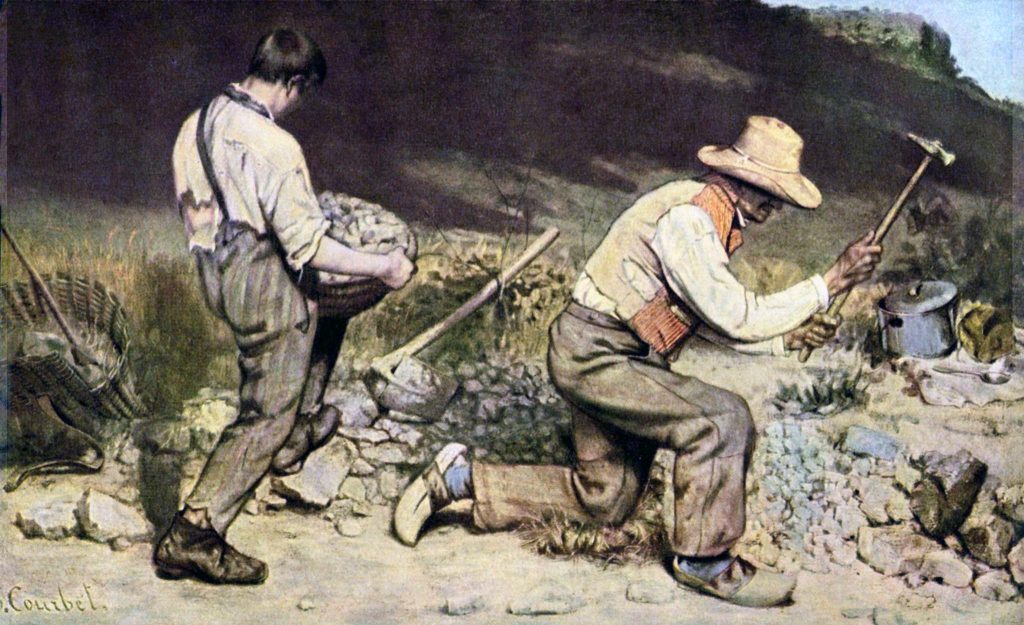
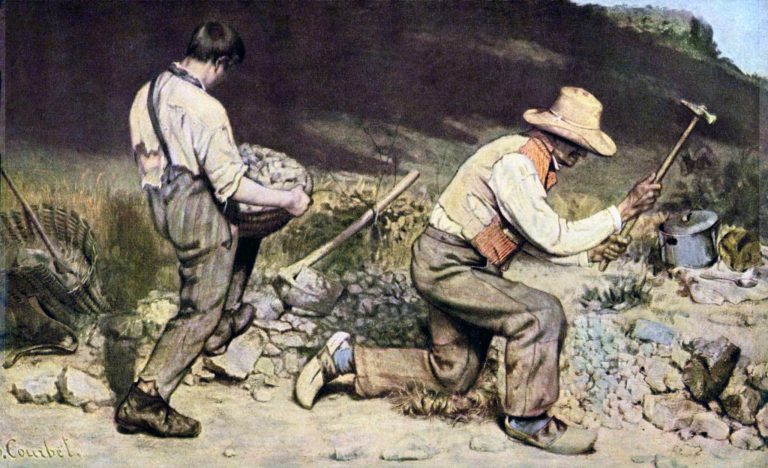
An older labourer kneels beside a heap of stones while a younger one lifts a heavy load. Their clothing is worn, their faces largely hidden, and the road seems to demand more work than two bodies could ever finish. Courbet builds the scene around the job itself: lifting, carrying and striking.
The challenge was also a matter of scale. Courbet gave an ordinary roadside task the size and seriousness associated with prestigious painting. These workers are neither comic villagers nor distant decoration in a landscape. Their equipment, damaged clothes and physical effort become the subject a Salon audience must confront.
The two ages suggest a life enclosed by labour, although that is a reading of the composition rather than a recorded biography of the men. The original painting was destroyed during the Second World War. Its survival through photographs and reproductions makes it an unusual entry here: a foundational Realist image whose painted surface we can no longer examine.
Collection reference: The Met’s history of French Realism.
Gustave Courbet · oil on canvas, made to order
Explore the artistGustave Courbet →
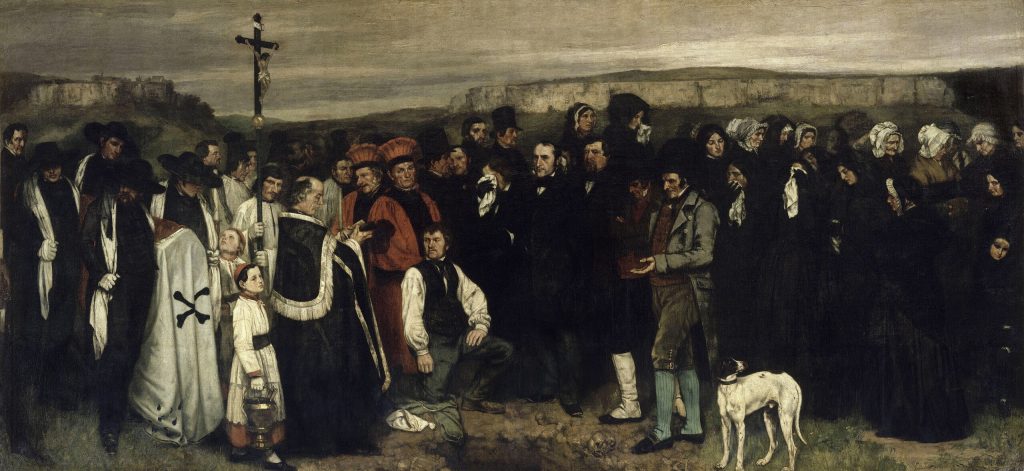
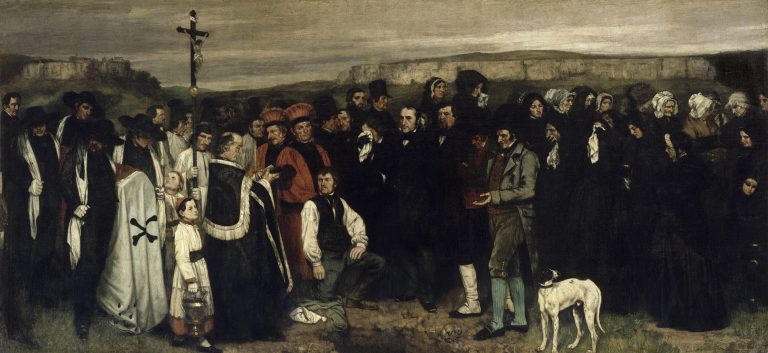
The grave opens almost at our feet. Across the canvas, mourners stand in an uneven line: clergy, townspeople, women in dark clothing and a dog that appears untouched by the ceremony. Courbet painted people from Ornans, his hometown, at a scale usually associated with history, religion and public heroes.
There is no single grieving figure to explain how everyone else should feel. Faces turn in different directions. Some people look attentive, others distracted or closed in their own thoughts. The funeral becomes a gathering of individuals rather than a perfectly organised performance of sorrow.
Shown at the Salon of 1850 to 1851, the painting challenged expectations about which lives deserved such a large canvas. Its size is part of its meaning: a local event occupies the visual space of a national story. Courbet makes the viewer stand before ordinary people with the attention normally reserved for exceptional ones.
Collection reference: Musée d’Orsay, Paris.
Gustave Courbet · oil on canvas, made to order
 Explore the artistIlya Repin →
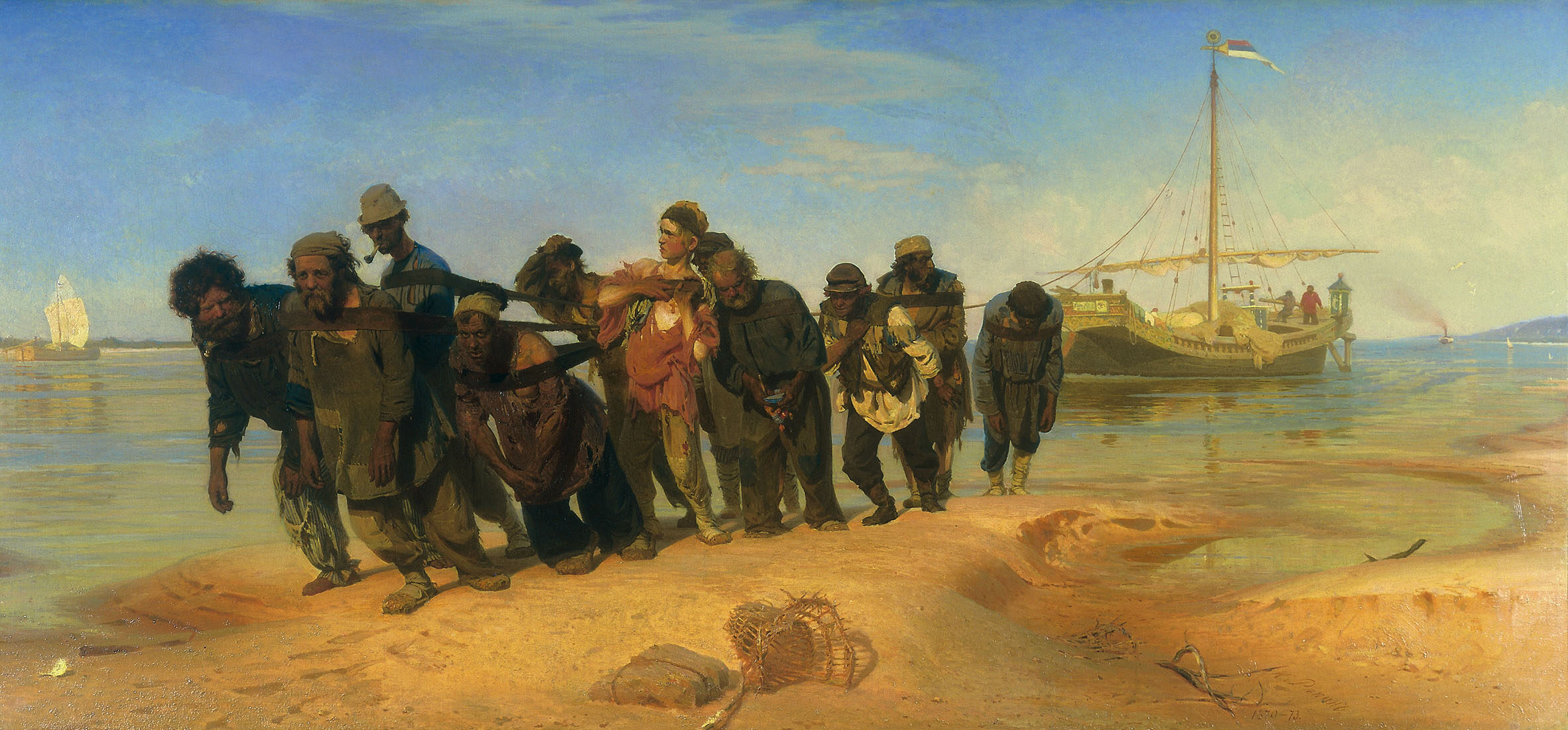
The landscape promises space. The men have almost none. Strapped into a shared effort, eleven haulers pull along the bank of the Volga. Their bodies lean under the load, but Repin makes each figure distinct through clothing, posture and expression. The group is a collective burden carried by individuals.
Watch the younger figure in a pinkish shirt near the centre. His upright movement interrupts the line of bent bodies. Around him, some men look exhausted, while others seem absorbed in the practised rhythm of the work. Repin prevents the figures from becoming an anonymous symbol of poverty.
This is Russian Realism, extending the guide beyond its French starting point. The painting gained international recognition at the Vienna World Exhibition in 1873. Its impact depends on a direct visual contradiction: a broad, sunlit river and a form of transport powered by human strain. The setting is beautiful without making the work look easy.
Collection reference: State Russian Museum, Saint Petersburg.
Ilya Repin · oil on canvas, made to order
 Explore the artistRosa Bonheur →
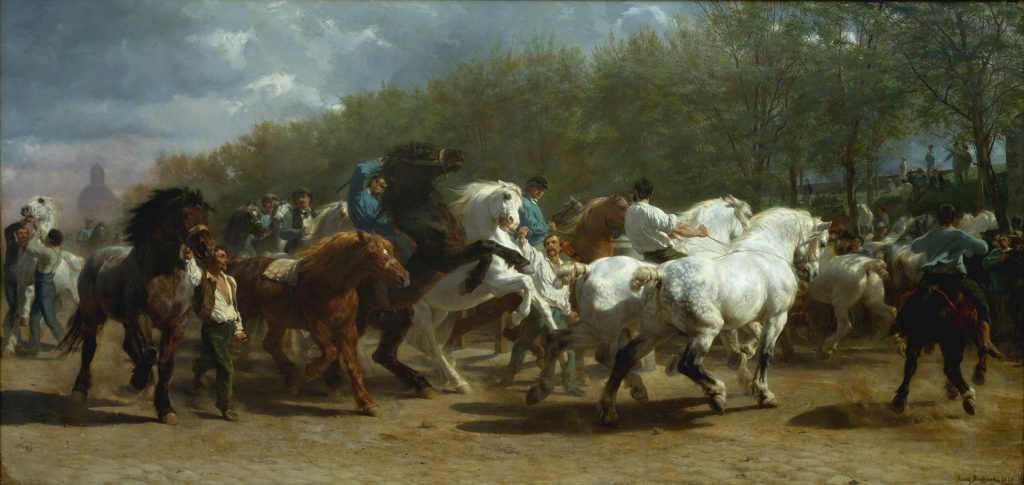
Hooves lift, reins tighten and heavy bodies turn across the foreground. The Horse Fair feels as though it might break out of its frame. Bonheur gives horses the commanding presence that other ambitious painters gave to soldiers or mythological figures.
She studied the market on Paris’s Boulevard de l’Hôpital for a year and a half, visiting twice a week. The Met records that she wore men’s clothing to discourage attention while she sketched. The finished work combines those observations with a carefully orchestrated composition; Bonheur compared its arrangement to a sculptural frieze.
Realism here means sustained attention to the living animal and its working environment. Look at the changing weight of necks, shoulders and legs, then at the handlers struggling to direct that movement. The picture was praised when it appeared at the Salon of 1853, before Bonheur retouched it in 1855. An everyday commercial setting had become a work of extraordinary public ambition.
Collection reference: The Metropolitan Museum of Art, New York.
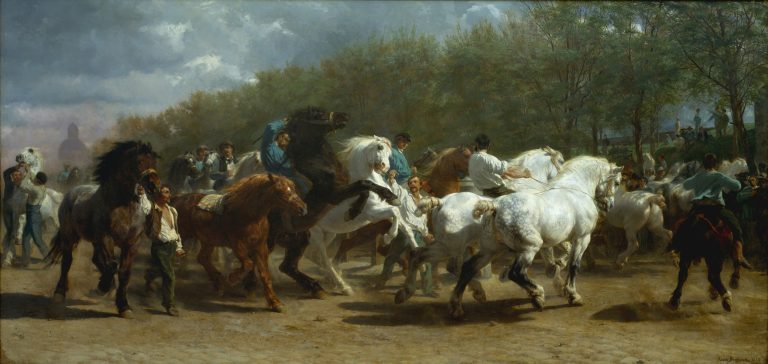
Rosa Maria Bonheur · oil on canvas, made to order
 Explore the artistHonoré Daumier →
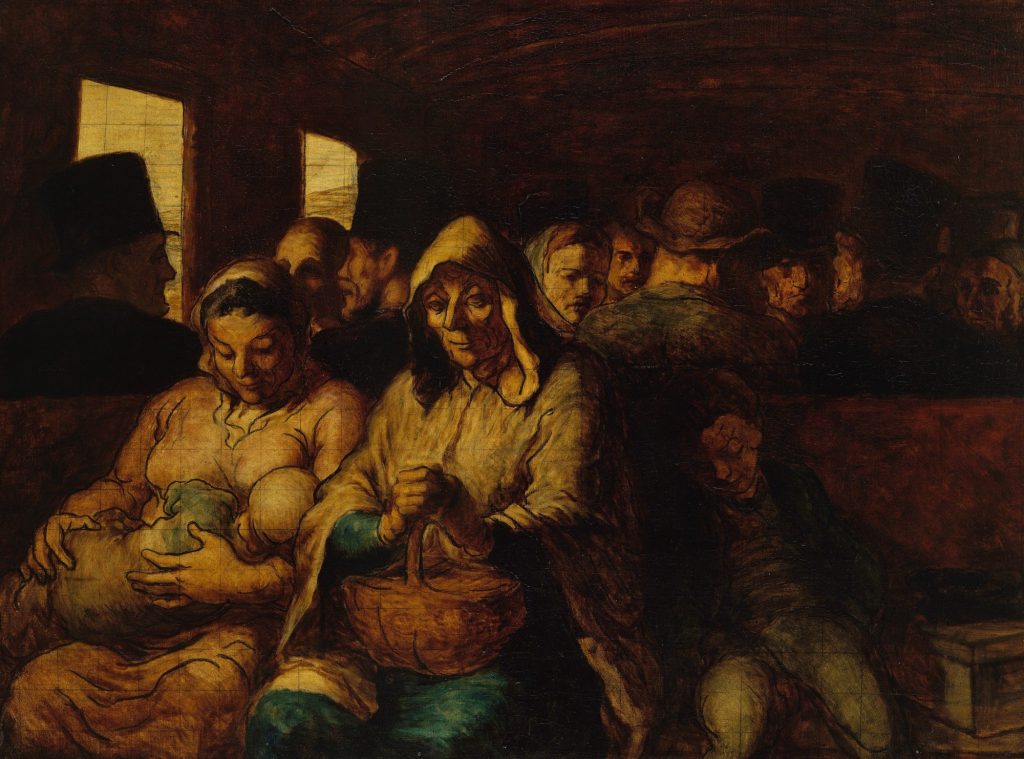
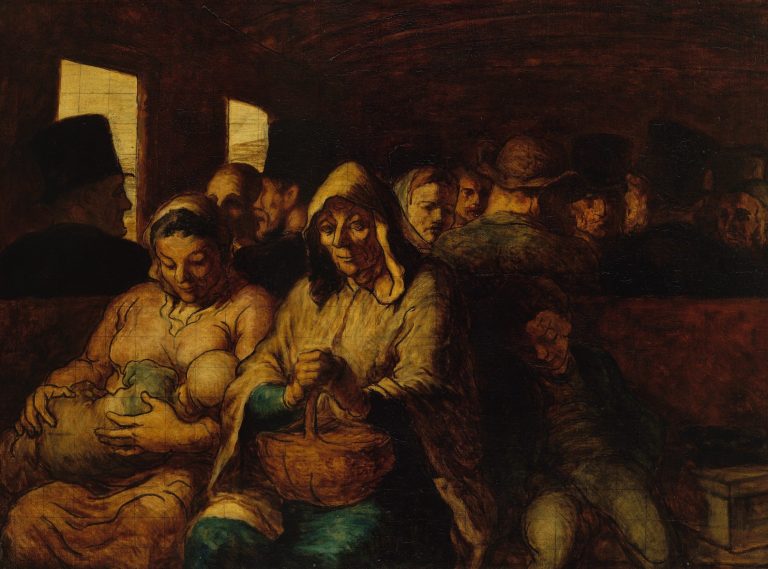
We seem to occupy the bench opposite them. A woman nurses a baby, an older passenger holds a basket, and a boy sleeps beside her. Behind them, hats and faces gather into a dark, crowded band. Daumier makes the modern railway visible through the people who could afford its cheapest seats.
The light falls on worn hands and tired faces, but the mood is restrained. These travellers are neither a joke nor a spectacle. Their stillness matters as much as the crowd around them. Daumier, famous for sharp political and social images, lets this scene hold its dignity without explaining every passenger’s history.
Several related versions exist. The one at the Met, dated 1864, is unfinished and retains a grid used to transfer the composition. That distinction matters when comparing images online: the finished painting in Ottawa is a separate version. In this one, the visible working process adds another layer to an already intimate encounter.
Collection reference: The Metropolitan Museum of Art, New York.
Honore Daumier · oil on canvas, made to order
Explore the artistJean-François Millet →
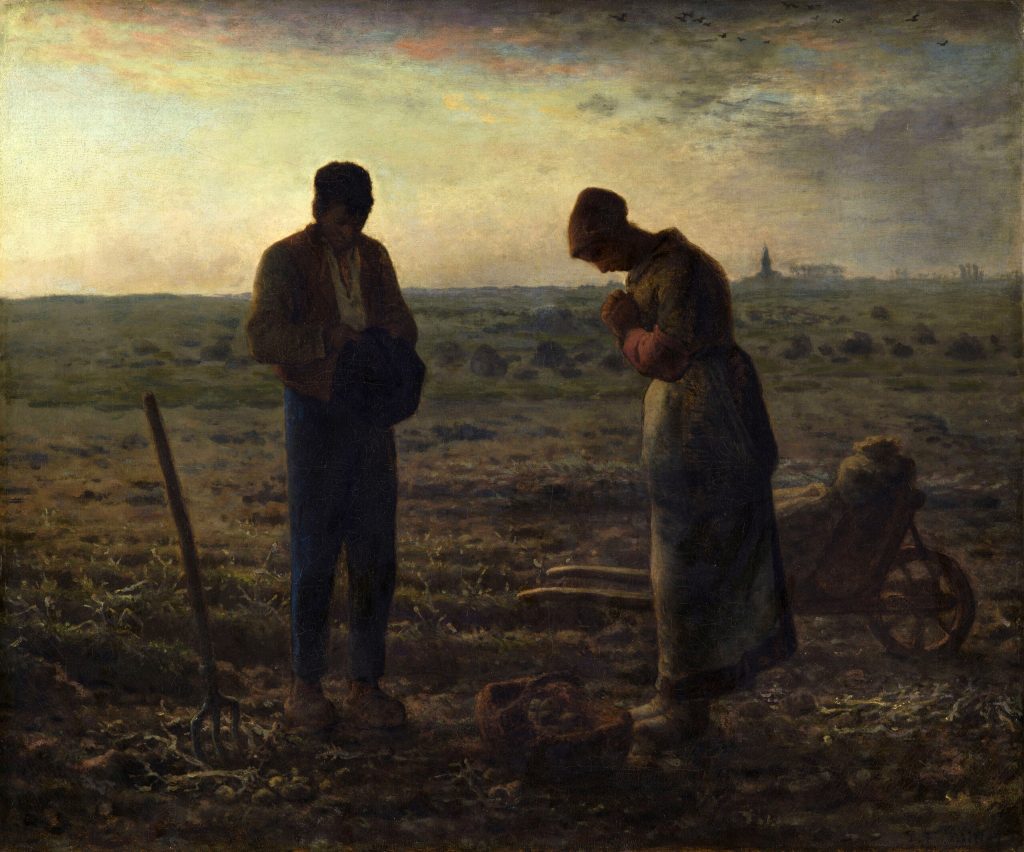
A man lowers his head, holding his hat. Opposite him, a woman brings her hands together. Between and beside them are the things the day’s labour requires: a basket, a fork and a wheelbarrow. The distant church gives the silence a possible sound, the bell calling them to the Angelus prayer.
Millet connected the scene to a childhood memory of his grandmother making the family stop work when the church bell rang. The subject joins physical routine and belief. Prayer does not remove the workers from their surroundings; it belongs to the same day as digging potatoes.
The figures have a monumental presence, although the original canvas is small. Their faces remain subdued while their gestures are unmistakable. Compared with The Gleaners, this is a pause in labour rather than its relentless repetition. Together, the two paintings show why Realist art can contain reflection and spirituality as well as social criticism.
Collection reference: Musée d’Orsay, Paris.
Jean Francois Millet · oil on canvas, made to order
 Explore the artistGustave Caillebotte →

The polished room depends on the men kneeling inside it. Three workers scrape the wooden boards, their arms and backs arranged along the strong lines of the floor. A window floods the apartment with light. Wood shavings make their repeated movements tangible.
Caillebotte exhibited with the Impressionists, but this painting’s interest in physical work makes it an important bridge to Realism. The bodies are carefully modelled; the perspective presses the floor toward us. We are shown the labour inside a modern urban interior rather than the leisure that such an apartment might usually advertise.
The Salon rejected the picture in 1875, and Caillebotte showed it at the Impressionist exhibition the following year. Keep that overlap in mind when assigning labels. A painter can share the Impressionists’ exhibition history while making an image whose subject and close observation speak strongly to the Realist project.
Collection reference: Musée d’Orsay, Paris.
Gustave Caillebotte · oil on canvas, made to order
 Explore the artistJules Breton →
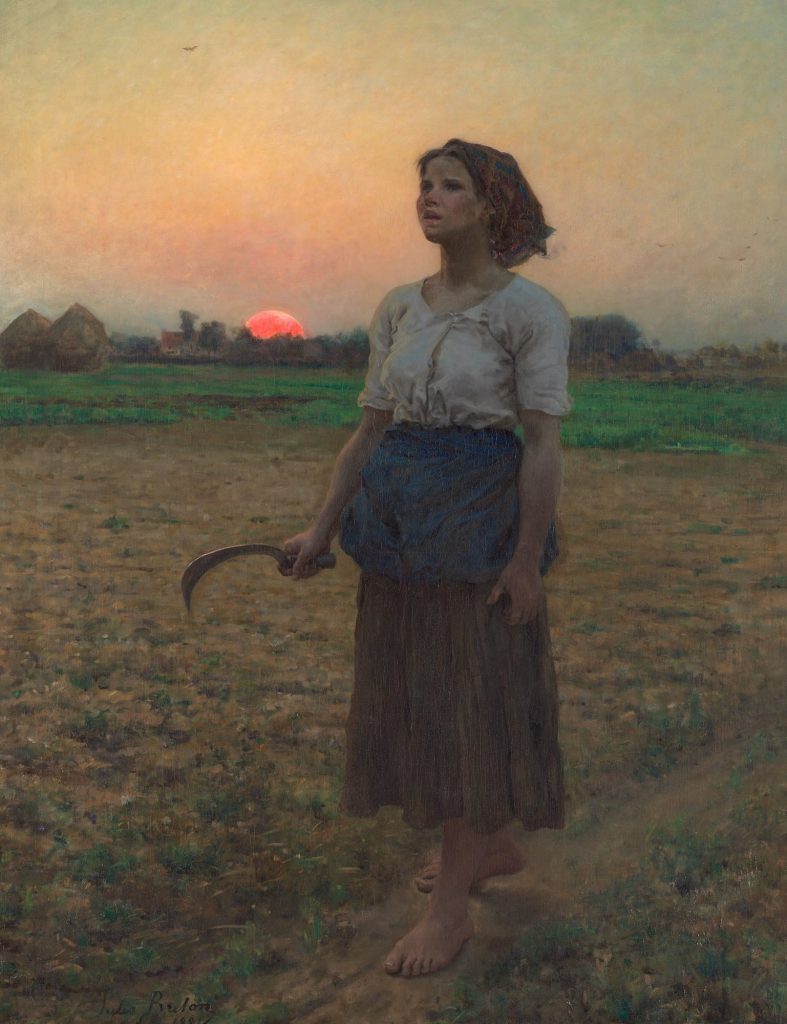
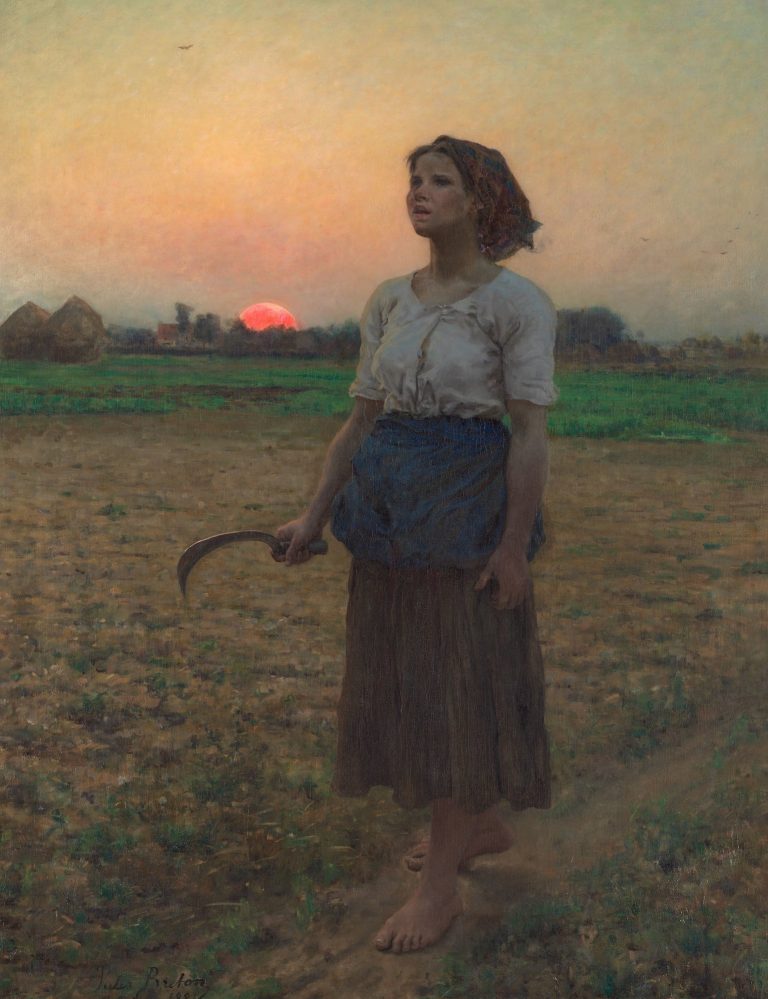
A young woman pauses in a field, sickle in hand, her attention drawn upward. The rising sun glows behind her. We cannot see the lark whose song gives the painting its title. Instead, Breton makes us watch someone listening.
The rural subject connects the work to Millet, but the emotional treatment differs. The Art Institute describes Breton’s approach to country life as idealised. The worker’s bare feet and tool remain visible, while the moment itself becomes an encounter with natural beauty. She has work to do, but the painting gives her attention a brief freedom.
That difference is useful in a Realism guide. A peasant subject does not guarantee a single political message or an unembellished account of hardship. Breton brings the everyday world into serious painting while allowing it a poetic glow. The result asks us to notice a private experience that could otherwise disappear inside the general idea of rural labour.
Collection reference: Art Institute of Chicago.
Read the full painting story →
Jules Breton · oil on canvas, made to order
 Explore the artistThomas Eakins →
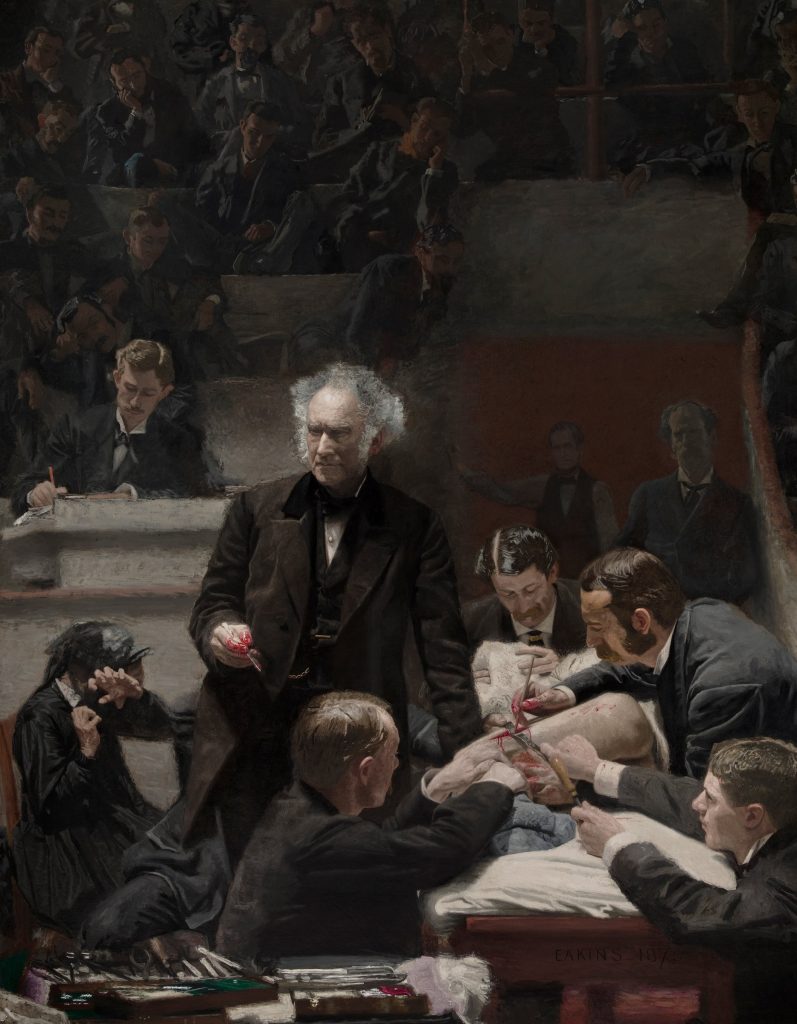
Dr Samuel D. Gross stands in a surgical amphitheatre, a blood-stained hand raised as he teaches. Around him, assistants operate on a patient while students watch from the shadowed seats. A seated woman recoils. Eakins puts professional confidence beside a response that many viewers may find easier to share.
The painting documents a demonstration at Philadelphia’s Jefferson Medical College. Its scale gives a modern surgeon the public stature of a historical hero, yet Eakins keeps the exposed patient and physical procedure within the scene. Knowledge is shown being practised on a vulnerable body.
The Centennial Exhibition’s art jury considered the work too disturbing for the main art display in 1876, and it was shown in a medical exhibition instead. That response brings the guide back to its central question: what belongs in a major painting? For Eakins, the answer included contemporary work, bodily risk and the difficult reality of looking closely.
Collection reference: Jointly owned by PAFA and the Philadelphia Museum of Art.
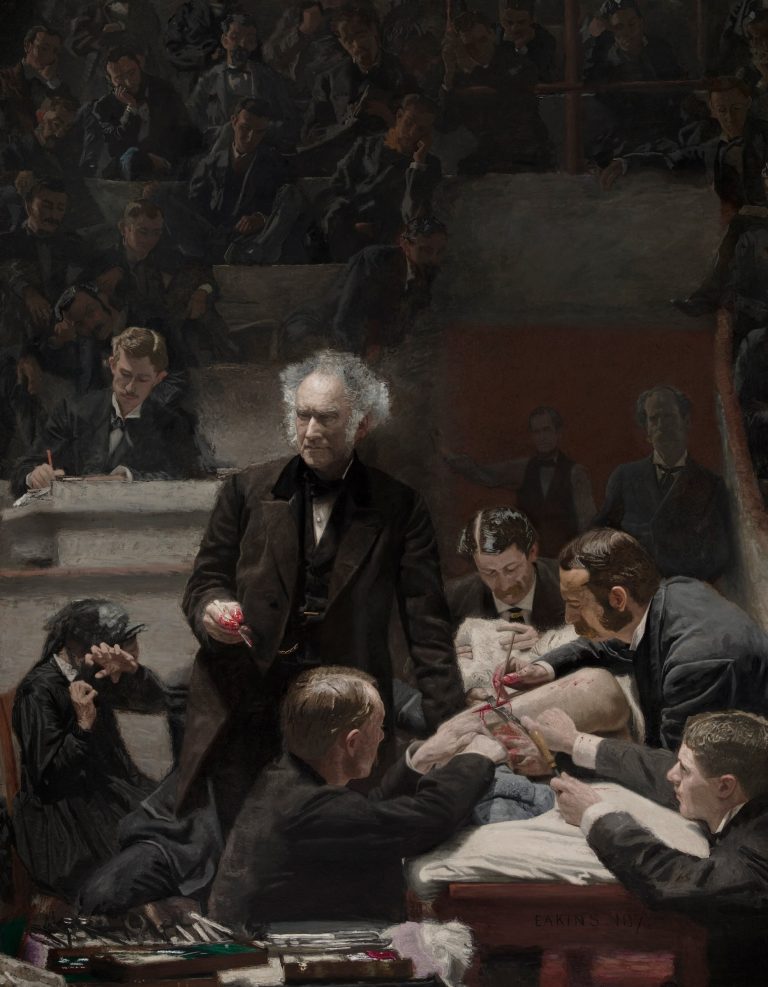
Thomas Eakins · oil on canvas, made to order
Realism is a nineteenth-century art movement that made contemporary life and ordinary people central subjects for serious painting. It developed strongly in France around the middle of the century. The term can also describe lifelike representation more generally, but that broader use is different from naming the historical movement.
The Gleaners by Jean-François Millet, The Stone Breakers and A Burial at Ornans by Gustave Courbet, and The Third-Class Carriage by Honoré Daumier are central French examples. Rosa Bonheur’s The Horse Fair, Ilya Repin’s Barge Haulers on the Volga and Thomas Eakins’s The Gross Clinic show the range of closely observed nineteenth-century painting.
Gustave Courbet is generally regarded as its leading figure. His large paintings of workers and provincial life challenged the prestige given to historical and mythological subjects. Millet and Daumier are also central to understanding French Realism, while Bonheur’s animal paintings demonstrate its breadth.
Look for contemporary subjects, identifiable workplaces, ordinary clothing, convincing bodies and objects, and close attention to social surroundings. Realist paintings often give workers or everyday events unusual importance. They do not all use the same brushwork, colour palette or political message.
Both movements took an interest in modern life. Realism is especially associated with subject matter and the serious representation of contemporary experience. Impressionism placed greater emphasis on changing light, colour and the sensation of a moment. The categories overlap: Caillebotte’s The Floor Scrapers joins a Realist subject to the history of Impressionist exhibitions.
No. Nineteenth-century Realism predates the Photorealist movement of the late 1960s and 1970s. Courbet and Millet did not need a surface that looked like a photograph to make a Realist painting. Their choices about subject, scale and social attention mattered as much as detailed representation.
Several are held by the Musée d’Orsay in Paris. The Met in New York holds The Horse Fair and the version of The Third-Class Carriage shown here. The Song of the Lark belongs to the Art Institute of Chicago, and Barge Haulers on the Volga to the State Russian Museum. The Gross Clinic is jointly owned by two Philadelphia institutions. The Stone Breakers no longer survives. Check each museum’s current display information before visiting.
Yes. Each painting’s expandable card links to its ByMuseum reproduction, where you can see available sizes, frames and current pricing. The products are paintings made to order in oil on canvas; the original museum works are separate objects.
Bonheur’s career continues in our guide to famous women artists. For the next chapter in modern painting, compare these works with our famous Impressionist paintings and Post-Impressionist artists. You can also browse the Realism oil painting collection.
This is an editorial selection of ten well-known works available in the ByMuseum catalogue, arranged to introduce different subjects and approaches. It is not a ranking of individual painting search volumes. Museum ownership does not guarantee that a work is currently on display. The Stone Breakers is represented through a reproduction of the lost original.
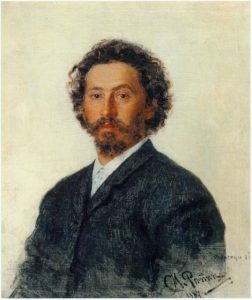
The Horse Fair image: The Metropolitan Museum of Art, public domain via Wikimedia Commons. Repin’s 1887 self-portrait and Breton’s 1895 self-portrait: public domain via Wikimedia Commons. Other artwork and profile images come from the existing ByMuseum media library.
Enjoyed this story?
Save articles to your collection
Log in or create a free account, and this article will be waiting in your Private Collection.
Log in or sign up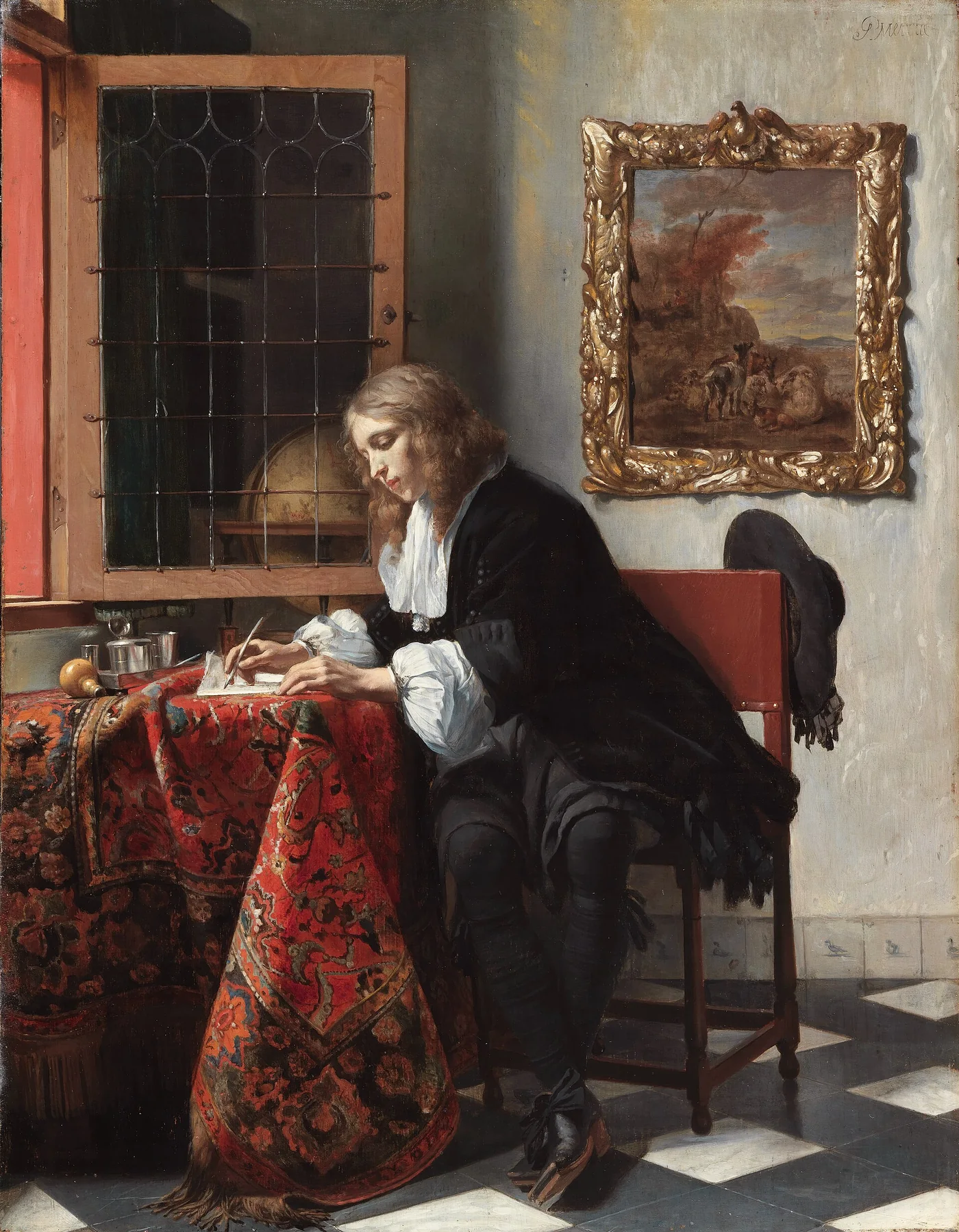
Man Writing a Letter
Gabriel Metsu, c. 1664
The gallery list
Every painting is already 50% off. Join the list and we will send you an extra $15 code, plus first access to new collections.
No spam. Unsubscribe anytime. · Privacy Policy
Welcome
Your $15 code is on its way. Explore the gallery while you wait.