Loading cart…
No products in the cart.

1896 · Oil on canvas · Private collection
Save articles to your collection
Log in or create a free account, and this article will be waiting in your Private Collection.
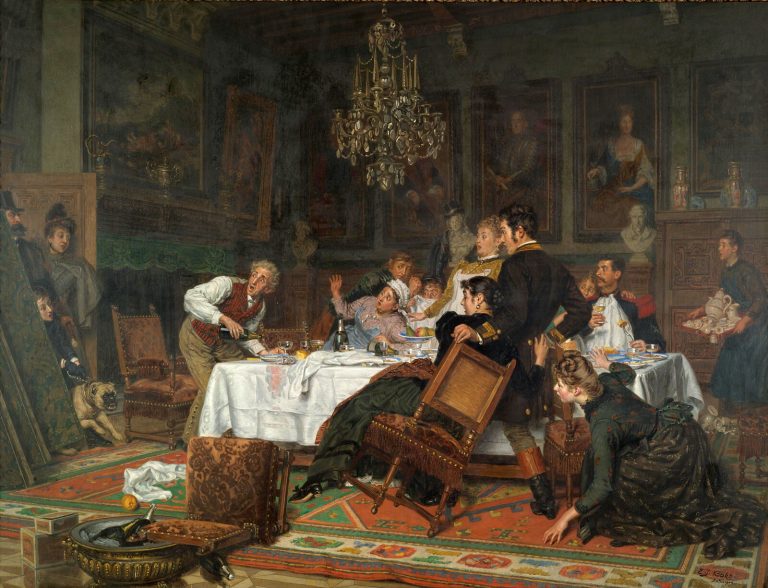
Log in or sign upSomething has just happened in this room, and for the moment do not look for the cause. Look at the people. A dining room full of them, a laid table, a chandelier, and every face turned the same way, toward something at the edge of the picture that we cannot see yet. Evert Jan Boks, a Dutch painter who spent his life in Antwerp making small comedies like this one, built the whole painting so that you would read the reactions first and the reason last. So that is the order we will take.
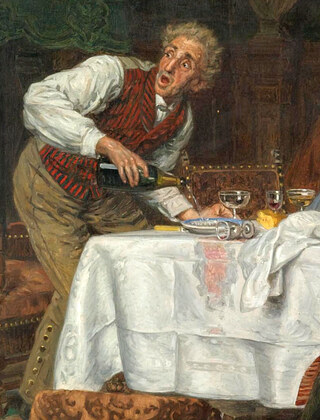
The older man. Grey-haired, in a red waistcoat with his coat off, he is jerking backward from the head of the table, and he has not stopped pouring. The bottle is still tilted over the glass. Whatever he has seen, his hand has not caught up with his face.
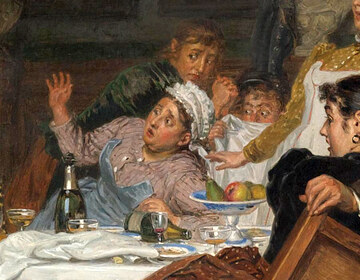
The women beside him. Three of them in caps and aprons: one throws a hand into the air, one shrinks down into her chair, one has put both hands over her face. Behind them a man in a green cap is turning the same way as everyone else.
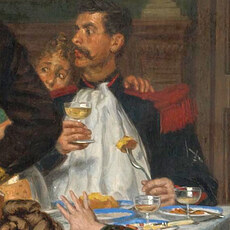
The man with the moustache. In uniform, at the right of the table, he turns with the rest, and his glass is still up. The tall man in the black coat with his back to us has stood up so fast that his chair has gone over.
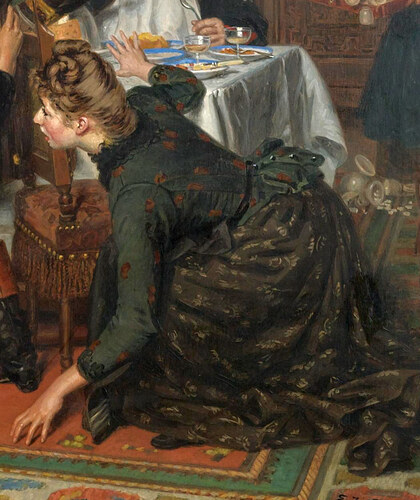
The woman on the floor. Beside the chair a woman in a dark dress is down on one knee, one hand braced on the carpet, looking back over her shoulder. She is going under the table. She is the best figure in the painting, and Boks signed the canvas beside her foot.
The tray. At the far right a maid is still carrying in a tray loaded with coffee cups and a pot, and has stopped in the doorway. The table in front of her is covered with food and drink, the fruit bowl, the champagne, the plates of a dinner in progress.
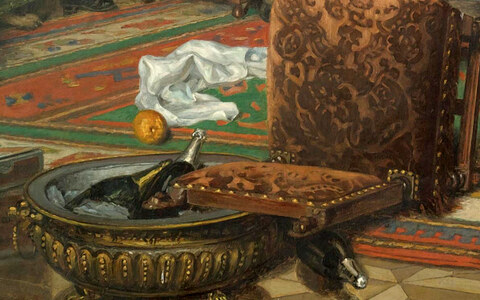
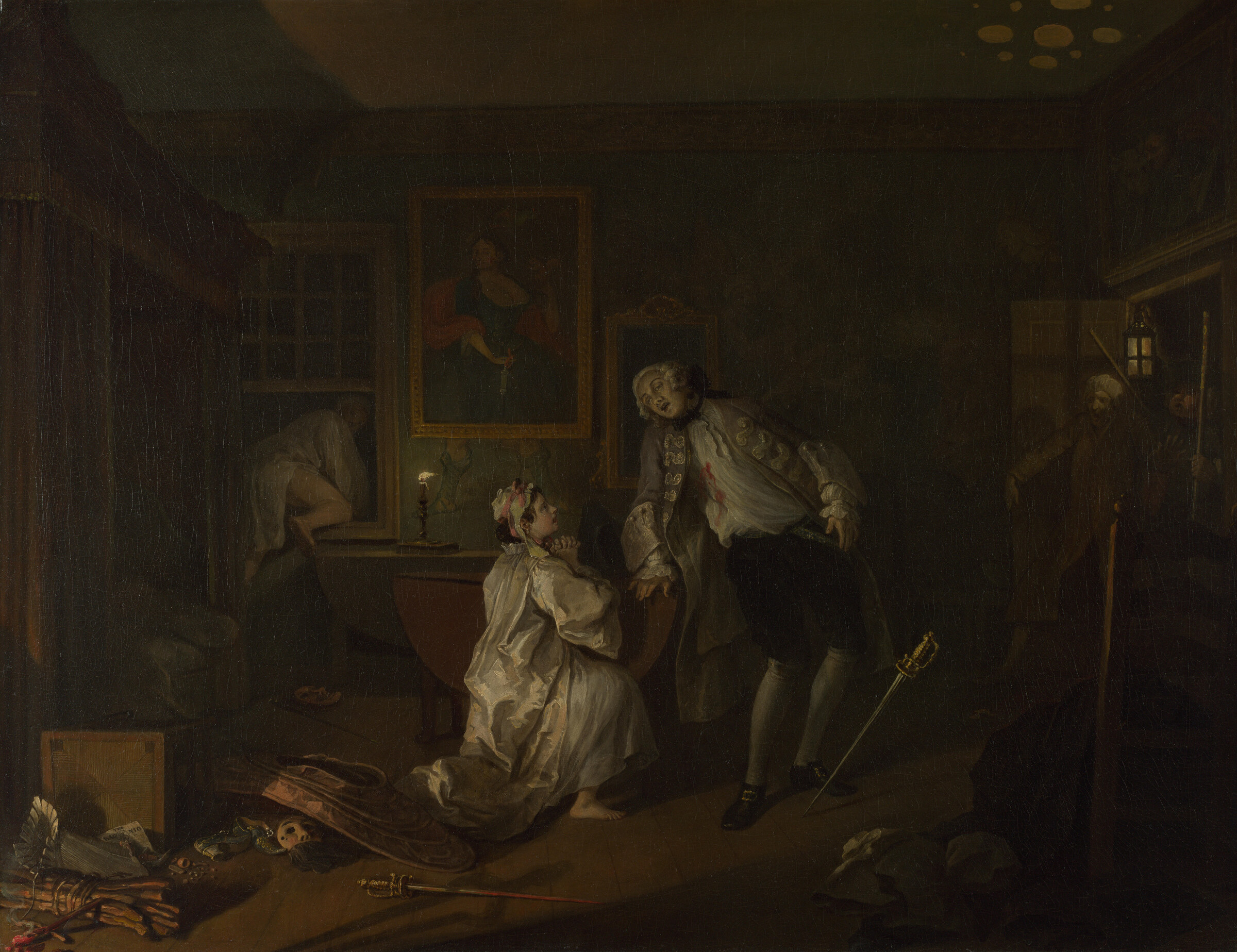
Genre painters learned from Hogarth that the floor is where you put the plot, and Boks had read his Hogarth. A silver wine cooler with two bottles in it stands on the carpet where it should not be; a footstool has gone over; a napkin and an orange have rolled off the table; a chair lies on its back. Everything that has happened in the last hour is written on the rug.
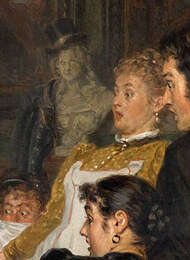
And then one detail that makes the room stranger. On the pedestal at the back, someone has put a top hat on the marble bust and draped a dark coat round its shoulders. The bust is one of the ancestors. This was not a formal dinner.
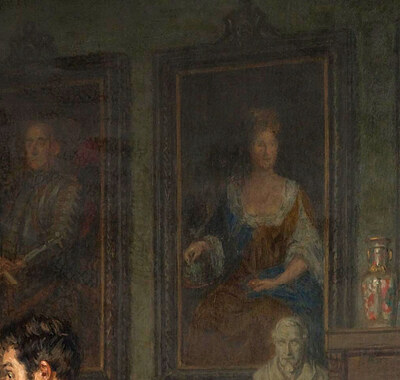
Above it all the painted ancestors, a man in armour and a woman in eighteenth-century silk, look down from the wall with the expression of people who have seen worse. The room itself is the rest of the joke: chandelier, carved oak, Delft on the sideboard, Turkish carpet. A rich house, and the people enjoying it are the ones who dust it.
Now stop looking at what everyone is doing and look at where they are looking. They react differently, the shriek, the flinch, the frozen glass, the dive for the tablecloth, but they all face the same way: left, toward the far edge of the canvas. Something there has made an entire room react at once.
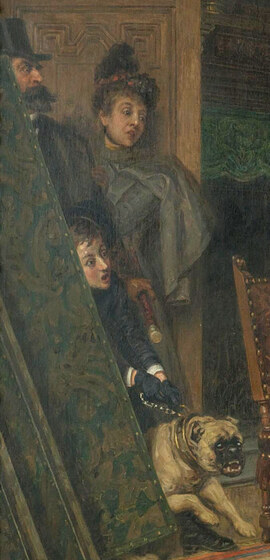
At the far left, half hidden by a tapestry screen, a bearded man in a top hat has appeared in the doorway, with a woman in a feathered hat beside him. Below them a boy is partly visible, and a dog has come in with them and strains forward to say hello, the only creature in the room with nothing on its conscience. The master and mistress of the house have come home early, and the servants are drinking the champagne.
That is the title, and it is the last thing you find out: The Surprise of the Master's Unexpected Arrival. Boks gives the arrivals almost no room on the canvas and makes everyone else's reaction the spectacle. He freezes the moment after everyone has noticed and before anyone has had time to recover, and now the bottle, the raised hand, the fallen chair and the coffee tray all belong to the same second. Nobody in it is wicked. They wanted one evening.
A Dutchman who became a Belgian painter. Boks was born in Gelderland in 1838, trained at the Antwerp Academy, where he won a first prize in 1863 and later the Prix de Rome, travelled in France and Italy, and then settled in Antwerp for the rest of his life, painting the kind of small, polished, funny genre scenes that sold across Europe and America in the second half of the nineteenth century: a girl caught reading a letter, a first beau, a courtship in a kitchen. He painted this one in 1896, at fifty-eight, and it is his most ambitious: a dozen figures, a full interior, and a joke timed to the second.
Pictures like this were the cinema of their day. They hung in dining rooms, were engraved in magazines, and were meant to be read aloud, figure by figure, after dinner, which is more or less what we have just done.
In a private collection; it has passed through the auction rooms rather than the museums, which is the fate of most good genre painting. It is oil on canvas, 68 by 90 centimetres.
It is a dining-room painting, obviously, and a good one for anyone who has ever thrown a party in someone else's house. Our hand-painted reproduction of The Surprise of the Master's Unexpected Arrival is painted in oil on canvas from the original, with every face given its own expression, which is where the work is.
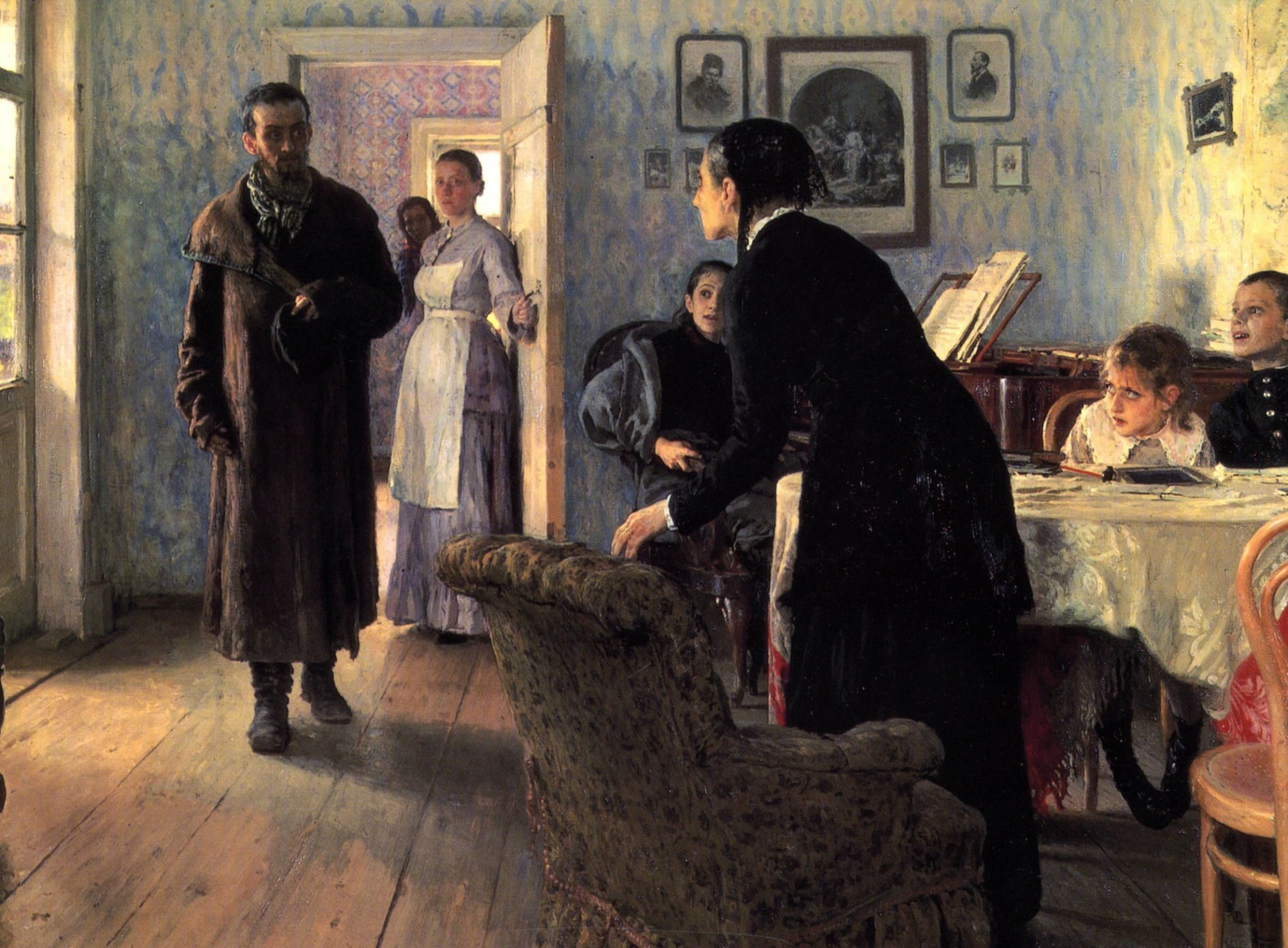
The same year Boks was painting his servants, a very different homecoming was hanging in Moscow. In Ilya Repin's Unexpected Visitors, a gaunt man in a worn coat steps into a family drawing room after years away in Siberian exile, and the room stops: his mother rising from her chair, his wife at the piano turning, one child delighted, the other afraid. Repin painted it in 1884 and repainted the man's face several times, unable to decide whether he should look like a hero or a ghost.
Put the two side by side and you have the whole range of the unexpected door in painting: in Antwerp it is a farce, in Moscow it is a tragedy, and in both the trick is the same. The painter shows you the second after the door opens and lets the faces do the rest. Hogarth, who taught them both, put the watch at the door of the Bagnio and let the room fall apart.
Enjoyed this story?
Save articles to your collection
Log in or create a free account, and this article will be waiting in your Private Collection.
Log in or sign upVisible details, documented facts and interpretation are kept separate. The identification of the figures by their dress (butler, cook, coachman, gardener) is a reading, and is marked as one.