Loading cart…
No products in the cart.

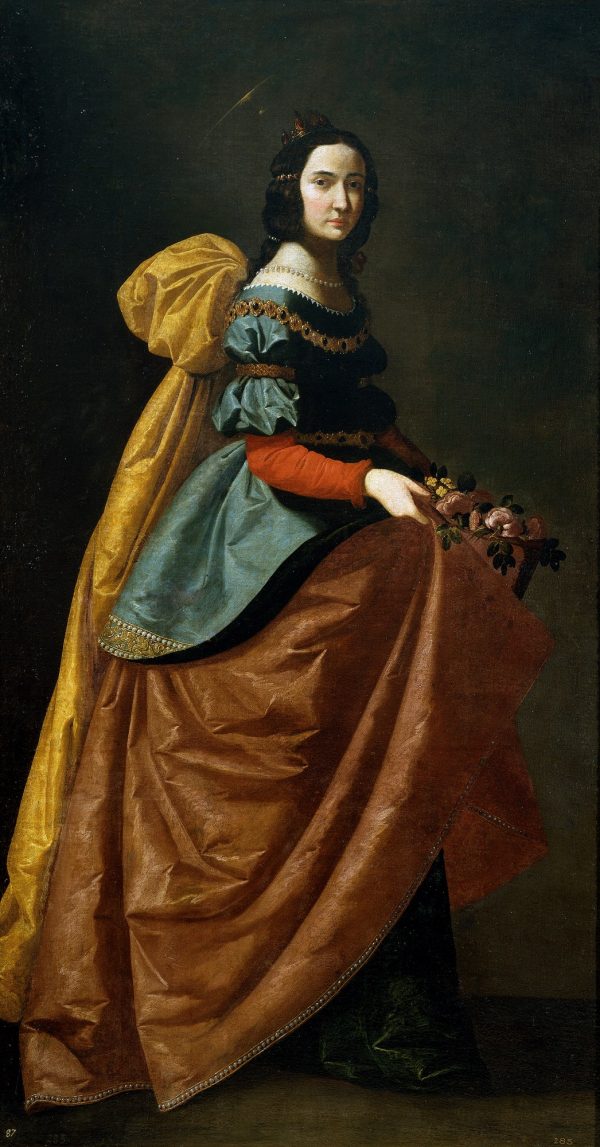
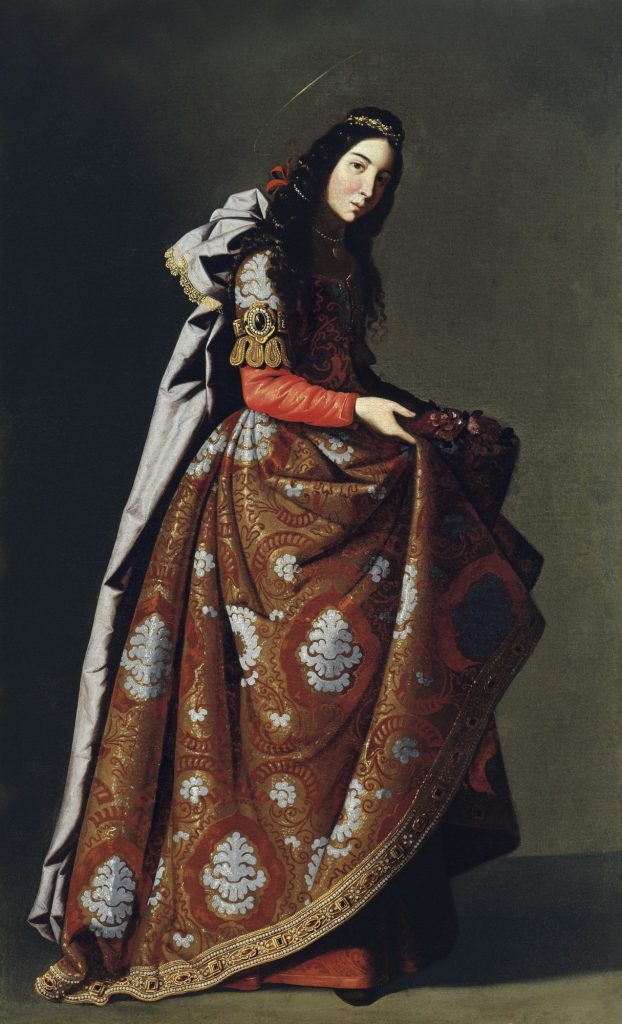
c. 1635 · Oil on canvas · Museo Nacional Thyssen-Bornemisza, Madrid
Save articles to your collection
Log in or create a free account, and this article will be waiting in your Private Collection.
Log in or sign upA young woman walks across an empty, softly lit space, almost in profile, and turns her head to look straight at us. She wears a magnificent dress of red and gold brocade, a silvery lilac mantle thrown over her shoulder, pearls, a jewelled armlet and a small golden diadem. With one hand she lifts a fold of her skirt, and in it she carries a heap of roses. Above her head, so faint you might miss it, is the thin gold line of a halo.
She is Saint Casilda, and Francisco de Zurbarán painted her around 1635. It is one of the most celebrated of his female saints: paintings of holy women dressed like the richest ladies of Seville, each one carrying the sign of her story.
According to her legend, Casilda was a Muslim princess, the daughter of the king of Toledo in the eleventh century. She took pity on the Christian prisoners held by her father and secretly carried bread to them, hidden in her clothes. One day her father stopped her and demanded to see what she was carrying. When she opened her skirt, the bread had turned into roses.
Later, the story goes, Casilda fell ill and was cured by the waters of a lake near Burgos, in northern Spain. She became a Christian and lived the rest of her life there as a hermit. Her shrine near Briviesca is still a place of pilgrimage.
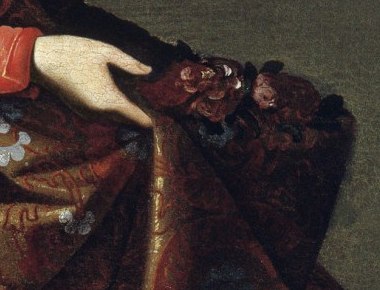
That is why she carries roses in her skirt. In Zurbarán's painting the miracle has already happened. The roses are the only clue to her story, and he paints them small, dark red, almost lost in the folds of the brocade.
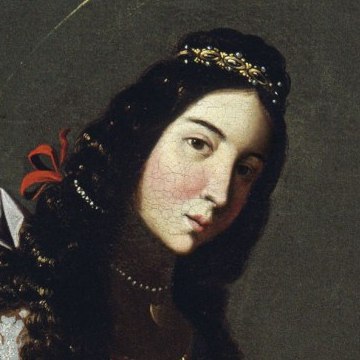
Because she probably was one. Her face is not idealised like a statue's. It is the face of a particular young woman, with flushed cheeks, a slightly serious expression and dark hair tied with a red ribbon. Her clothes are the luxury fabrics of Seville in the 1630s, not the robes of a medieval saint.
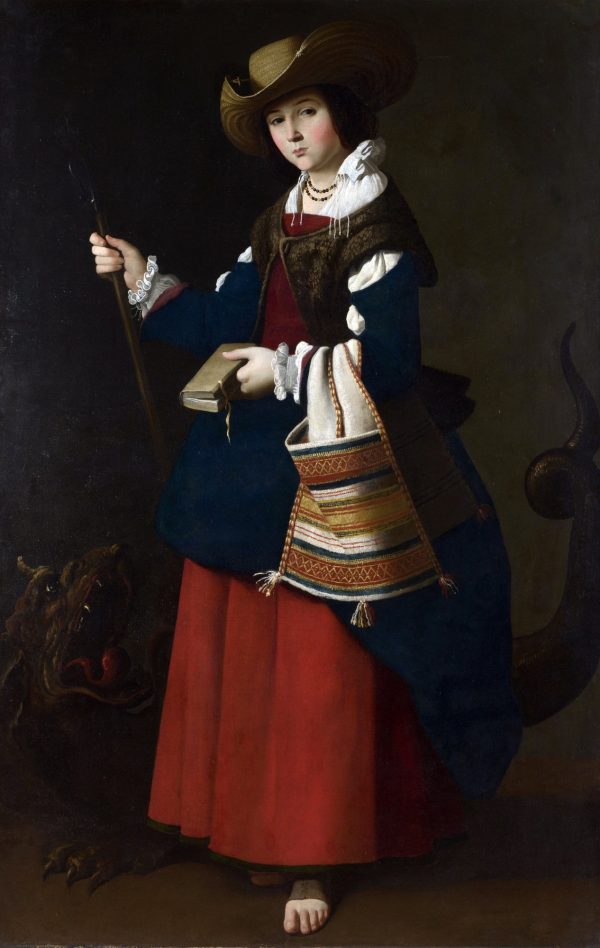
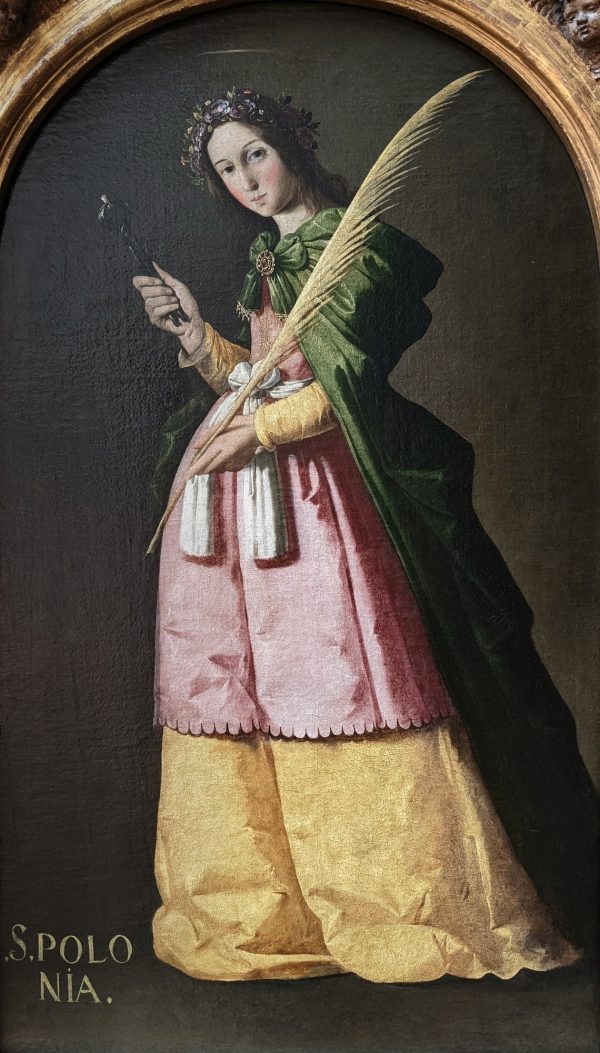
Zurbarán and his workshop painted many of these female saints, often in series, for convents in Spain and for churches in Spanish America. They walk one after another, as if in a procession, each dressed in her finest clothes.
What you can see, and what is interpretation: the realistic face, the fashionable dress and the jewels are all clearly painted. It is often suggested that the models were real women of Seville, perhaps portrayed as their favourite saints, but no document names the sitter for this painting.
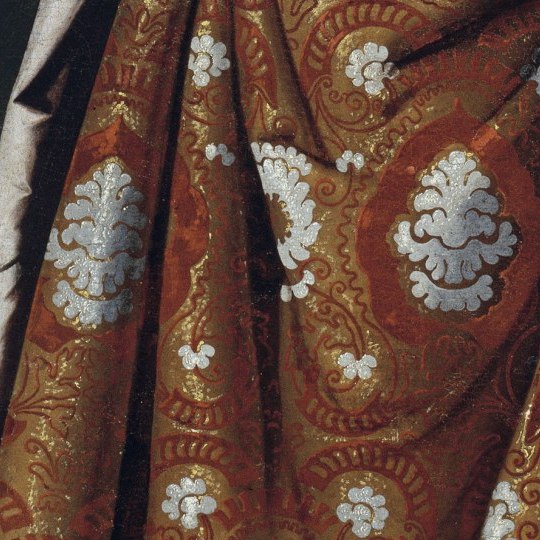
The dress is the real subject of the picture, and it is a tour de force. The brocade skirt is woven with gold thread and patterned with large silvery-white flowers. Zurbarán makes the pattern follow every fold and curve of the heavy fabric, so that it looks as if it would rustle if she moved.
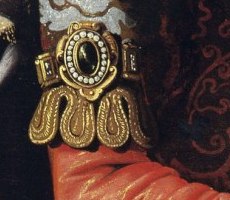
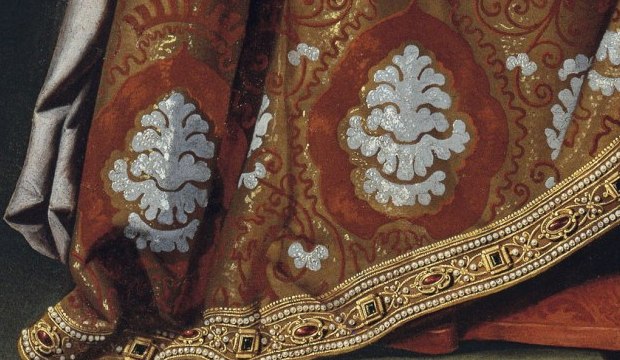
The details are as rich as the fabric: a gold armlet set with pearls, a string of pearls at her neck, and a hem embroidered with gold and studded with pearls and coloured stones. Against the plain background and the cool lilac of the mantle, all this colour seems to glow.
Because it combines two things Zurbarán did better than almost anyone: the calm, single figure set against an empty background, and the patient, loving painting of fabric. The result is part portrait, part fashion plate and part religious image, and it still feels surprisingly modern.
Today it is one of the best-known paintings by Zurbarán in Madrid, and the finest example of his saints in silk.
Read more about the painter and his other masterpieces in our guide to Francisco de Zurbarán.
The painting is in the Museo Nacional Thyssen-Bornemisza in Madrid. It is oil on canvas, 171 by 107 centimetres, painted around 1635.
We paint Saint Casilda by hand in oil on canvas, at the original size or the size that suits your wall, with the gold brocade, the pearls and the roses built up in layers. See the hand-painted reproduction.
Enjoyed this story?
Save articles to your collection
Log in or create a free account, and this article will be waiting in your Private Collection.
Log in or sign upWhat can be seen in the painting, what is documented, and what is interpretation are kept separate throughout this article.