Loading cart…
No products in the cart.

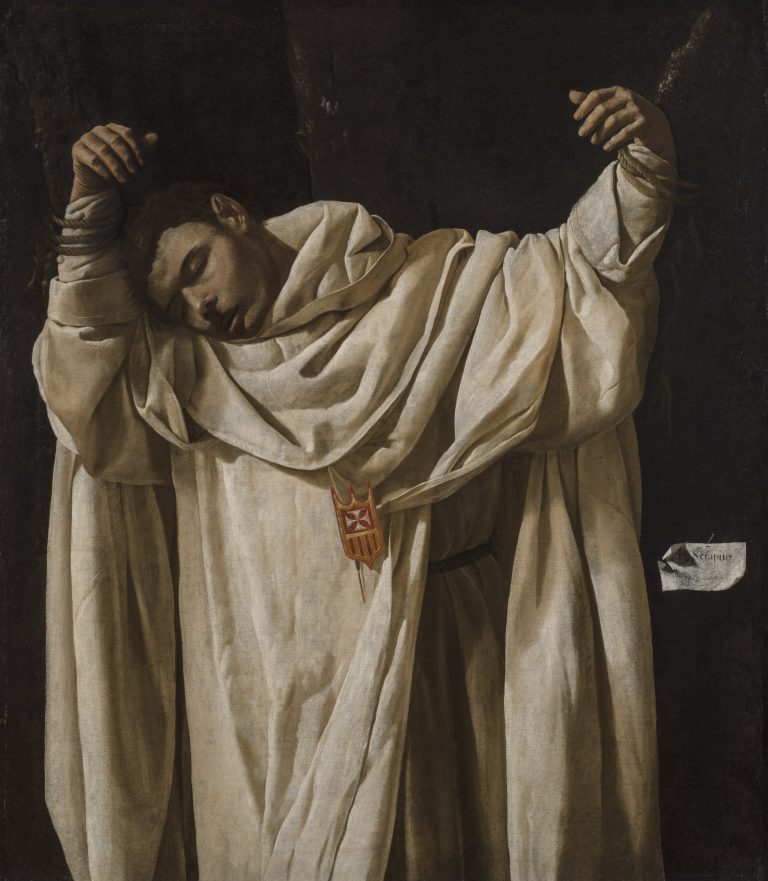
1628 · Oil on canvas · Wadsworth Atheneum Museum of Art, Hartford
Save articles to your collection
Log in or create a free account, and this article will be waiting in your Private Collection.
Log in or sign upA young friar in a white habit hangs by his wrists in the dark. His arms are tied with rough rope above his head, his head has fallen onto his shoulder, and his eyes are closed. He has just died, or is about to. There are no executioners, no wounds on show and almost no blood. There is only the body, the rope and an enormous white habit that falls in heavy folds to the bottom of the picture.
Zurbarán painted it in 1628, when he was about thirty, and it is often called his first masterpiece. It is one of the most powerful images of martyrdom in Spanish art, and also one of the quietest.
Serapion was a friar of the Order of Mercy, the Mercedarians, a religious order founded in Spain in the thirteenth century with one unusual mission: to free Christians held captive in North Africa, by paying ransoms and, if necessary, by offering themselves as hostages in their place. According to the order's tradition, Serapion did exactly that and was put to death in 1240 when the money did not arrive in time.
The Mercedarians of Seville commissioned Zurbarán to paint scenes from the history of their order in 1628. This painting hung in a room of their monastery used for funeral rites, where the friars would see it as they prayed for their own dead brothers. It was meant to be looked at in silence.
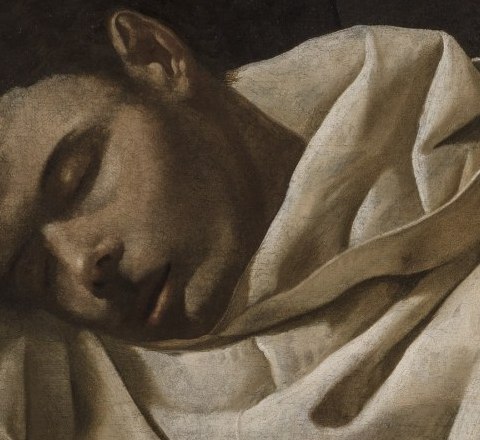
Other painters of martyrdom showed the torture in detail. Zurbarán chose the moment after it. Serapion's face is calm, almost asleep, with only a slight pallor and the mouth falling open. The emotion is in his stillness, not in his wounds.
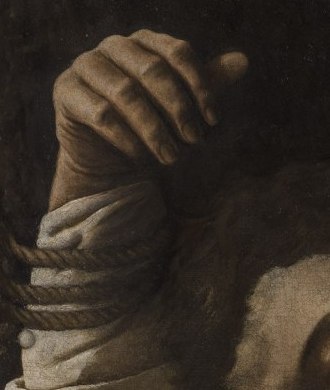
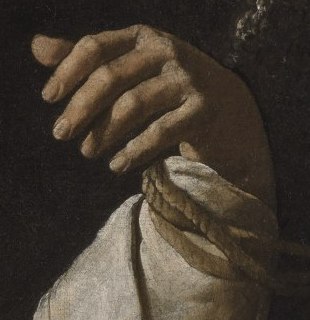
The hands tell the rest. Both are tied at the wrist, and both have gone slack, the fingers curling loosely. It is the only part of the body that shows how he died.
What you can see, and what is interpretation: the ropes, the closed eyes and the limp hands are all clearly painted. The written accounts of Serapion's death describe terrible tortures; Zurbarán leaves them out. Whether he did so to spare the friars who prayed in front of it, or because he believed calm was more powerful, he does not say. The painting itself is the only evidence.
The habit takes up most of the picture. It is the white robe of the Mercedarian friars, and Zurbarán paints it with extraordinary care: hundreds of shades of cream, grey and warm white in the folds, heavy where it hangs from the arms and sharp where it creases. White habits would become his speciality, and Saint Serapion is where that fame begins.
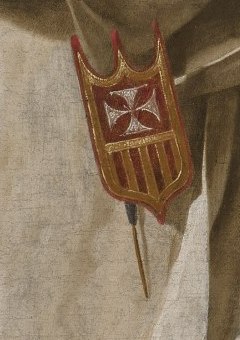
The only colour is a small shield pinned to the chest: the badge of the Order of Mercy, with a white cross on red above the red and gold stripes of the arms of Aragon. It marks Serapion as one of the order's own, a hero the friars could claim as their brother.
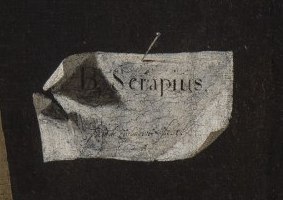
On the right, a small piece of paper seems to be pinned to the dark wall. It reads "B. Serapius", short for Beatus Serapius, Blessed Serapion: in 1628 he had been beatified but not yet declared a saint. Underneath, in smaller letters, are Zurbarán's signature and the date. It is a painted trick, a label that looks real enough to peel off, and it reminds us that this is a picture to be read as well as seen.
Read more about the painter and his other masterpieces in our guide to Francisco de Zurbarán.
The painting is in the Wadsworth Atheneum Museum of Art in Hartford, Connecticut, one of the oldest public art museums in the United States. It is oil on canvas, 120 by 103 centimetres, signed and dated 1628.
We paint Saint Serapion by hand in oil on canvas, at the original size or the size that suits your wall, with every fold of the white habit built up in layers of oil paint. See the hand-painted reproduction.
Enjoyed this story?
Save articles to your collection
Log in or create a free account, and this article will be waiting in your Private Collection.
Log in or sign upWhat can be seen in the painting, what is documented, and what is interpretation are kept separate throughout this article.