Loading cart…
No products in the cart.

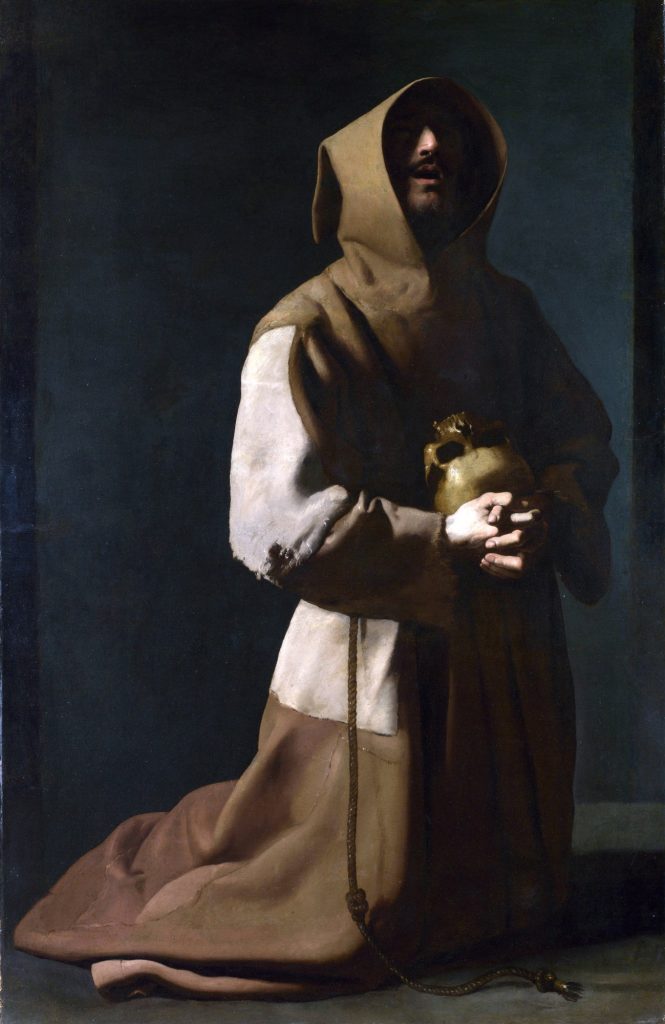
1635-1639 · Oil on canvas · National Gallery, London
Save articles to your collection
Log in or create a free account, and this article will be waiting in your Private Collection.
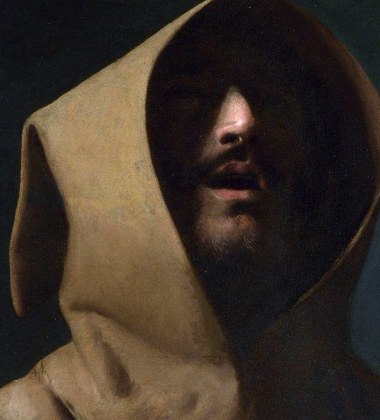
Log in or sign upA man in a rough brown habit kneels on a bare floor against a dark, empty wall. His hood is pulled so far forward that most of his face is lost in shadow. All we see are his lips, slightly open, and the line of his beard. His eyes, hidden under the hood, seem to look upwards. In his clasped hands he holds a human skull against his chest.
This is Saint Francis of Assisi, the founder of the Franciscan order, painted by Francisco de Zurbarán in the late 1630s. There is no landscape, no vision of angels and no birds, nothing of the gentle Francis of popular imagination. There is only a man alone with death, in prayer.
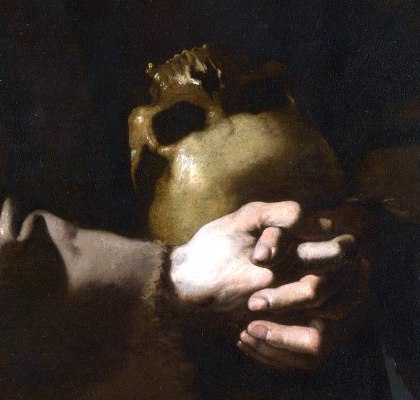
The skull is a reminder of death, a memento mori. In the religious culture of seventeenth-century Spain, meditating on death was a central spiritual exercise: thinking about your own end was meant to free you from attachment to the world and prepare your soul. Francis holds the skull close, against his heart, as if it were something precious.
The light falls on the skull and the hands, which are the brightest parts of the painting after the patched sleeve. Zurbarán makes sure that whatever else we notice, we notice death.
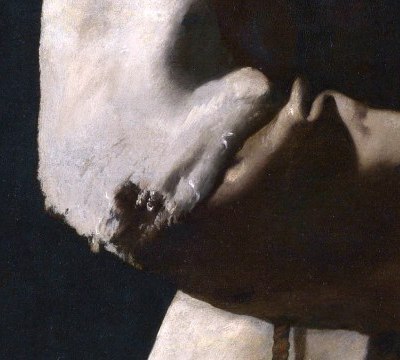
Look at the sleeve. The habit is torn and patched with a lighter cloth, a sign of the absolute poverty Francis chose when he gave up his family's wealth. Zurbarán paints the rough, worn wool with the same attention he gave to silk and brocade in his paintings of female saints.
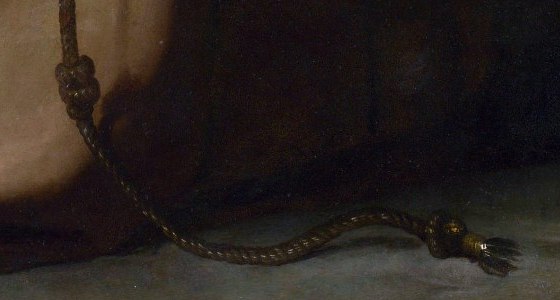
Around his waist is the simple cord of the Franciscan friars, which hangs down and trails on the floor. Franciscans traditionally tie knots in it for the three vows of their order: poverty, chastity and obedience.
Many times. Saint Francis was one of his favourite subjects, and he and his workshop painted him kneeling, standing and in meditation in a number of versions, now in museums across Europe and the Americas. The kneeling Francis in London is one of the most admired, for its simplicity and for the extraordinary shadow of the hood.
It came to the National Gallery in London in the nineteenth century, at a time when Spanish painting was just being discovered outside Spain, and it helped to make Zurbarán's name known in Britain.
Read more about the painter and his other masterpieces in our guide to Francisco de Zurbarán.
The painting is in the National Gallery in London. It is oil on canvas, 152 by 99 centimetres, painted between 1635 and 1639.
We paint Saint Francis in Meditation by hand in oil on canvas, at the original size or the size that suits your wall, with the deep shadow of the hood and the worn wool of the habit built up in layers. See the hand-painted reproduction.
Enjoyed this story?
Save articles to your collection
Log in or create a free account, and this article will be waiting in your Private Collection.
Log in or sign upWhat can be seen in the painting, what is documented, and what is interpretation are kept separate throughout this article.