Loading cart…
No products in the cart.

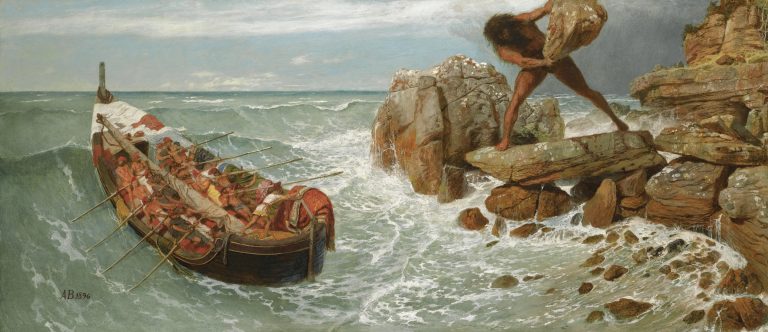
1896 · Oil and tempera on panel · Museum of Fine Arts, Boston, USA
Save articles to your collection
Log in or create a free account, and this article will be waiting in your Private Collection.
Log in or sign up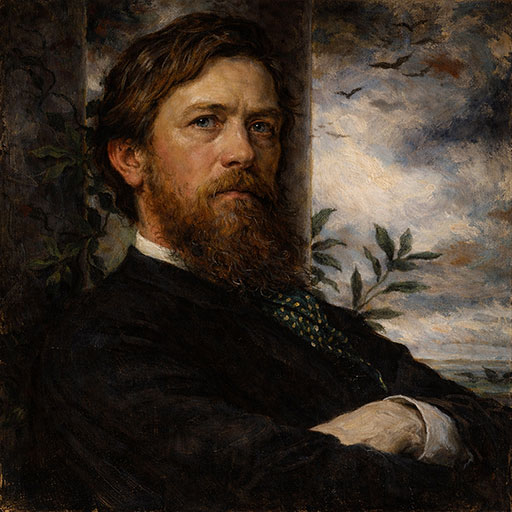 Explore the artistArnold Böcklin →
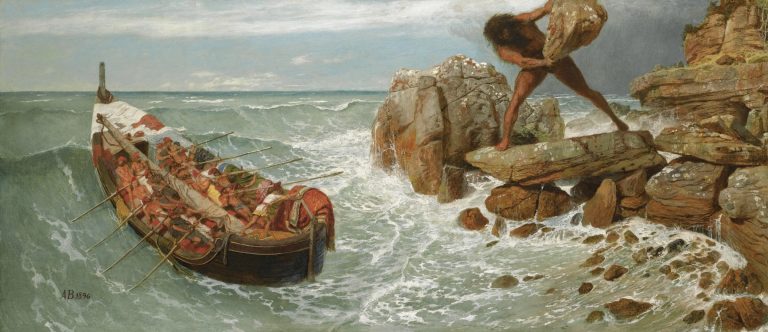
The boat is already off the rocks. Its oars reach into the water, its crew crowd together, and the open sea lies beyond them. Then a man at the stern turns towards the shore. Across the water, a giant bends under the weight of a boulder.
Odysseus and Polyphemus, painted by Arnold Böcklin in 1896, shows the Greek hero taunting the Cyclops after escaping his cave. The painting belongs to the Museum of Fine Arts, Boston. It is a surprisingly narrow panel for such an enormous confrontation: 66 centimetres high and 150 centimetres wide, painted in oil and tempera.
Böcklin gives us the moment when getting away is still possible. The men have a boat, oars and distance. Their captain also has something he wants the giant to hear.
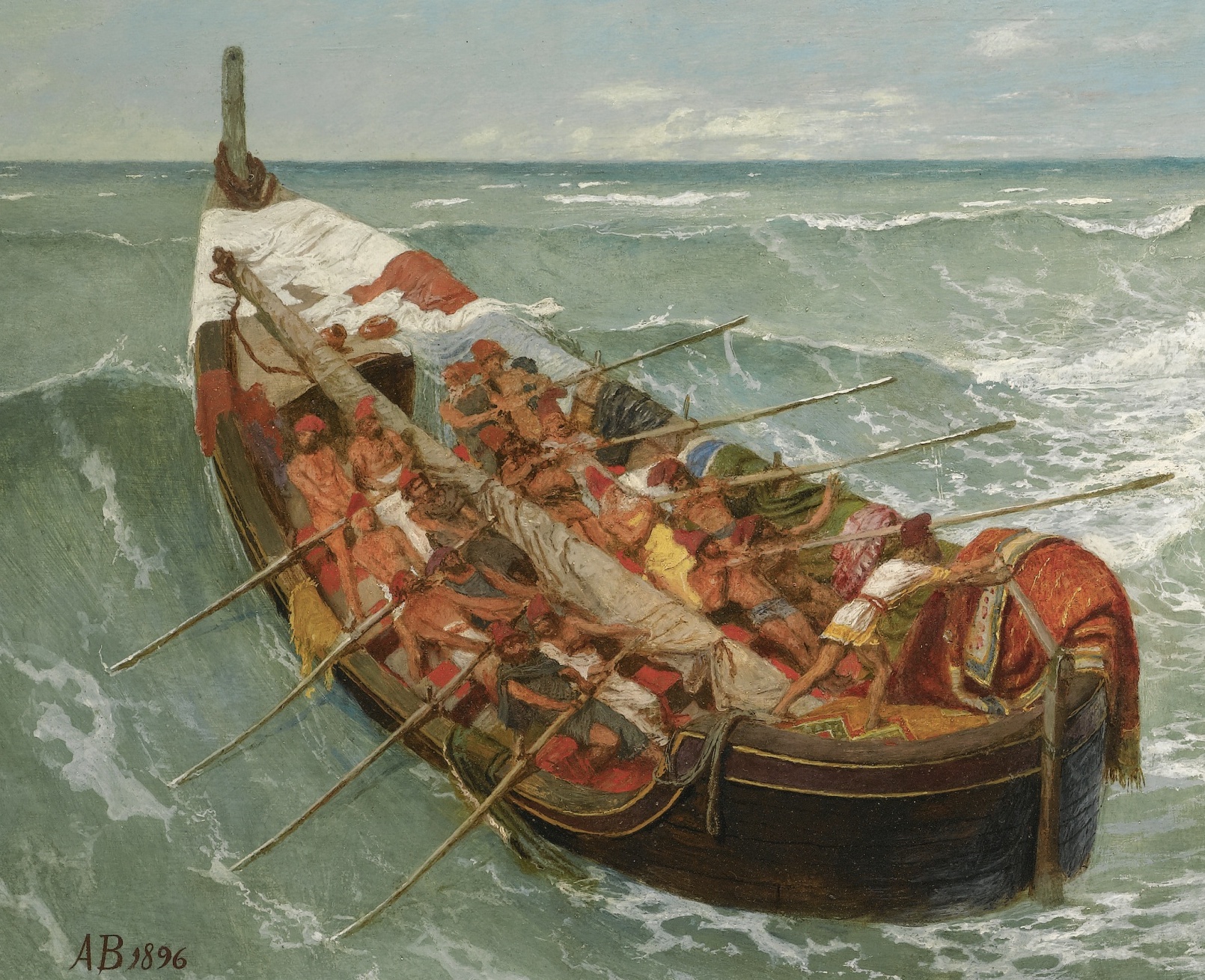
Odysseus stands near the high, rounded stern on the right of the boat. His pale tunic, gold-coloured armour and dark red cloak distinguish him from the crowded rowers. His arms extend towards the shore, where the danger remains.
The people around him have less room for a grand gesture. Their bodies overlap, their hands work among the oars, and a long pale fold of sail or cloth runs diagonally through the vessel. The eye has to pick its way through heads, arms, shafts and fabric. This is a crowded escape.
The boat's red and gold fittings make it striking against the green water. They do not make it secure. Its curved wooden side looks thin beside the blocks of stone on the opposite shore. At this scale, even a boulder that misses the hull could throw up a dangerous wave.
That difference matters. Odysseus addresses a single opponent; the consequences of the exchange fall on everyone aboard.
The episode comes from Book 9 of Homer's Odyssey. Polyphemus traps Odysseus and his companions in his cave and eats some of the men. Odysseus gives him wine and a false name: Nobody, rendered as Noman in Samuel Butler's translation.
"My name is Noman; this is what my father and mother and my friends have always called me."
Homer, Odyssey, Book 9, translated by Samuel Butler
The men blind the sleeping Cyclops with a heated stake. When he calls for help, his claim that Noman is attacking him defeats his own appeal. The survivors then escape beneath his sheep.
Out at sea, Odysseus calls back. His companions beg him to stop provoking the giant. He ignores them and reveals his identity. Polyphemus can now name the man he curses when he appeals to his father, Poseidon, god of the sea. Butler uses the Roman names Ulysses and Neptune for Odysseus and Poseidon. Read the passage in Book 9.
The painting becomes sharper once we know that the escape depended on concealment. The gesture at the stern exposes what the earlier trick had hidden.
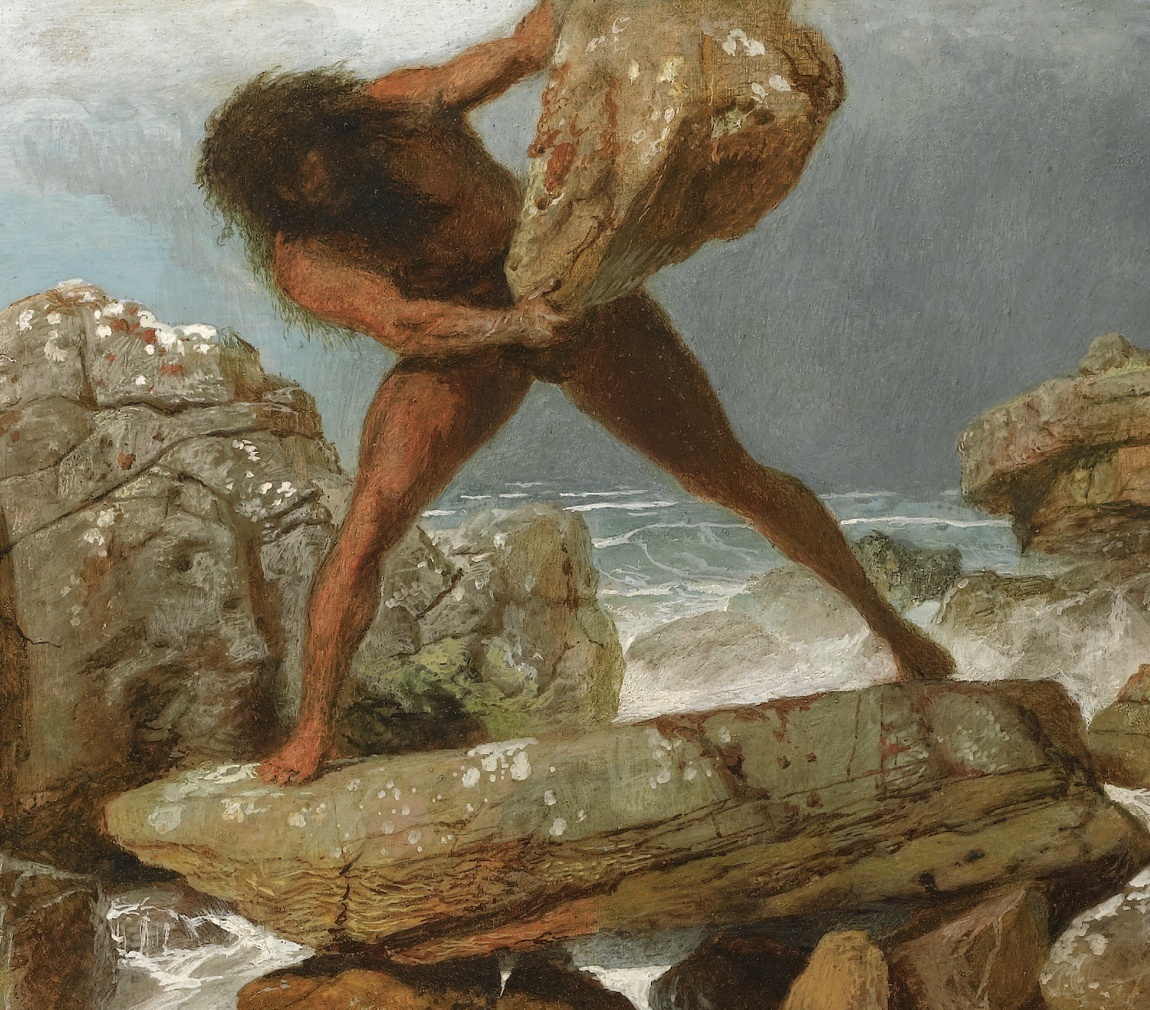
Polyphemus is famous for his single eye, yet Böcklin does not offer us a clear view of it. The giant's lowered head disappears into dark hair and the angle of his upper body. The boulder occupies the space where we might expect to study his expression.
Instead, we read his weight. His feet are planted far apart on a ledge. One leg reaches towards the right while the other braces closer to the boat. His back and arms gather around the stone. The top of the boulder continues beyond the upper edge of the original painting, making its bulk difficult to take in at once.
There is something awkward about the pose. Lifting the rock demands work, even from a giant. Böcklin makes that physical effort visible, rather than placing a weightless monster above the shore.
The reddish flesh also belongs to the same range of colours as the surrounding rock. Look from his bent body to the broken coastline beneath him: the shore seems capable of producing a body as heavy and ungainly as itself. That is a visual resemblance, not a separate event in Homer's story.
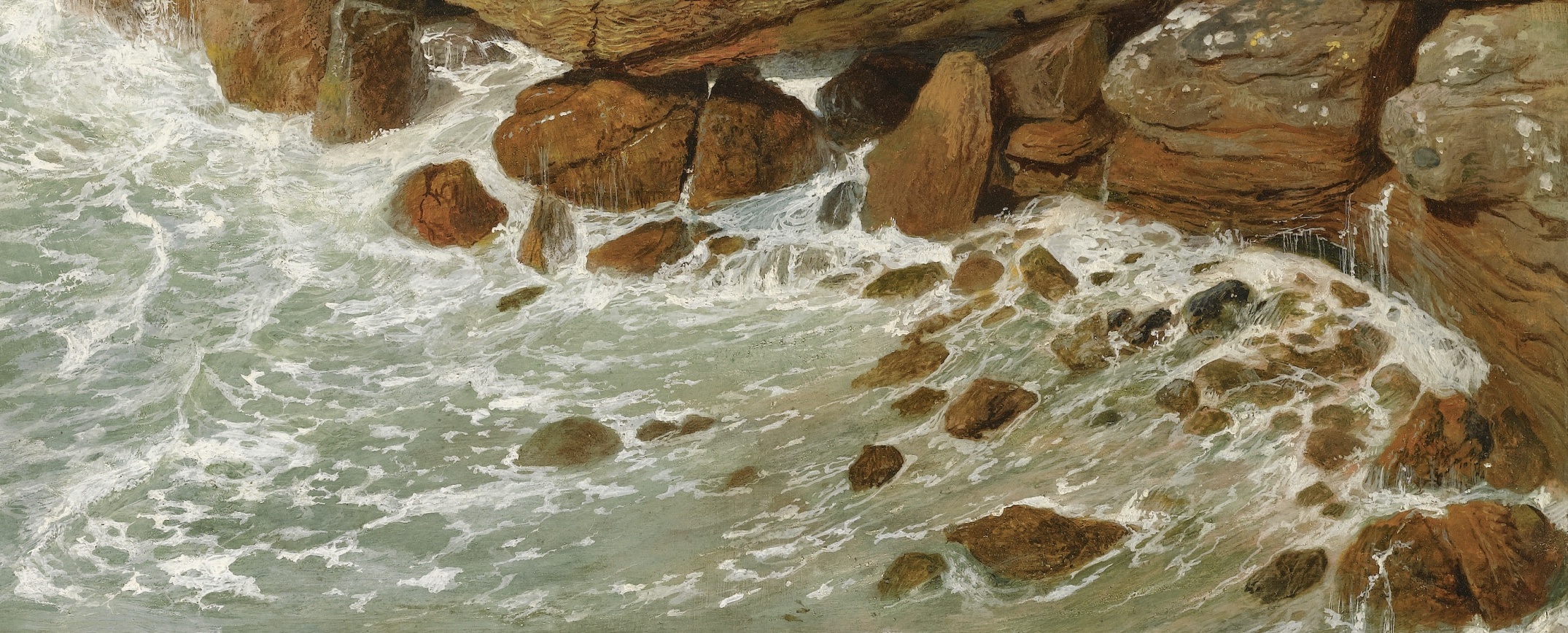
The gap between boat and giant is full of movement. White foam curls around the rocks, breaks into small branching lines and gathers in the channels between stones. Pale green water occupies the open areas; brown and ochre rocks interrupt it near the shore.
This detail deserves attention because it carries the danger outwards. The threat does not end at the giant's hands. Water connects his position to the boat, and the crew must row through the same unsettled surface that breaks against his ledge.
Above that agitation, the horizon is almost level. A low strip of sea and a broad pale sky suggest how much space there would be if the men could simply leave. Böcklin places a possible escape in sight, then keeps our attention caught in the nearer water.
The long, horizontal format lets us compare both sides without turning the scene into a distant panorama. We can follow the oars, cross the surf and arrive at the giant's feet in a single sweep.
The central tension is between Odysseus' intelligence and his desire to be recognised. The same man who understood the usefulness of a false name cannot bear to leave the victory anonymous.
This reading does not require the painting to deliver a simple moral verdict. Polyphemus has killed members of the crew. Odysseus has reason to feel anger, triumph and grief. Böcklin leaves us with the uncomfortable sight of a justified hatred becoming another risk for the survivors.
Scale makes the choice look particularly reckless. At the stern, the captain is a small figure with an expansive gesture. On shore, a much larger body is gathering a much larger answer. The rowers occupy the space between his confidence and the giant's force.
That combination of an extraordinary creature and a convincing physical setting also helps explain the painting's particular mood. The monster is fantastical; the difficulties of keeping a crowded boat away from rocks are easy to understand.
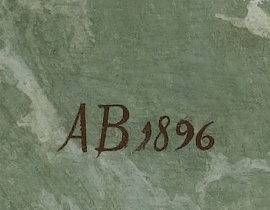
At the lower left, the inscription reads AB 1896. It sits in a relatively quiet patch of water below the boat. After the strain of the figures and the broken surf, this small detail returns us to the work as a made object, signed and dated by its painter.
The Sotheby's catalogue for the panel records its appearance in the Basel Böcklin exhibition of 1897. The Museum of Fine Arts acquired it in 2012; its accession number is 2012.626. The museum identifies the medium as oil and tempera on panel.
If you know Böcklin through Isle of the Dead, this is a different kind of encounter with a rocky shore. Here, the people are noisy, the water is turbulent, and an act of defiance is still unfolding. Both paintings reward looking at the small human vessel before taking in the enclosing landscape.
Arnold Böcklin painted this version in 1896. Other artists treated the same myth, so the artist's name and date help distinguish this panel from other Odysseus and Polyphemus paintings.
Odysseus and his crew are leaving the Cyclops' island after escaping his cave. Odysseus calls towards the shore while Polyphemus prepares to throw a boulder at their boat.
It is in the collection of the Museum of Fine Arts, Boston. The panel measures 66 × 150 cm, approximately 26 × 59 inches.
Böcklin shows his head lowered and partly obscured. His identity comes from the episode and the enormous rock he is preparing to throw, rather than a frontal view of his face.
The journey continues through threats that demand more than strength. In Waterhouse's Ulysses and the Sirens, the crew must contend with an irresistible song. Read how the sailors' preparations change what we see in that painting.
Arnold Böcklin, Odysseus and Polyphemus, 1896. Museum of Fine Arts, Boston, accession 2012.626. Public-domain reproduction via Wikimedia Commons / Sotheby’s. Painting image source.
Enjoyed this story?
Save articles to your collection
Log in or create a free account, and this article will be waiting in your Private Collection.
Log in or sign up
Man Writing a Letter
Gabriel Metsu, c. 1664
The gallery list
Every painting is already 50% off. Join the list and we will send you an extra $15 code, plus first access to new collections.
No spam. Unsubscribe anytime. · Privacy Policy
Welcome
Your $15 code is on its way. Explore the gallery while you wait.