Loading cart…
No products in the cart.

1891 · Oil on canvas · National Gallery of Victoria, Melbourne, Australia
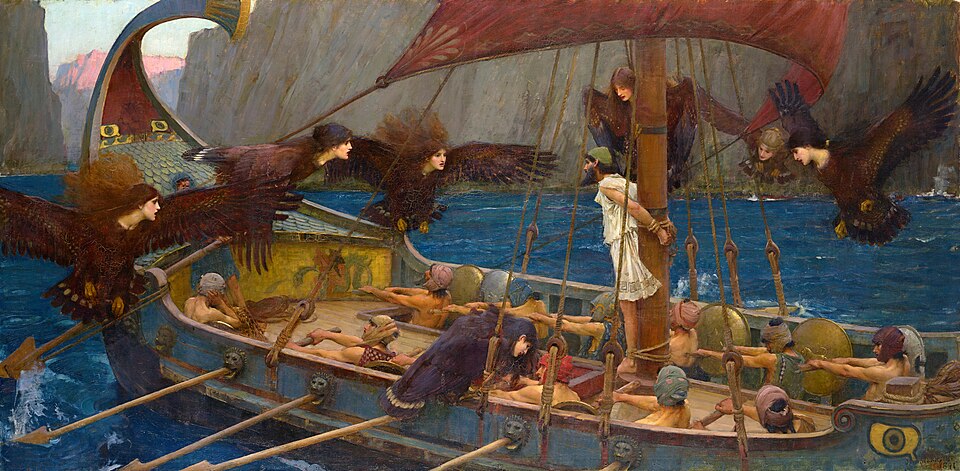
Ulysses and the Sirens was completed in 1891 and exhibited at the Royal Academy in that year before being acquired by the National Gallery of Victoria in Melbourne, where it has remained a centerpiece of the collection ever since. The subject was drawn from Book XII of Homer's Odyssey, one of the foundational texts of the Western literary tradition, in which the hero Ulysses orders his men to bind him to the mast of his ship so that he may hear the song of the Sirens without being able to act upon it. The Sirens, in the original Homeric text, are not described in physical terms, but the tradition of depicting them as part woman and part bird stretches back through centuries of visual art. Waterhouse drew on this iconographic tradition but interpreted it with characteristic originality, depicting the Sirens not as the serene temptresses of many earlier representations but as aggressive, physically threatening creatures descending in a flock on the vessel and its helpless crew. By the time Waterhouse painted this work, his reputation as a painter of classical mythological subjects was well established. He had already exhibited a number of significant works in this vein, including Circe Offering the Cup to Ulysses in 1891, and he was developing the richly populated, dramatically charged compositional language that would define his mature style. The large horizontal format of the canvas, measuring over two meters in width, allowed him to spread the action across the picture plane in a manner that maximizes the sense of chaos and enclosure.
The compositional strategy of Ulysses and the Sirens is one of deliberate overwhelming. Waterhouse filled the upper two-thirds of the picture plane with the massing forms of the Siren creatures, creating a sense of claustrophobic assault that mirrors the experience of the sailors below. The figure of Ulysses is positioned at the center of the canvas, bound to the mast, his body straining against the ropes, his face tilted upward toward the source of the song. This vertical axis of the mast and the bound hero provides the only stable element in a composition otherwise defined by turbulent diagonal movement. The Sirens themselves are rendered with remarkable variety of pose and expression, some diving toward the boat with wings outstretched, others perched at the edges of the vessel already, and others still hovering in the middle distance. Their faces carry expressions ranging from cold hunger to something that reads almost as curiosity, a range of emotional register that prevents the image from collapsing into simple allegory. Waterhouse handled the sea and sky with a looser, more atmospheric touch than he used for the figures, creating a background that recedes convincingly while keeping the visual weight concentrated in the foreground action. The cool blue-green of the water contrasts with the warm, dark tones of the wooden vessel and the strange, dusky coloring of the Siren bodies. This is a technically demanding composition, and the hand-painted oil reproduction format is the only way to experience the textural and chromatic complexity of the original at anything approaching its true scale. If you want to own this as a hand-painted oil reproduction, it is available through ByMuseum in customizable sizes.
The episode of Ulysses and the Sirens has served as a philosophical parable since antiquity, interpreted as a meditation on the relationship between knowledge, desire, and self-control. The Homeric hero chooses to hear the song that promises forbidden knowledge but protects himself from its consequences by submitting voluntarily to physical restraint. This is a paradox that has fascinated thinkers from Plato onward, and it was particularly resonant in the Victorian period, when questions of will, temptation, and moral discipline occupied a central place in both popular and intellectual culture. Waterhouse brought his own visual intelligence to this inherited tradition, choosing to emphasize not the serenity or beauty of the Sirens but their predatory energy, their physical menace, and their sheer numerical force. In his version, the danger is not primarily erotic but existential, a confrontation with forces that overwhelm through accumulated pressure rather than singular enchantment. This interpretation gives the painting a psychological texture that goes beyond simple moral allegory. The bound figure of Ulysses, straining and helpless yet also somehow dignified in his chosen vulnerability, becomes a figure of genuine ambiguity, neither simply heroic nor simply victimized. The painting also carries within it a sustained meditation on the nature of artistic experience itself. To hear the song of the Sirens is to receive something that cannot be safely absorbed without mediation, a quality that art historians have read as a metaphor for the encounter with overwhelming beauty in any form. Owning this as a hand-painted oil reproduction means bringing one of the great images of that paradox into your own environment.