Loading cart…
No products in the cart.

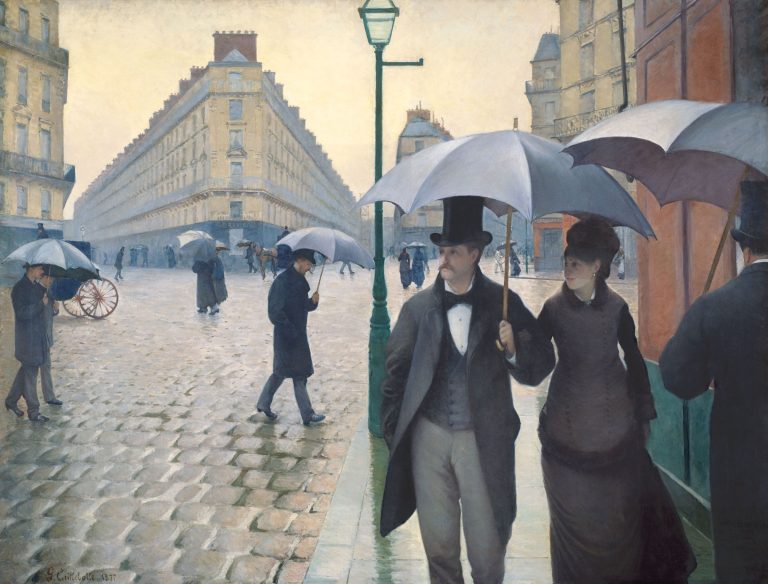
1877 · Oil on canvas · Art Institute of Chicago
Save articles to your collection
Log in or create a free account, and this article will be waiting in your Private Collection.
Log in or sign up Explore the artistGustave Caillebotte paintings →
Collection reference: Art Institute of Chicago.
A couple walks towards us beneath a dark umbrella. A man enters from the right, almost cut off by the frame. Behind them, pedestrians cross a broad junction where wet paving stones catch the pale light.
Gustave Caillebotte painted Paris Street; Rainy Day in 1877. The canvas belongs to the Art Institute of Chicago and measures more than two metres high. At that scale, the foreground figures can feel like people whose path we are about to cross.
The scene appears casual, but its arrangement is exacting. A lamppost divides the view, streets recede in several directions, and umbrellas produce a rhythm of repeated curves. A fleeting encounter has been carefully constructed.
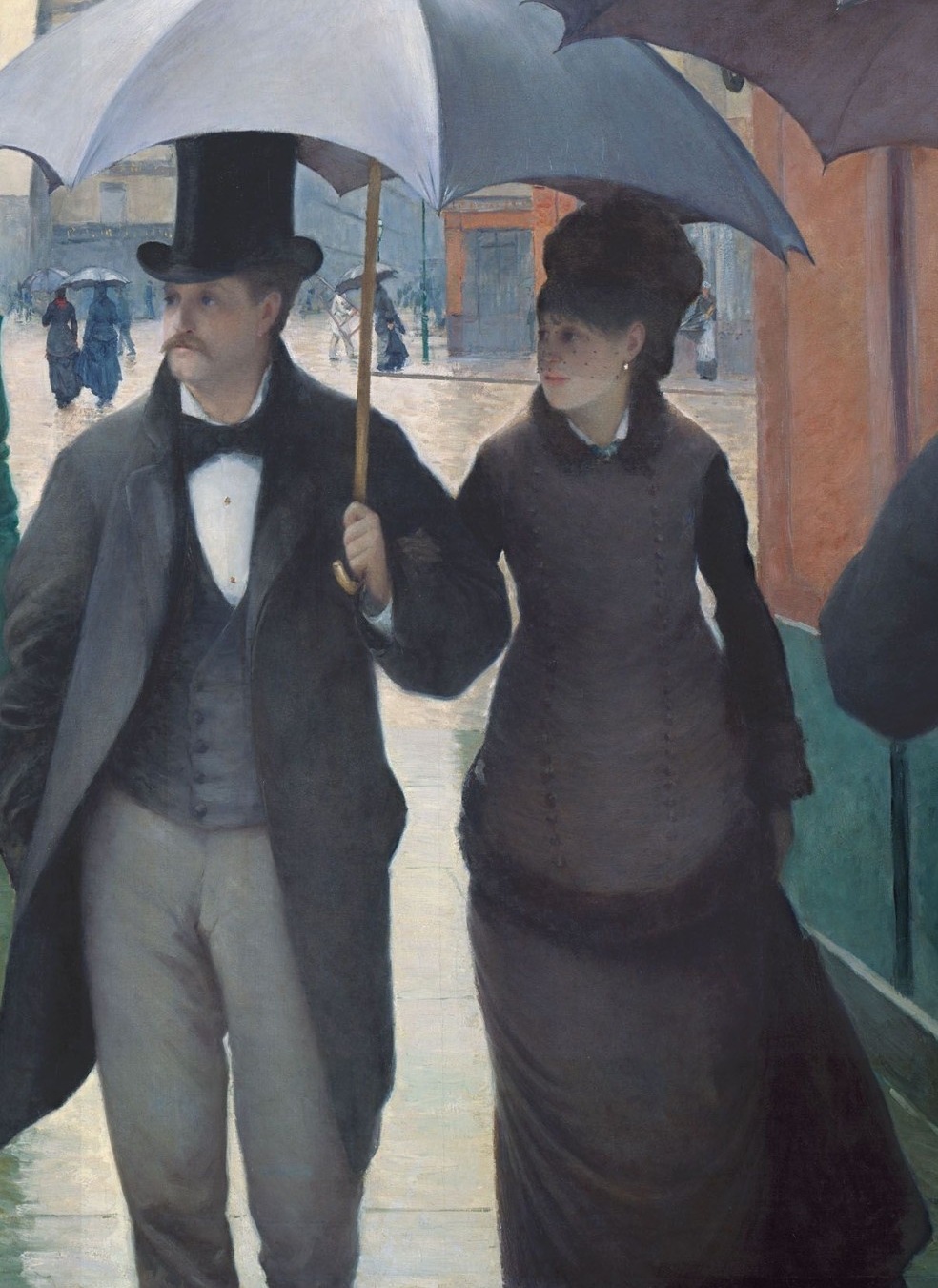
The foreground couple occupies one side of the canvas. Their clothes and umbrella create a substantial dark shape against the lighter paving and buildings. They are close enough for their faces to register, but they do not look towards us.
At the right edge, another man is partly cropped. His entry suggests that the composition continues beyond its frame and that the couple’s walk may soon require a small adjustment.
The picture depends on this near-intersection of paths. Nothing dramatic has happened, yet we recognise the practical awareness involved in moving through a city among strangers. Looking, approaching and making space become sufficient events for a painting.
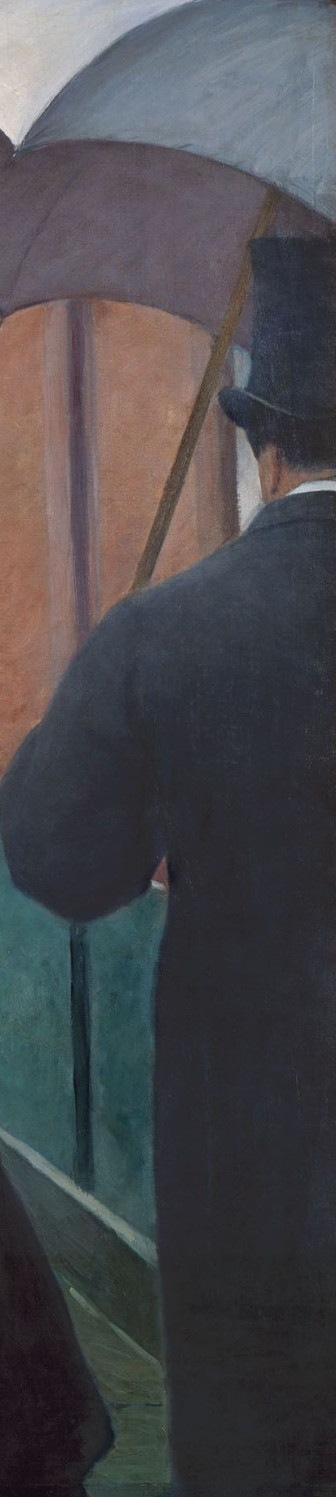
The cropped man is not just a convenient way to fill the margin. His incomplete body makes us imagine the continuation of his movement beyond what the canvas contains. The picture feels like a portion of a larger street in which someone can enter unexpectedly.
That sensation depends on placement. A figure wholly enclosed within the frame would be easier to regard as one element in an arranged group. Cutting him at the edge leaves the encounter less settled.
The setting is a junction near the Gare Saint-Lazare, in the part of Paris transformed by nineteenth-century redevelopment. Broad streets and pale stone buildings give the view an openness different from the city’s older, narrow lanes.
Caillebotte places the junction itself at the centre of the composition. The streets do not simply run behind the figures as a backdrop. Their converging lines organise how people approach, cross and disappear into the distance.
The rebuilt city offers room for movement, yet the pedestrians remain separated by their paths and umbrellas. The space is shared without producing a single shared activity.
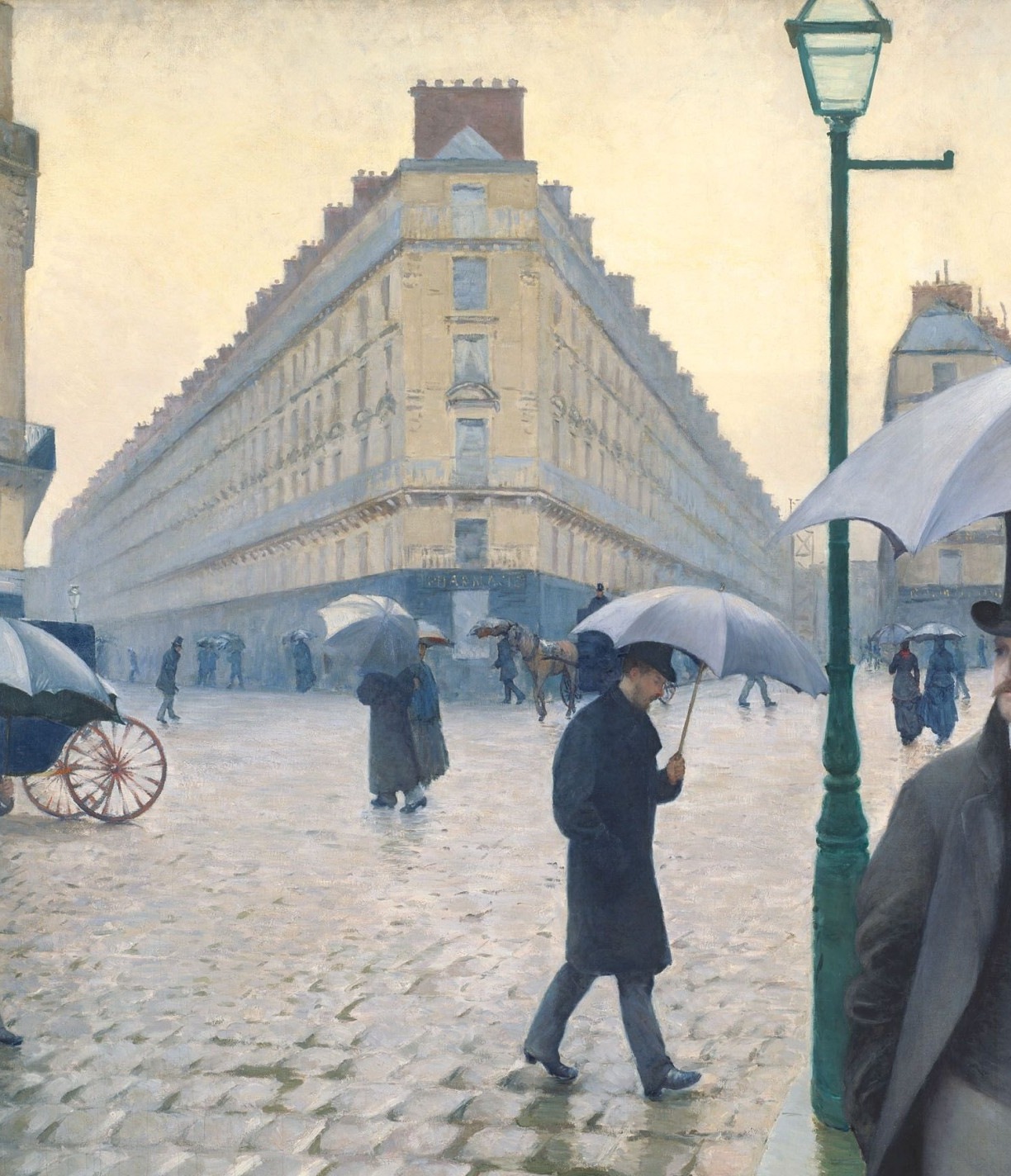
The green lamppost makes an emphatic vertical division. It cuts through the light sky and meets the foreground paving, giving the picture a stable axis amid the many directions of movement.
Behind it, a sharply angled building pushes into the junction. Its windows and roofline lead the eye into the distance while the streets open around it. The architecture feels measurable and planned.
The figures complicate that order. A rigid perspective system can organise buildings and paving, but pedestrians follow separate routes. Caillebotte lets the viewer experience both the city’s constructed framework and the less predictable movements within it.
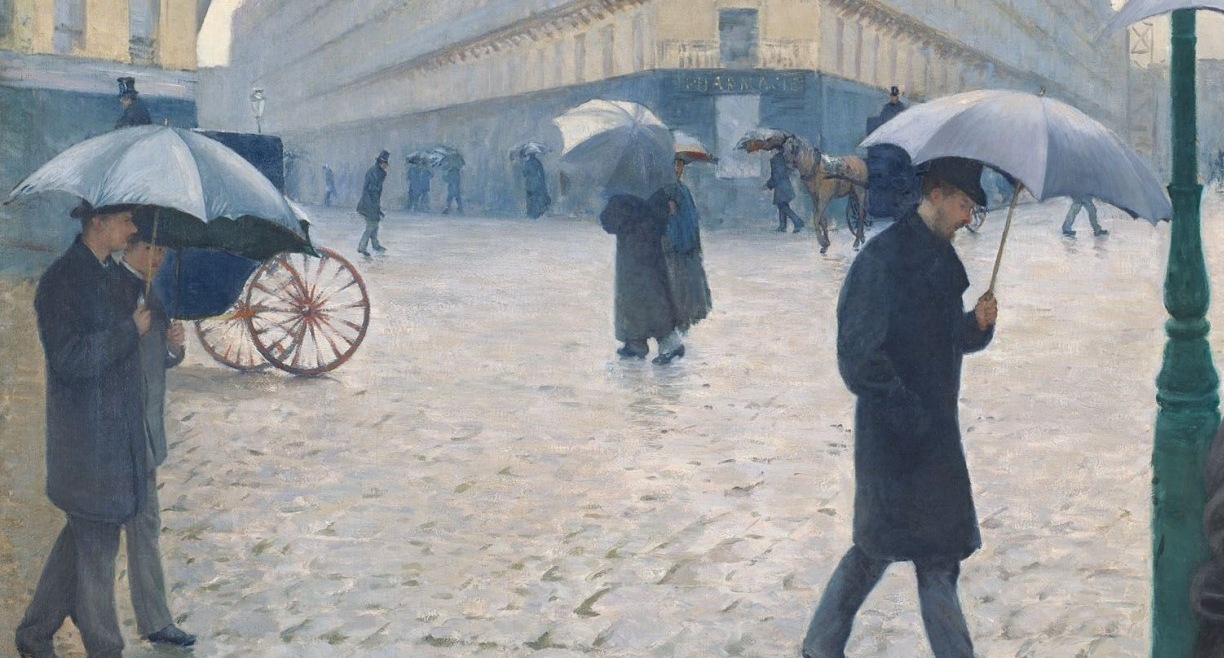
Follow the smaller pedestrians beyond the couple. Their separation becomes clearer as their scale diminishes. One umbrella can be read almost as a dark arc, another figure as a brief upright, while the junction remains wide enough to hold several independent routes.
The city’s depth therefore comes from more than the lines of buildings. The intervals between people measure the public space, giving the perspective a social as well as an architectural scale.
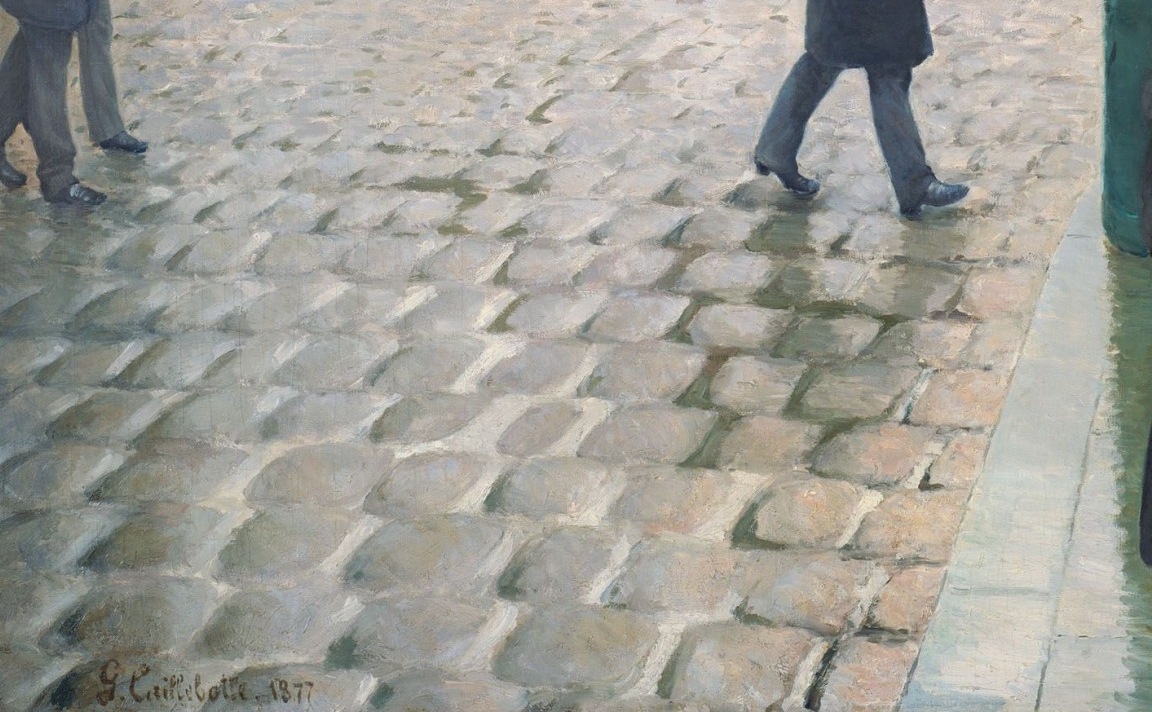
The paving is one of the painting’s most absorbing surfaces. Near us, individual stones appear larger and more distinct. Farther away, they compress into a finer texture, reinforcing the street’s depth.
Moisture changes their colour and sheen. Small pale reflections interrupt darker stone, making the light feel spread across the ground rather than concentrated in one bright source.
The restrained palette does not make the painting colourless. Green, brown, blue-grey and warm stone tones shift in relation to one another. The rainy atmosphere depends on these close differences as much as on the presence of umbrellas.
The cropped passer-by and seemingly incidental encounter can remind modern viewers of photography. The wide view and strong changes in scale also create the feeling of an instant caught before it rearranges itself.
Yet Caillebotte developed his composition through preparation. Studies and drawings show that apparent spontaneity can be the result of sustained planning. The painting should not be described as a direct copy of one photograph without evidence.
This makes the composition more interesting. Its casual appearance is achieved through decisions about what to include, where to cut a figure and how much empty wet street to leave between people.
Paris Street; Rainy Day appeared in the third Impressionist exhibition in 1877. Caillebotte was a participant and supporter of the group, even though his firm outlines and controlled perspective differ from Monet’s more broken treatment of atmosphere.
The connection helps broaden a useful definition of Impressionism. Modern subjects, independent exhibitions and new ways of framing experience mattered alongside visible brushwork and bright outdoor colour.
The painting’s weather is a changing condition, but its buildings remain clear and substantial. Caillebotte shows that the group could contain different approaches to observation, finish and pictorial structure.
A common reading concerns anonymity in the modern city. People occupy the same broad space while passing without an obvious connection. Umbrellas shelter them and also separate their fields of vision.
The painting supports that interpretation, but it does not confirm that every figure is lonely or unhappy. Shared movement through a city can involve absorption, companionship, caution or simple routine. The couple is together even as the larger crowd remains dispersed.
Its lasting force lies in this openness. Caillebotte turns an ordinary act of walking into a way to think about proximity: how near strangers can come while continuing in different directions.
The Art Institute of Chicago holds the canvas as part of the Charles H. and Mary F. S. Worcester Collection, accession 1964.336. Its recorded dimensions are 212.2 by 276.2 centimetres.
An image on a screen compresses that scale. In front of the original, the paving and approaching figures occupy a substantial part of the viewer’s field of vision. The street feels closer to an environment than a small scene observed from a distance.
Compare Renoir’s Luncheon of the Boating Party, where Caillebotte appears seated among companions. The two paintings offer distinct pictures of social life: an informal gathering at leisure and a public space in which paths briefly converge.
Gustave Caillebotte painted it in 1877. It was shown in the third Impressionist exhibition that year.
It belongs to the Art Institute of Chicago, accession 1964.336, in the Worcester Collection.
The canvas measures 212.2 by 276.2 centimetres. Its large scale makes the foreground pedestrians feel close to the viewer.
It shows a junction near the Gare Saint-Lazare in the redeveloped northwestern part of Paris.
Yes. He exhibited with and supported the group. Impressionism included different approaches to finish and perspective, alongside shared interests in modern experience.
Its cropping can suggest photography, but Caillebotte developed the composition through preparatory work. A photographic effect alone does not establish that he copied a particular photograph.
Detail images are crops of the historical painting, with no painted forms added.
Continue with our guide to ten famous Impressionist paintings.
Enjoyed this story?
Save articles to your collection
Log in or create a free account, and this article will be waiting in your Private Collection.
Log in or sign up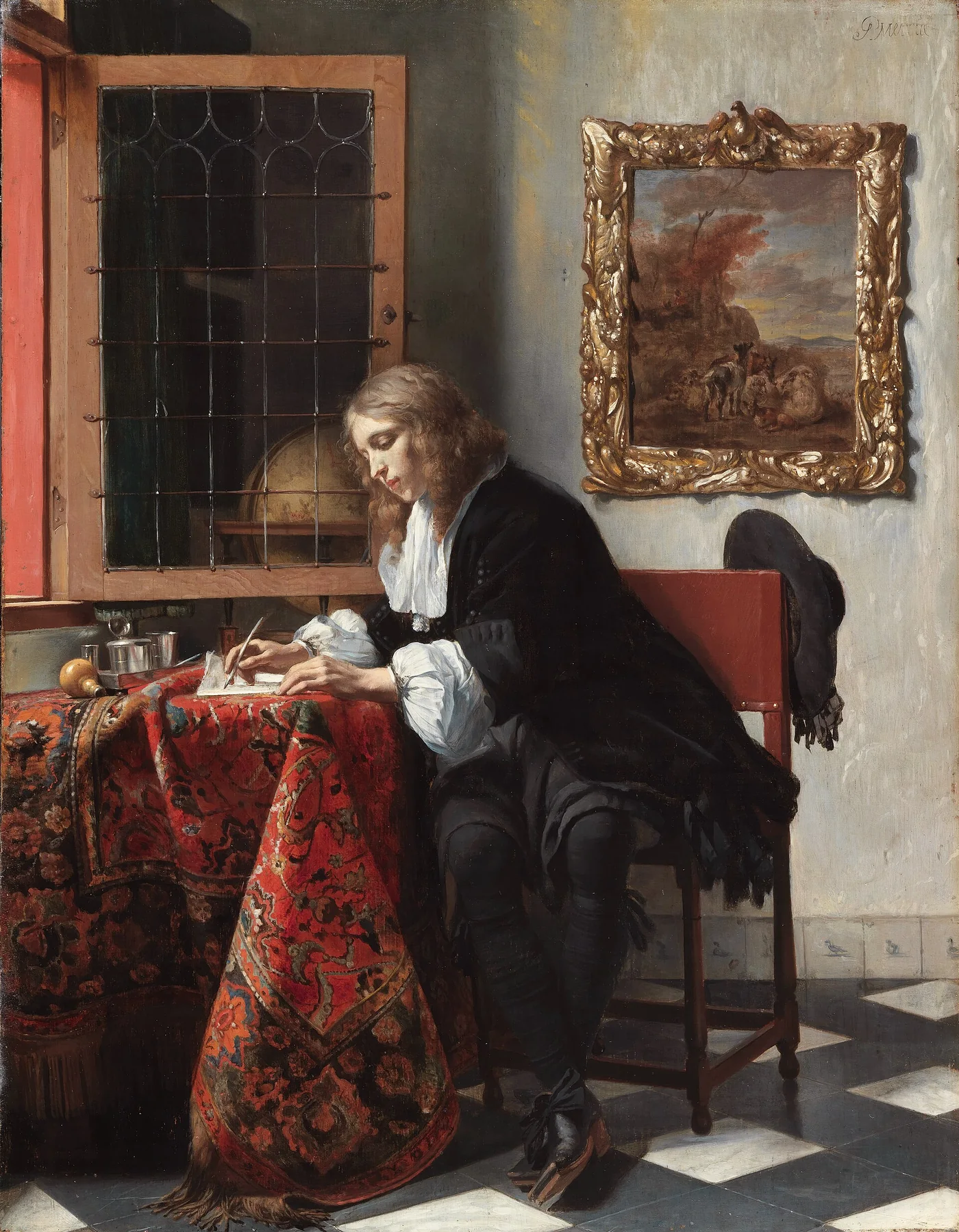
Man Writing a Letter
Gabriel Metsu, c. 1664
The gallery list
Every painting is already 50% off. Join the list and we will send you an extra $15 code, plus first access to new collections.
No spam. Unsubscribe anytime. · Privacy Policy
Welcome
Your $15 code is on its way. Explore the gallery while you wait.