Loading cart…
No products in the cart.

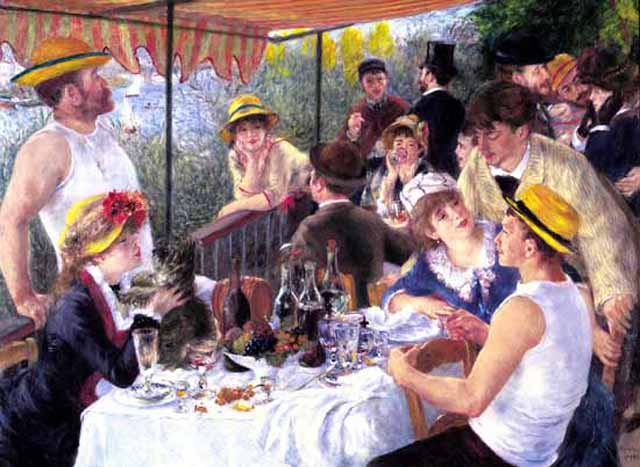
1880-1881 · Oil on canvas · The Phillips Collection, Washington D.C., United States
Save articles to your collection
Log in or create a free account, and this article will be waiting in your Private Collection.
Log in or sign upRenoir began work on this ambitious composition in the summer of 1880 and completed it by early 1881, describing it to his dealer Paul Durand-Ruel as the painting he most wanted to make at that time. The setting is the upper terrace of the Maison Fournaise, a popular establishment on an island in the Seine at Chatou, roughly fifteen kilometers from Paris. The restaurant was a well-known gathering place for boaters, artists, writers, and members of the Parisian bourgeoisie who sought leisure along the river on weekends. Renoir gathered a circle of real friends and acquaintances to pose for the figures in the scene, including the actress Jeanne Samary, the journalist Adolph Alphonse Fournaise, and Aline Charigot, who later became Renoir's wife. The inclusion of identifiable individuals gives the composition a documentary quality that distinguishes it from purely invented genre scenes.
The work was exhibited at the Seventh Impressionist Exhibition in 1882 and received considerable critical attention, with reviewers noting the scale and ambition of the canvas relative to earlier Impressionist works. Duncan Phillips acquired the painting in 1923 for the then-remarkable sum of 125,000 dollars, making it one of the most expensive purchases in American collecting at that time. Phillips considered it among the most important works in his collection and built a dedicated gallery to house it. The canvas represents a critical moment in Renoir's career when he was beginning to reassess the looseness of pure Impressionism and seeking a more structured approach to figure painting while still celebrating the pleasures of modern Parisian life.
The composition arranges approximately fourteen figures across the terrace in a carefully orchestrated yet seemingly spontaneous grouping. Renoir divides the scene into three loosely defined clusters, each centered on a different social exchange, allowing the viewer's eye to move continuously across the canvas without settling on a single focal point. The diagonal of the striped awning overhead creates a dynamic architectural frame that organizes the space without imposing rigidity. Light filters through the canopy and reflects off the tablecloth and glassware, generating the characteristic flickering luminosity associated with Renoir's Impressionist technique. The palette is warm and sun-drenched, dominated by whites, yellows, and soft reds that evoke the heat of a summer afternoon along the water.
Renoir handles the figures with greater solidity than in many of his contemporaneous outdoor scenes, paying careful attention to the physical weight and posture of each individual. Faces are rendered with enough specificity to suggest portraiture, yet they are embedded naturally within the larger social tableau. The still life of wine bottles, glasses, and fruit on the table in the foreground is painted with exceptional precision and anchors the lower register of the composition. The treatment of the river and foliage visible beyond the railing remains loose and atmospheric, creating a contrast between the defined social world of the terrace and the shimmering natural world beyond it. This tension between structure and spontaneity is central to the visual energy of the work.
The painting celebrates the culture of leisure that expanded significantly in France during the latter decades of the nineteenth century, particularly among urban workers and the middle classes who gained greater access to free time and inexpensive rail travel to the countryside. The gathering depicted is democratic in a meaningful sense, bringing together people of different professions and social standings united by the shared pleasure of food, wine, and conversation on a summer afternoon. Renoir consistently returned to themes of communal joy and sensory pleasure throughout his career, and this work represents one of the most fully realized expressions of that vision. The scene argues, through visual means, that happiness is accessible and real, grounded in the company of others and the enjoyment of the physical world.
The presence of Aline Charigot, shown in the lower left corner playing with a small dog, adds a personal dimension to the composition. She and Renoir were involved romantically at the time of the painting, and her inclusion suggests that the scene is not merely a social document but also an intimate record of a specific moment in Renoir's own life. The boating party setting, with its combination of physical activity, social mingling, and outdoor eating, embodied a modern Parisian ideal of the good life that Renoir found genuinely compelling. The painting does not idealize its subjects by removing them from the recognizable present but instead finds beauty in the ordinary textures of contemporary existence, which was a central ambition of the Impressionist project from its earliest formulations.
Enjoyed this story?
Save articles to your collection
Log in or create a free account, and this article will be waiting in your Private Collection.
Log in or sign up