Loading cart…
No products in the cart.

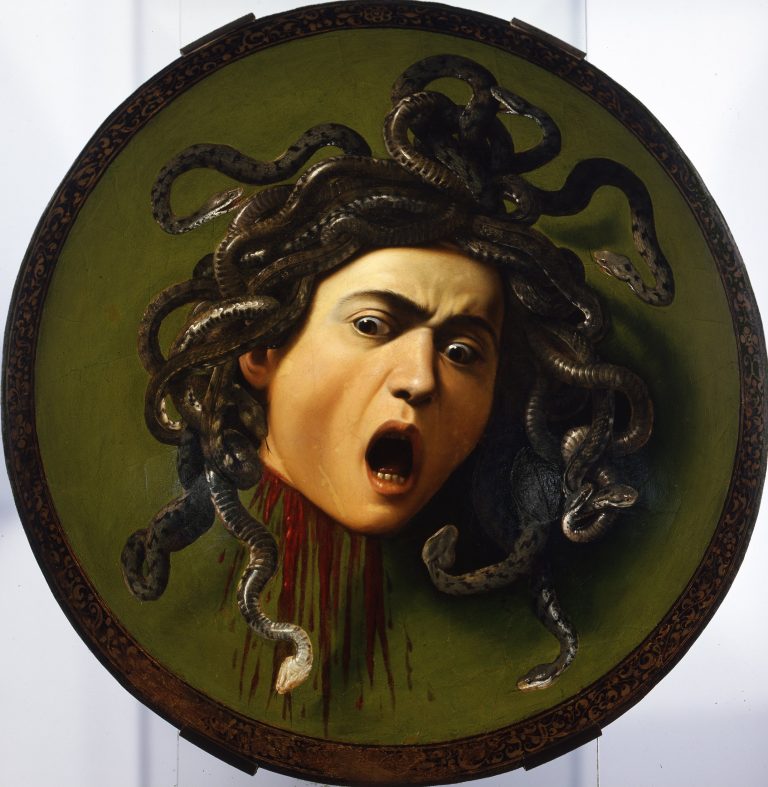
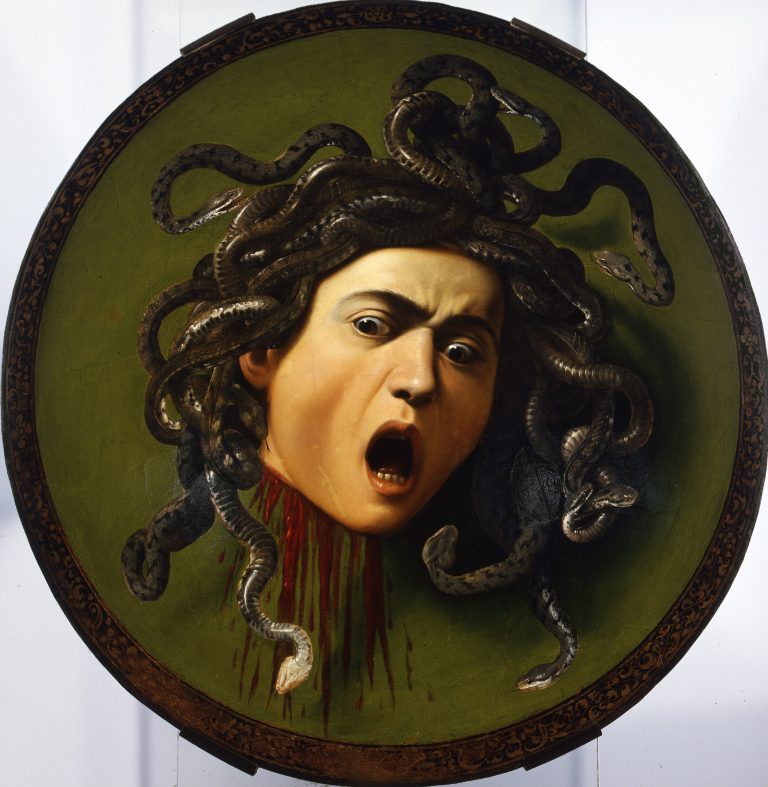
About 1597–1598 · Oil on canvas mounted on a convex wooden shield · Uffizi, Florence
Save articles to your collection
Log in or create a free account, and this article will be waiting in your Private Collection.
Log in or sign up Explore the artistCaravaggio →
Her mouth has fallen open. The eyes turn sideways beneath a deeply contracted brow. Around the face, snakes coil, twist and lift their small heads. Below it, thin red streams make the violence unmistakable. Yet the most disturbing part of Caravaggio’s Medusa is the impression that she has not had time to understand what has happened.
The painting isolates an impossible instant between a fatal blow and the end of awareness. No executioner appears. No landscape explains where the head has fallen. The face hangs against a green field, close enough for us to examine an expression that the myth says no living person should confront directly.
This is the Medusa shield in the Uffizi collection in Florence, painted around 1597–1598. It is an object as well as a picture: oil paint on canvas carried on a convex wooden shield, approximately 60 × 55 centimetres. The shaped support matters to the way the head appears suspended before us.
Medusa is one of the Gorgons of Greek mythology. Her gaze turns those who meet it to stone. Perseus overcomes that danger by approaching through a reflected image rather than looking straight at her. He beheads her; the terrible head subsequently becomes a protective emblem associated with Athena’s shield.
The Uffizi’s account stresses this connection between reflection, decapitation and the shield. Caravaggio gives the viewer the dangerous image in a form that can be looked at safely. The monster’s power has become a painted surface. That does not make the encounter feel comfortable.
Notice where the eyes point. They do not form a steady, symmetrical stare directed at us. Their sideways movement makes the expression seem caught in an unfolding event. We can look at Medusa because she seems preoccupied with something we cannot see.
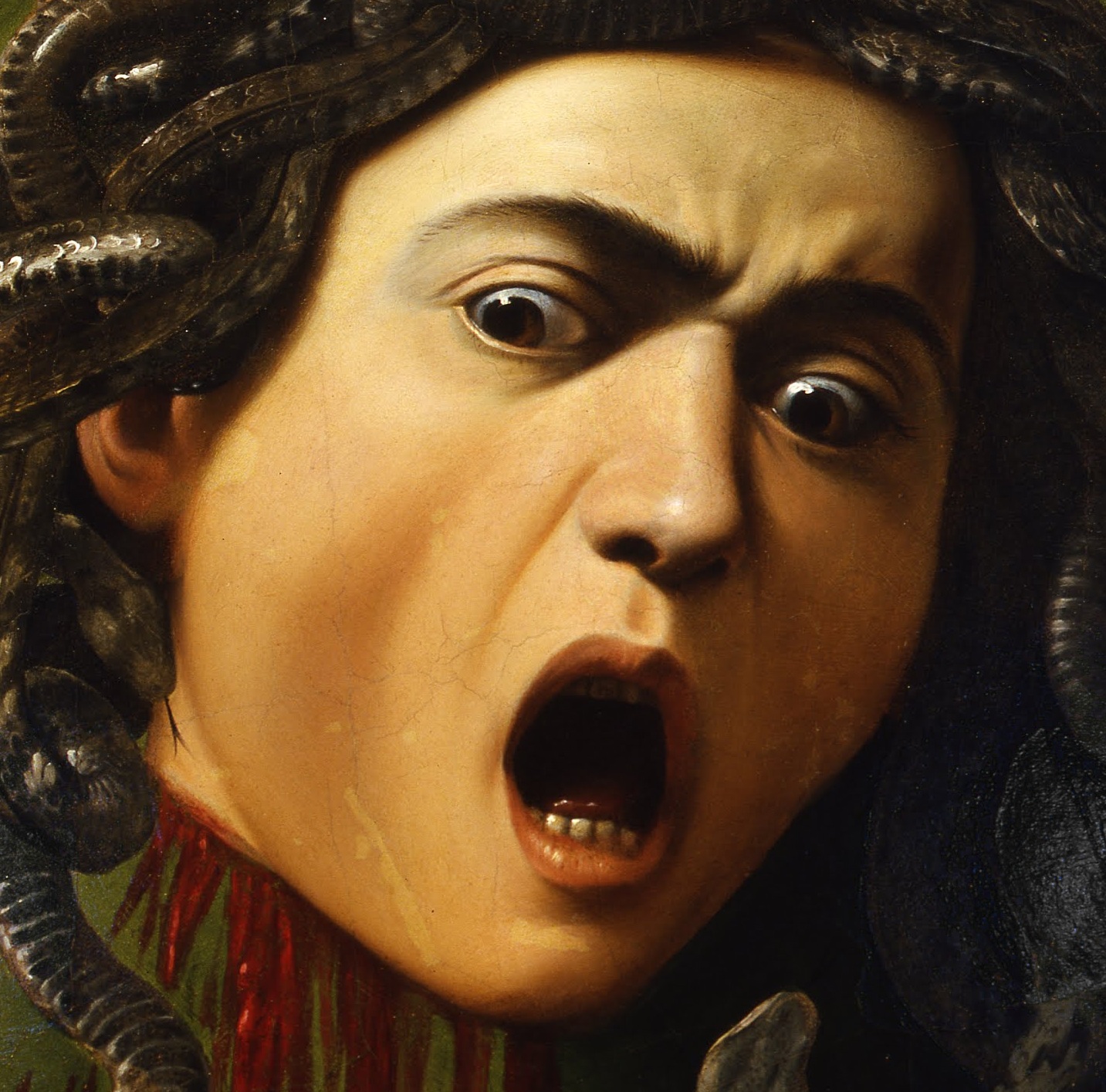
The mouth is dark inside, with the teeth and lower lip catching the light around it. That small opening gives the face a sense of breath and interrupted speech. Above it, the brows pull inward while one side of the face receives much stronger light than the other.
The skin has the unevenness of a living face. It is neither an ornamental mask nor a smooth theatrical ideal. The bent eyebrows, tense forehead and displaced gaze make recognition arrive before any explanation of the myth. We read alarm first and identify the famous monster afterwards.
Whether the expression suggests pain, astonishment or horror is partly the viewer’s response. It would go beyond the evidence to turn those impressions into Medusa’s precise thoughts. What the painting does show is muscular tension: this is a face actively changing, rather than a lifeless head calmly displayed.
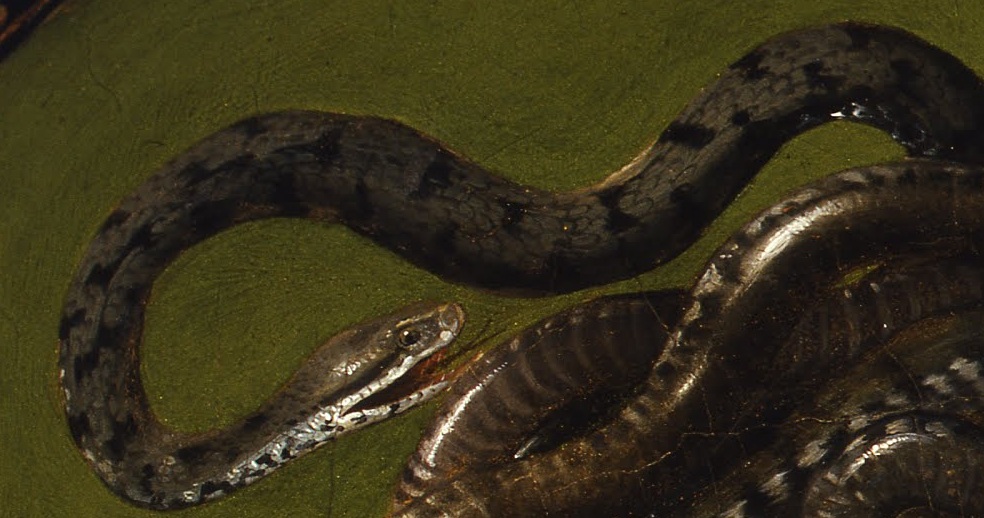
The living hair refuses the stillness of the severed head. Some bodies make tight loops; others extend into the green field. Their pale undersides and darker patterned backs separate one coil from another. Small glints keep the mass from becoming a single dark wig.
Look at the projecting snake heads. They give the perimeter an irregular rhythm, unlike the smooth oval of a conventional portrait. The movement continues after the event at the neck, keeping the picture restless even where the face seems held in place.
The snakes also expose Caravaggio’s control of different surfaces. Skin absorbs the light softly. Scales answer it with harder flashes. The green background is quieter than either. These distinctions make the fantastic subject feel materially convincing without requiring a natural setting.
Seen in a reproduction, Medusa can look like a round canvas. The Uffizi identifies the actual support as a ceremonial shield. Its outward curve gives the painted illusion a physical complication: the painter is making a head occupy convincing space on a surface that already projects towards the viewer.
The shadow beside the head helps distinguish it from the green field. Blood descends into that apparently empty space, while the snakes reach across it. We feel depth even though the object itself has very little room in which a severed head could exist.
The border encloses the violence within an expensive, controlled object. A terrifying face has become something that can be collected and presented. In the context of a shield, the ancient protective function of the Gorgon’s head remains legible: an image intended to frighten can also announce the power of the person who owns it.
This does not mean the surviving shield should be described as equipment Caravaggio painted for use in an actual battle. Its ceremonial and display character is essential to understanding the work.
The Uffizi’s interpretation identifies the face as a self-portrait. That reading gives the image a particularly unsettling possibility: the artist has placed his own appearance inside the defeated monster, rather than safely outside the scene.
A painted self-portrait is not a photograph, however, and the resemblance should not become a licence to invent a biographical confession. The work alone cannot tell us that Caravaggio felt guilty, feared an execution or intended a prediction of his death. Those are stories added to the image, not documented explanations of it.
What the interpretation does bring into focus is the difficulty of performing an expression. The face must look as though its reaction is involuntary, although every line of it is the result of deliberate observation and painting. The convincing shock is a carefully made illusion.
Caravaggio’s Bacchus offers a useful comparison. There, a youthful figure extends a glass towards the viewer. Here, a head confronts us with a shock. Both works reduce the distance between a mythological subject and a physically immediate encounter.
Medusa’s most lasting effect comes from that proximity. The ancient story promises petrification. The painting achieves a smaller, recognisable version of it: we stop before a face we know we should want to turn away from.
The shield discussed here belongs to the Uffizi Galleries in Florence.
It is generally dated around 1597–1598. Published catalogues vary slightly in their dating.
Yes. The painting is on canvas mounted on a convex wooden shield, rather than on an ordinary flat stretched canvas.
An earlier shield known as the Murtola Medusa is discussed separately in the scholarship. The image and details in this article all show the Uffizi version.
Faithful public-domain reproduction of Medusa, via Wikimedia Commons. Detail images are crops of the same historical painting; no reconstruction or upscaling.
Enjoyed this story?
Save articles to your collection
Log in or create a free account, and this article will be waiting in your Private Collection.
Log in or sign up
Man Writing a Letter
Gabriel Metsu, c. 1664
The gallery list
Every painting is already 50% off. Join the list and we will send you an extra $15 code, plus first access to new collections.
No spam. Unsubscribe anytime. · Privacy Policy
Welcome
Your $15 code is on its way. Explore the gallery while you wait.