Loading cart…
No products in the cart.

1598-1599 · Oil on canvas · Galleria Nazionale d Arte Antica, Rome, Italy

Save articles to your collection
Log in or create a free account, and this article will be waiting in your Private Collection.
Log in or sign upJudith Beheading Holofernes was painted between approximately 1598 and 1599, during a period when Caravaggio was working under the patronage of Cardinal Francesco Maria del Monte in Rome. The subject is drawn from the deuterocanonical Book of Judith, a text that had been popular in Italian art since the Renaissance, with notable earlier treatments by Donatello, Botticelli, and Artemisia Gentileschi, who would later produce her own celebrated version under the direct influence of Caravaggio work. The canvas remained in relatively private hands for many years before entering the collection of the Galleria Nazionale d Arte Antica at Palazzo Barberini in Rome, where it is now one of the institution most significant holdings.
The painting was confirmed as an autograph Caravaggio work through careful archival and technical research, and it has since become a central reference point in discussions of the artist approach to violent biblical subjects. The composition reflects the influence of northern European printmaking traditions while simultaneously transforming those sources through Caravaggio distinctive emphasis on physical immediacy and unidealized human figures. The work predates many of the large-scale public commissions that would define the later phase of his career, and it demonstrates the degree to which his mature style was already fully formed by the end of the sixteenth century.
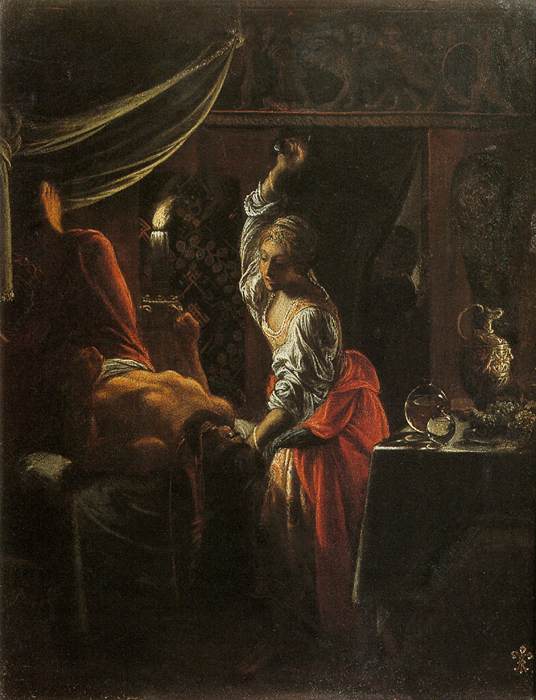
The formal organization of Judith Beheading Holofernes is structured around the dramatic interaction of three figures in tight proximity. Judith occupies the center of the composition, her posture tense with effort and her expression a mixture of resolve and slight repulsion. She leans slightly away from Holofernes even as she draws the blade through his neck, a detail that communicates the psychological distance she maintains between herself and the act she is performing. Holofernes, rendered with extraordinary anatomical specificity, grips the sheets in his final agony, his mouth open in a silent cry. To the right, the elderly maidservant Abra holds open a sack to receive the severed head, her deeply lined face watching with detached pragmatism.
Caravaggio use of a dark, undifferentiated background concentrates all visual attention on the three figures and the act unfolding between them. The chiaroscuro is deployed to maximum expressive effect, with the pale flesh of Judith and Holofernes illuminated against the darkness while Abra recedes slightly into shadow. The blood issuing from the wound is painted with clinical precision, and the textures of fabric, skin, and hair are rendered with the same careful attention Caravaggio brought to his still-life elements. This refusal to aestheticize violence was considered bold in its own time and remains one of the defining characteristics of this particular composition.
The meaning of Judith Beheading Holofernes operates on multiple levels, combining political allegory, moral instruction, and gender dynamics within a single image. In the biblical narrative, Judith is a widow of Israel who infiltrates the camp of the Assyrian general Holofernes, seduces him with her beauty, and kills him while he is drunk and sleeping, thereby saving her people from conquest. The subject carried strong resonance in Counter-Reformation Rome, where stories of individual courage in service of religious community were particularly valued. Judith was frequently read as a type of the Church triumphant over heresy and military threat, and Caravaggio representation emphasizes her agency and determination rather than her vulnerability.
The psychological complexity of the image distinguishes it from more triumphalist representations of the same subject. Caravaggio Judith does not exult in her act. Her expression communicates a sober understanding of what she is doing and why it is necessary, rather than any pleasure in the violence itself. This moral seriousness elevates the work beyond simple celebration of female heroism and invites reflection on the conditions under which violence can be justified. The tension between the beauty of the figures and the brutality of the act being depicted creates a sustained moral discomfort that aligns with the broader Counter-Reformation interest in using art to provoke genuine spiritual engagement rather than passive admiration.
Enjoyed this story?
Save articles to your collection
Log in or create a free account, and this article will be waiting in your Private Collection.
Log in or sign up