Loading cart…
No products in the cart.

c. 1899 · Oil on canvas · Musée d’Orsay, Paris, France
Save articles to your collection
Log in or create a free account, and this article will be waiting in your Private Collection.
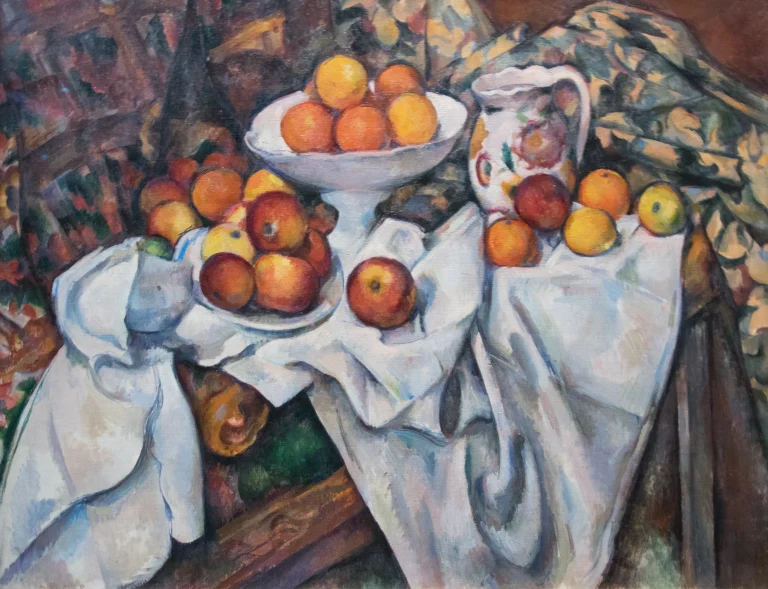
Log in or sign upAt first glance, Still Life with Apples and Oranges looks abundant and calm. Apples and oranges fill two dishes, a floral jug rises at the right, and white cloth spreads across the table. Look longer and the room begins to shift. The tabletop tips toward us, the dishes do not share one horizon, and the folds seem to push the fruit forward.
This is not careless drawing. Paul Cézanne lets several acts of looking exist in the same painting. We see the fruit bowl almost from the front, the plates more clearly from above, and the jug from another position again. The result feels stable enough to believe and unstable enough to keep the eye moving.

The raised white compotier is the composition's anchor. Its curved rim encloses a compact group of oranges, but the ellipse is deliberately difficult to reconcile with the base below. Cézanne gives the bowl the clarity it needs to hold the picture together without forcing it into strict optical perspective.
The fruit gains volume through neighboring colors. Yellow, orange, red and green meet in short, visible strokes. Dark contours appear, disappear and return, so each piece of fruit feels built rather than smoothly modelled.

The decorated earthenware jug introduces curves, floral ornament and a tall vertical accent. Its mouth, handle and body do not settle into a single viewpoint. Instead, each part is adjusted to remain legible within the crowded arrangement.
The jug also joins foreground and background. Its pale surface catches the whites of the cloth, while its red, green and yellow decoration repeats colors from the fruit and patterned textile. Cézanne turns an ordinary household object into a hinge for the entire composition.

The cloth is more than a backdrop for the fruit. Its folds behave like slopes, ledges and valleys. They divide the tabletop into a sequence of planes and guide the eye from the lower edge toward the bowl and jug.
White is never simply white here. Blue, green, violet, rose and grey strokes describe reflected light and shadow. The cloth links the separate objects while making the space beneath them feel active and uncertain.


The lower plate is one of the clearest demonstrations of Cézanne's method. Its rim opens toward us more than a conventional view would allow, revealing the apples while preserving their weight. A loose apple to the right appears to rest on another level, increasing the sensation that the table has been assembled from several moments of observation.

Painting from nature is not copying the object, it is realizing one's sensations.
Paul Cézanne
The Musée d'Orsay dates the work to about 1899 and identifies it as part of a group of six still lifes painted in Cézanne's Paris studio. The same earthenware dishes, floral jug, fruit and textiles reappear in changing arrangements. Repetition gave the artist a controlled set of objects through which he could test color, balance and spatial construction.
The draped textile also recalls the theatrical abundance of seventeenth-century Flemish still life painting. Cézanne keeps that sense of richness, then replaces polished illusion with a more openly constructed surface.
The painting belonged to the critic and novelist Gustave Geffroy before passing through the Paris gallery Bernheim-Jeune in January 1907. Collector Isaac de Camondo acquired it in May of that year. His 1911 bequest brought the work into the French national collection.
After periods at the Louvre and the Jeu de Paume, the painting entered the Musée d'Orsay in 1986. It is catalogued as RF 1972. Display locations can change, so visitors should consult the museum's current object page before travelling.
Cézanne did not abandon observation. He slowed it down and allowed the picture to record how vision changes as the eye moves. The sloping table, altered ellipses and faceted cloth show that a painting can remain convincing without pretending that the viewer occupied one fixed point.
This approach became crucial for later modern painters. Artists associated with Cubism pushed its implications further, breaking objects and spaces into multiple planes. In this still life, that future is already present in quiet form: fruit, crockery and cloth become a complete investigation of how pictures organize sight.
Enjoyed this story?
Save articles to your collection
Log in or create a free account, and this article will be waiting in your Private Collection.
Log in or sign up