Loading cart…
No products in the cart.

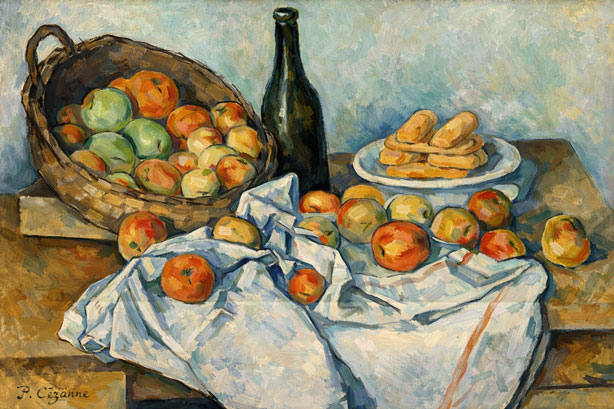
c. 1893 · Oil on canvas · Art Institute of Chicago, Chicago, United States
Save articles to your collection
Log in or create a free account, and this article will be waiting in your Private Collection.
Log in or sign upThe Basket of Apples was painted in Cezanne studio in Aix-en-Provence during the early 1890s, a period of intense focus on still-life composition. Cezanne gave the work to his childhood friend and literary champion Emile Zola before a falling out between the two men complicated their relationship. The painting eventually entered the collection of the Chicago art dealer and patron Frederic Clay Bartlett, who donated it to the Art Institute of Chicago in 1926, where it has remained ever since as one of the most studied works in the institution. The historical significance of this painting extends well beyond its decorative qualities. By the time Cezanne completed it, he had spent decades refining his approach to representing solid objects in space, and this work represents a culmination of those investigations. Contemporary critics largely ignored Cezanne during his lifetime, but younger painters including Pablo Picasso and Georges Braque later cited compositions such as this one as foundational references for the development of Cubism. The painting is therefore not merely a record of fruit and cloth but a document of a pivotal transition in the history of Western art.
The most immediately striking feature of the composition is its deliberate rejection of a unified perspective. The table surface appears to tilt forward on the left side while remaining level on the right, creating two separate spatial zones within a single scene. The basket of apples leans at an angle that would be physically unstable in reality, yet within the logic of the painted surface it feels resolved and intentional. Cezanne achieves this by treating each object as a self-contained study, observed from a slightly different viewpoint and then assembled into a coherent pictorial whole rather than a transcription of a single moment of vision. Cezanne handling of color in this painting is equally significant. The apples are rendered in short, directional brushstrokes that model their spherical volumes through gradations of red, yellow, and green rather than through conventional chiaroscuro. The white cloth cascading across the table is constructed from layered strokes of cream, blue-gray, and pale violet, giving the fabric a structural weight that rivals the solidity of the fruit. The dark wine bottle anchors the upper right of the composition, its cylindrical form contrasting with the irregular organic shapes of the apples and establishing a rhythmic dialogue across the canvas.
At a deeper level, The Basket of Apples embodies Cezanne lifelong philosophical inquiry into the nature of seeing. Rather than painting what he knew an object to be, Cezanne committed himself to recording what he actually perceived during prolonged observation, a process that revealed the fundamental instability of visual experience. The tilted table and the leaning basket are not errors of draftsmanship but honest records of how the eye moves across a scene and synthesizes multiple impressions over time. This approach placed Cezanne in direct opposition to the academic tradition and anticipated twentieth-century ideas about the subjectivity of perception. The choice of humble domestic objects carries meaning as well. Cezanne returned to apples throughout his career, and scholars have noted that these familiar fruits allowed him to focus entirely on formal problems without the social or narrative expectations attached to figure painting or landscape. The basket, the bottle, and the draped cloth become vehicles for investigating light, volume, color relationships, and spatial logic. In this sense the painting operates as both a visual argument and a record of sustained intellectual labor, demonstrating that the most ordinary subjects can sustain the most rigorous pictorial investigation.
Enjoyed this story?
Save articles to your collection
Log in or create a free account, and this article will be waiting in your Private Collection.
Log in or sign up