Loading cart…
No products in the cart.

1898 to 1905 · Oil on canvas · Philadelphia Museum of Art, Philadelphia, United States
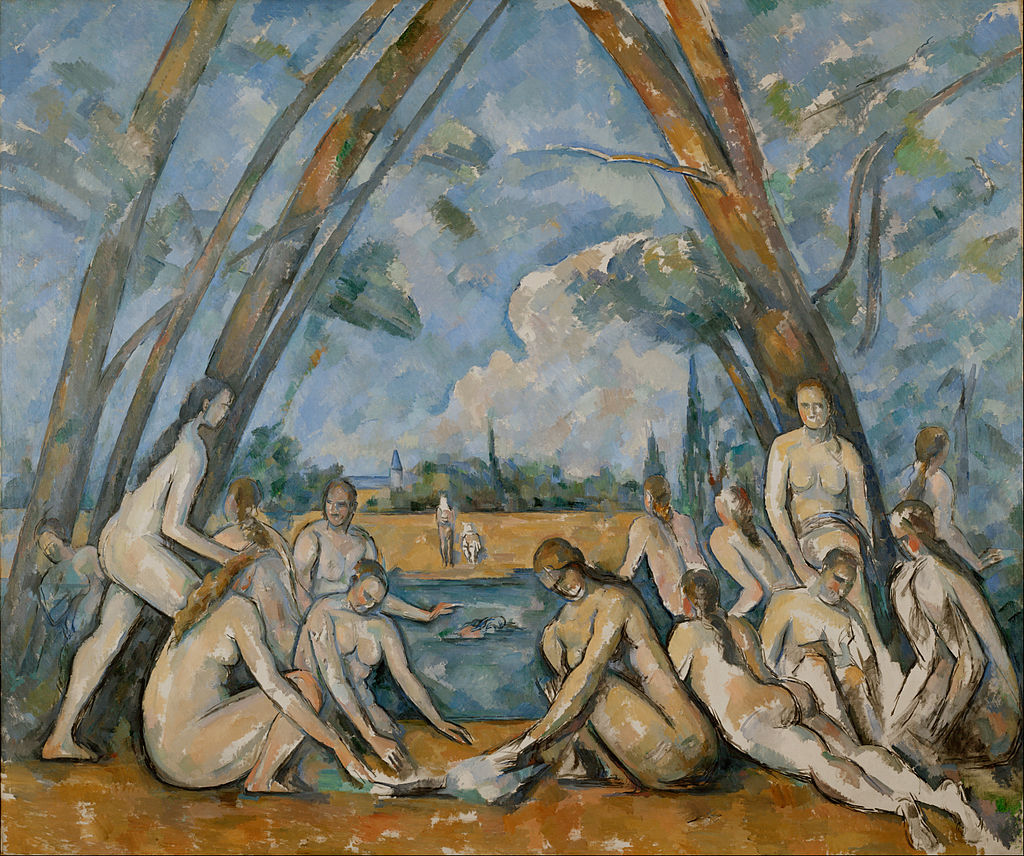
The subject of bathers in a landscape occupied Cezanne from the earliest years of his career until the very end of his life. He worked on three large-scale Bathers canvases in the final decade of his life, of which the Philadelphia painting is the largest and the most complex. He began work on it around 1898 and continued to develop it until shortly before his death in 1906, meaning the canvas occupied him for approximately seven years. This extended period of labor is evident in the painting itself, where passages of varying finish and different degrees of resolution coexist across the surface, creating a work that feels simultaneously complete and perpetually in process. Because Cezanne worked primarily in Aix-en-Provence and did not have access to professional models willing to pose nude in outdoor settings, the figures in the Bathers series were not drawn from direct observation in the way his still-life subjects or his landscapes were. Instead, he drew on a combination of memory, imagination, drawings made after sculptural casts, and sketches from earlier in his career. He reportedly made use of works from the Louvre as visual references, including figures from paintings by Nicolas Poussin and Peter Paul Rubens. The Philadelphia canvas was acquired by the museum in 1937 and has been central to the posthumous reputation of Cezanne, frequently appearing in major exhibitions devoted to Post-Impressionism and to the origins of modern art. Its scale alone sets it apart from the majority of the work of Cezanne and signals an ambition to compete with the grand tradition of monumental figure painting that stretched back through French academic art to the Italian Renaissance.
The composition of The Large Bathers is organized around a triangular armature formed by the arching trees that rise from either side of the canvas and converge toward the top center, framing a pale strip of sky and water in the distance. The figures are arranged along the base of this triangle, distributed across the foreground in a loosely frieze-like arrangement that recalls classical relief sculpture while remaining entirely personal in its handling. No single figure dominates, and the viewer is not guided toward one particular point of focus. Instead, the eye moves across the ensemble, encountering individual figures in various poses of reclining, sitting, and standing, each one rendered with the same constructive stroke and the same limited palette of blue, grey-green, ochre, and warm flesh tones that Cezanne used throughout the late period. The bodies are not idealized in a conventional academic sense. They are substantial and somewhat angular, built from planes of color rather than from smooth tonal gradients, and they possess a physical weight and presence that is quite different from the graceful nudes of the French academic tradition. The landscape setting is handled in a similar register to the figures, so that the boundary between the human forms and the natural environment feels permeable. The trees seem to grow partly from the same painterly logic as the bodies, and the water in the background rhymes chromatically with passages of the sky visible through the foliage. This integration of figure and landscape is one of the most discussed aspects of the painting. You can own this as a hand-painted oil reproduction and bring its remarkable formal energy into your living space.
The Large Bathers occupies a singular position in the history of Western figure painting. It is simultaneously a summation of a lifetime of inquiry into the relationship between the human figure and the natural world, and a declaration of the possibility of a new kind of monumental painting rooted not in mythological narrative or academic convention but in the direct confrontation between the painter and the challenge of form. The absence of a specific narrative or mythological subject is significant. The figures do not tell a story in the traditional sense. They exist in a timeless, almost pastoral space that is neither fully real nor fully imagined, suspended between the observed world and the constructed world of the picture. This quality of suspension, of existing between categories, is central to the meaning of the work. Critics and art historians have written extensively about the relationship between The Large Bathers and the work of artists who came after. Henri Matisse studied it closely before developing his own figure compositions, including his celebrated work Le Bonheur de Vivre. Pablo Picasso acknowledged it as one of the key reference points for Les Demoiselles d'Avignon, his landmark work of 1907 that is widely considered a founding moment of Cubism. The Philadelphia canvas thus functions as a hinge point in the history of art, connecting the tradition of the old masters that Cezanne revered with the radical experiments of the twentieth century that his painting made possible. Owning a hand-painted oil reproduction of The Large Bathers means living alongside one of the most consequential images in the entire history of painting.