ByMuseum.com

USD
  • USD
  • EUR
Artist
Paul Cezanne
Paintings
11 deep-dives
Artist profile
All paintings
Paul Cezanne Paintings: Famous Works as Hand-Painted Oil Reproductions
Post-Impressionism · French · 1839 to 1906

Paul Cezanne

BornJanuary 19, 1839, Aix-en-Provence, France
MovementPost-Impressionism
Known forThe Card Players, Mont Sainte-Victoire, The Large Bathers
~900paintings
Post-ImpressionismFrench Painters
Artist guide · 11 most famous paintings

Paul Cezanne Paintings: His Most Famous Works as Hand-Painted Oil Reproductions

Imagine standing before a canvas where a mountain does not merely sit in the distance but seems to breathe, to press forward through layered planes of blue, green, and ochre, as if the act of seeing itself has been made…

Who was Paul Cezanne?

Imagine standing before a canvas where a mountain does not merely sit in the distance but seems to breathe, to press forward through layered planes of blue, green, and ochre, as if the act of seeing itself has been made visible. That painting is one of many renditions of Mont Sainte-Victoire, a limestone peak near Aix-en-Provence, and the man who returned to it dozens of times over the final decades of his life was Paul Cezanne. Born in 1839 into a prosperous banking family in the south of France, Cezanne spent much of his career in a state of restless, almost obsessive inquiry into the nature of form, space, and perception. He studied law briefly to appease his father before abandoning that path and traveling to Paris, where he encountered the Impressionists and befriended Camille Pissarro, who became a formative influence on his development as a painter. Yet Cezanne was never content to dissolve form into light the way Claude Monet did. He wanted something more enduring, something structural beneath the shimmer of sensation.

Cezanne spent long periods working in isolation at his family estate, the Jas de Bouffan, and later in a purpose-built studio north of Aix. He submitted work to the Salon repeatedly and was rejected just as repeatedly, facing ridicule even from critics who admired his contemporaries. Recognition came slowly and, in certain respects, only fully after his death in 1906. Yet the painters who followed him, from Pablo Picasso and Georges Braque to Henri Matisse, were unambiguous about what he had given them. He had shown that a painting could be simultaneously a faithful record of visual experience and a rigorous construction of interlocking geometric relationships. He called himself a primitive of a new art, and that phrase captures something essential: not a beginning in naivety, but a deliberate return to foundations, a willingness to dismantle inherited conventions in order to rebuild the act of painting on more honest and more durable ground.

What defines Paul Cezanne style

The technique of Cezanne defies easy categorization because it operates on multiple registers simultaneously. On the surface, his brushwork consists of short, directional strokes laid side by side in patches, a method often described as his constructive stroke. These patches of color do not blend smoothly into one another but remain distinct, each one a unit of both color and spatial information. Looking at a passage of sky or rock in one of his landscapes, a viewer can see how each stroke carries a slight variation in hue and value, and how those variations collectively produce a sense of volume and recession that conventional atmospheric perspective would achieve through tonal graduation alone. Cezanne was deeply interested in the way warm and cool colors advance and recede in the visual field, and he used that phenomenon structurally, building three-dimensional form through chromatic tension rather than through light and shadow in the traditional sense. His palette in the mature period leans heavily on blue, green, yellow-ochre, and terre verte, with warm passages of orange and sienna activating surfaces and suggesting solidity.

Equally important to understanding the visual language of Cezanne is his treatment of multiple viewpoints within a single picture. Unlike the single-point perspective codified during the Renaissance, the spaces in the work of Cezanne sometimes shift subtly from one part of the canvas to another, as if the painter had looked at the subject from slightly different positions over time and recorded each observation without forcing them into artificial unity. A table in one of his still-life paintings may appear to tilt at an angle inconsistent with the bowl resting upon it, yet the overall composition holds together with remarkable coherence. This was not error or naivety but a deliberate effort to record the full complexity of sustained visual attention. It is precisely this quality that made his paintings so generative for the artists of the twentieth century who followed him.

Hand-painted · Not printed
Own a Paul Cezanne. The real way.
Every reproduction is painted by hand in oil on canvas. The brushstrokes are real. That is the difference.
Browse Paul Cezanne paintings

Paul Cezanne most famous paintings

Each card links to its own article with full analysis and reproduction details.

The Card Players by Frederick Arthur Bridgeman - hand-painted oil reproduction #1
The Card Players
1894 to 1895 · Musee d'Orsay, Paris, France
The Card Players is a monumental study of concentration and rural dignity, depicting two men absorbed in a game of cards at a simple wooden table.
Analysis and reproduction
Still Life with Apples and Oranges by Paul Cezanne - hand-painted oil reproduction #2
Still Life with Apples and Oranges
1899 · Musee d Orsay, Paris, France
Paul Cezanne composed this richly layered still life to investigate the structural relationships between fruit, fabric, and pictorial space using his signature method of multiple viewpoints.
Analysis and reproduction
Boy in a Red Waistcoat by Paul Cezanne - hand-painted oil reproduction #3
Boy in a Red Waistcoat
1888-1890 · National Gallery of Art, Washington D.C., United States
Paul Cezanne painted this contemplative portrait of a young Italian boy during a period of intense focus on the human figure, using structured brushwork and a rich palette to explore form and psychological stillness.
Analysis and reproduction
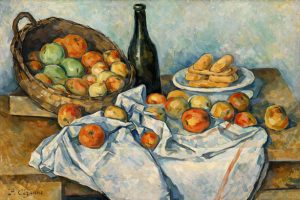
The Basket of Apples by Paul Cezanne, hand-painted oil reproduction #4
The Basket of Apples
c. 1893 · Art Institute of Chicago, Chicago, United States
Cezanne painted this celebrated still life around 1893, arranging fruit, a tilted basket, a bottle, and cloth on a table to explore the tension between perception and pictorial structure.
Analysis and reproduction
The Bather by William Bouguereau - hand-painted oil reproduction #5
The Bather
c. 1885 · Museum of Modern Art, New York, USA
This monumental standing male figure represents Cezanne's decades-long investigation into the human form placed within a natural landscape setting.
Analysis and reproduction
Mont Sainte-Victoire by Paul Cezanne - hand-painted oil reproduction #6
Mont Sainte-Victoire
1902 to 1904 · Philadelphia Museum of Art, Philadelphia, United States
The Philadelphia version of Mont Sainte-Victoire is among the most fully resolved of the late series, presenting the mountain as a luminous structure built from interlocking planes of color against a vibrant blue sky.
Analysis and reproduction
Farmhouse in Provence by Vincent Van Gogh - hand-painted oil reproduction #7
House in Provence
c. 1886-1890 · National Gallery of Art, Washington D.C., USA
This structured landscape painting demonstrates Cezanne's method of organizing the visual world into geometric planes of color that reveal the underlying architecture of nature.
Analysis and reproduction
The Large Bathers by Paul Cezanne - hand-painted oil reproduction #8
The Large Bathers
1898 to 1905 · Philadelphia Museum of Art, Philadelphia, United States
The Large Bathers is the most ambitious and fully realized work in the extended series of bather compositions by Cezanne, presenting a group of female figures arranged within a landscape in a composition of monumental, almost architectural grandeur.
Analysis and reproduction
Self-Portrait with a Bowler Hat by Paul Cezanne - hand-painted oil reproduction #9
Self-Portrait with a Bowler Hat
c. 1885-1886 · Ny Carlsberg Glyptotek, Copenhagen, Denmark
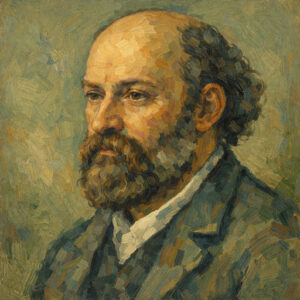
This reserved and structurally rigorous self-portrait shows Cezanne examining his own face with the same analytical detachment he brought to still life objects and Provencal landscapes.
Analysis and reproduction
Das Meer bei lEstaque by Paul Cezanne - hand-painted oil reproduction #10
The Gulf of Marseille Seen from LEstaque
c. 1885 · The Metropolitan Museum of Art, New York, USA
This sweeping view of the Mediterranean coast from the hillside village of LEstaque captures Cezanne's ability to render vast spatial depth through pure chromatic and planar organization.
Analysis and reproduction
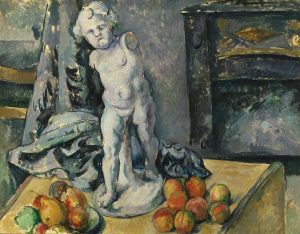
Still Life with Plaster Cupid by Paul Cezanne - hand-painted oil reproduction #11
Still Life with Plaster Cupid
c. 1894 · Courtauld Gallery, London, United Kingdom
This philosophically layered still life places a plaster cast of a cupid among fruits and painted canvases, raising complex questions about representation, reality, and the nature of the painted image itself.
Analysis and reproduction

Why hand-painted, not printed

A print can reproduce colors. What it cannot reproduce is texture, depth, and the physical presence of oil paint on canvas. Paul Cezanne technique depends on these.

At ByMuseum, every reproduction is painted by hand using oil on canvas. There is no inkjet, no digital print. The brushwork is real. The result looks like a painting because it is one.

Read: how our hand-painted reproductions are made

ByMuseum Editorial
Art history desk · ByMuseum

Written and fact-checked by the ByMuseum editorial team: art historians and painters who research each work from museum records and catalogues raisonnés, then explain how it is recreated by hand in oil on canvas.