Loading cart…
No products in the cart.

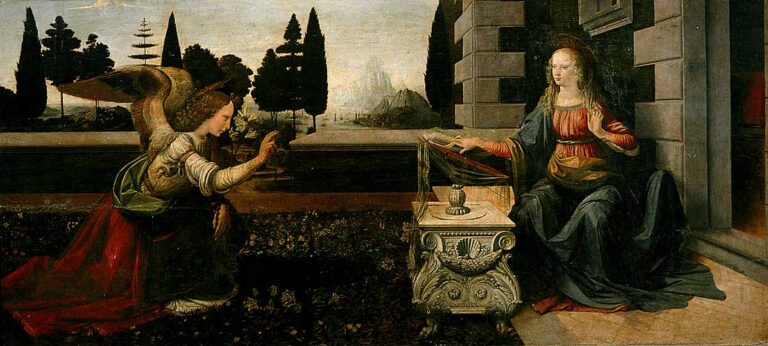
c. 1472 to 1476 · Oil and tempera on panel · Uffizi Gallery, Florence, Italy
Save articles to your collection
Log in or create a free account, and this article will be waiting in your Private Collection.
Log in or sign upThe Annunciation is one of the earliest paintings attributed to Leonardo da Vinci, produced during his years as a pupil and later an independent collaborator in the workshop of Andrea del Verrocchio in Florence. The precise attribution of the work has been debated by scholars for many years, with some arguing for a collaborative origin involving both Leonardo and Verrocchio, and others proposing that Leonardo was the primary author with possible contributions from workshop assistants in specific passages. The current scholarly consensus attributes the majority of the painting to Leonardo on the basis of stylistic analysis, underdrawing studies using infrared reflectography, and comparisons with other works from this period.
The painting was recorded in the collection of the monastery of San Bartolomeo a Monte Oliveto near Florence before entering the Uffizi Gallery, where it has been displayed since the late nineteenth century. The large horizontal format of the panel is unusual for an Annunciation scene, which was more commonly rendered in a vertical or square format during this period, and suggests that the work may have been intended for a specific architectural setting such as a sacristy or a chapel with particular spatial requirements. Technical examination of the panel has revealed revisions in the underdrawing, indicating that Leonardo adjusted the composition during the painting process, particularly in the positioning of the Virgin's reading stand and her right arm.
The composition of the Annunciation divides the pictorial space into two distinct zones separated by the reading stand that stands at the center of the panel. To the left, the Archangel Gabriel kneels on a lawn before a low garden wall, his multicolored wings spread behind him and a white lily, the traditional symbol of purity, held in his left hand. To the right, the Virgin Mary sits before a Renaissance palazzo, her right hand raised in a gesture of surprise or acceptance while her left rests on an open book. The architectural setting behind the Virgin, with its carefully rendered pilasters and moldings, demonstrates Leonardo's interest in perspectival construction, though scholars have noted that the proportions of the reading stand are not fully consistent with the spatial recession of the rest of the composition.
The landscape visible beyond the garden wall in the background is one of the most accomplished passages in the painting, featuring a receding vista of mountains rendered with atmospheric perspective, the technique of using paler and cooler tones to represent distant forms. This treatment of the background landscape anticipates the more fully developed atmospheric effects of Leonardo's later works. The angel's wings, which have been cited as an early example of Leonardo's practice of studying natural specimens, show an attempt to render feathers with more anatomical accuracy than was conventional in Florentine painting of the period, though they remain more decorative than strictly naturalistic when compared with the wing studies preserved in his notebooks.
The Annunciation scene was one of the most frequently depicted subjects in Italian Renaissance painting, valued both for its theological significance as the moment when divine and human history intersected, and for its artistic potential as a scene of encounter between two contrasting figures. For Leonardo, working early in his career within the established conventions of Florentine religious painting, the subject offered an opportunity to demonstrate his command of compositional arrangement, architectural perspective, and the depiction of natural detail. The choice to set the scene in a walled garden, a traditional symbol of the Virgin's purity derived from the biblical Song of Solomon, connects the painting to a long tradition of Marian iconography while allowing Leonardo to display his interest in the rendering of plant life and landscape.
The emotional register of the painting is notably restrained compared with some earlier Florentine treatments of the same subject, in which the Virgin often recoils dramatically from the angel. Here, the Virgin's gesture suggests composed acceptance rather than shock, communicating a theological reading of the event that emphasizes her willing participation in the divine plan. The angel, similarly, kneels with ceremonial dignity rather than urgent energy, making the encounter feel like a formal ritual as much as a sudden interruption. This tonal control, which moderates emotional expression in favor of dignified reserve, is characteristic of Leonardo's approach to narrative subjects throughout his career and distinguishes his work from the more expressive tendencies of some of his contemporaries.
Enjoyed this story?
Save articles to your collection
Log in or create a free account, and this article will be waiting in your Private Collection.
Log in or sign up