Loading cart…
No products in the cart.

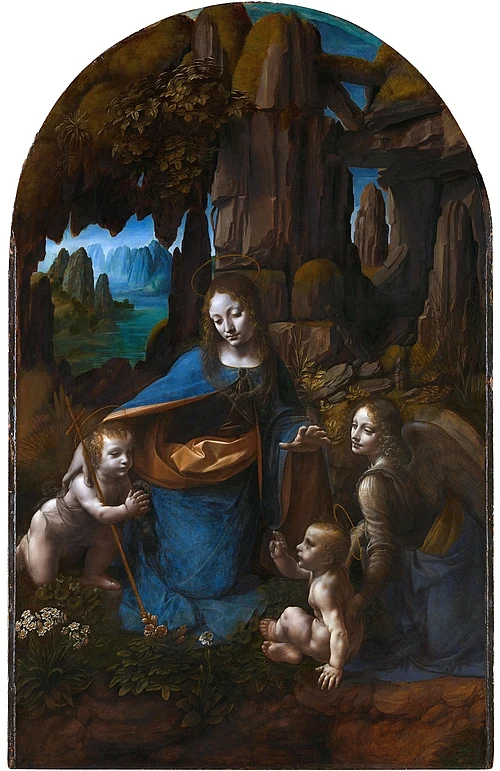
c. 1483 to 1486 (Louvre version) · Oil on panel · Louvre Museum, Paris, France
Save articles to your collection
Log in or create a free account, and this article will be waiting in your Private Collection.
Log in or sign upThe Virgin of the Rocks exists in two versions, both attributed in large part to Leonardo da Vinci. The earlier version, housed at the Louvre in Paris, was begun around 1483 shortly after Leonardo relocated from Florence to Milan at the invitation of Ludovico Sforza. The painting was commissioned by the Confraternity of the Immaculate Conception for the chapel of San Francesco Grande in Milan, intended as the central panel of a large altarpiece. The commission contract, which survives, specified a complex program involving multiple figures and detailed iconography, and Leonardo interpreted these requirements with considerable creative independence, producing a composition that departed significantly from conventional altarpiece traditions of the period. The relationship between the two versions of the painting has been a subject of scholarly debate for generations. The Louvre panel was apparently retained by Leonardo and eventually made its way to France, while a second version now at the National Gallery in London was produced to fulfill the original commission after disputes arose over payment and the terms of the contract. Documents from the 1490s record a protracted legal disagreement between Leonardo and the confraternity, suggesting that the first version was either sold separately or withheld as leverage during negotiations. The London version, completed with the assistance of Leonardo's workshop, differs in several details including the presence of halos and the angel's pointing gesture, modifications that may reflect adjustments made to satisfy the confraternity's theological requirements.
The composition of the Virgin of the Rocks arranges its four figures in a triangular grouping within a cavernous landscape of dark rock formations and shallow pools. The Virgin occupies the apex of the triangular arrangement, her right arm extending protectively toward the infant John the Baptist while her left hand hovers above the infant Christ. An angel at the right edge of the group turns outward toward the viewer with a direct gaze, creating a connection between the sacred scene and the observer that was uncommon in devotional painting of the era. The rocky grotto setting, unlike the architectural or garden backgrounds typical of contemporary Florentine religious painting, creates an atmosphere of enclosure and mystery. Leonardo applied his technique of sfumato with particular sophistication throughout this painting, using imperceptible gradations of tone to model the figures so that they appear to emerge from the surrounding shadow rather than being illuminated by a clearly defined external light source. The plants rendered in the foreground, including columbine and other botanically identifiable species, reflect his practice of studying natural specimens directly rather than relying on conventional pictorial formulas. The light within the grotto seems to emanate from an unspecified source, giving the figures an internal luminosity that reinforces their spiritual status while simultaneously grounding them in a convincingly physical setting.
The iconographic program of the Virgin of the Rocks centers on the theological concept of the Immaculate Conception, the doctrine that the Virgin Mary was preserved from original sin from the moment of her own conception. This doctrine was of particular importance to the Confraternity of the Immaculate Conception, who commissioned the work, and Leonardo embedded references to this belief throughout the composition. The rocky grotto, which has no clear precedent in the written Gospels, may derive from apocryphal narratives describing an encounter between the infant Christ and the infant John the Baptist during the Holy Family's flight into Egypt, giving the painting a narrative specificity beyond simple devotional portraiture. The angel's outward gaze and pointing gesture introduce a didactic element into the composition, directing the viewer's attention toward the Christ child and implicitly instructing the faithful in the proper object of their veneration. The Virgin's sheltering gesture over both infants communicates maternal protection as a divine attribute, linking her intercessory role in Catholic theology to the physical act of guardianship depicted. For Renaissance patrons and viewers, the combination of naturalistic detail with theological symbolism would have reinforced the reality of the sacred narrative, making the figures feel present and approachable while simultaneously marking them as participants in a drama of cosmic significance.
Enjoyed this story?
Save articles to your collection
Log in or create a free account, and this article will be waiting in your Private Collection.
Log in or sign up