Loading cart…
No products in the cart.

1495 to 1498 · Tempera and oil on plaster · Santa Maria delle Grazie, Milan, Italy
Save articles to your collection
Log in or create a free account, and this article will be waiting in your Private Collection.
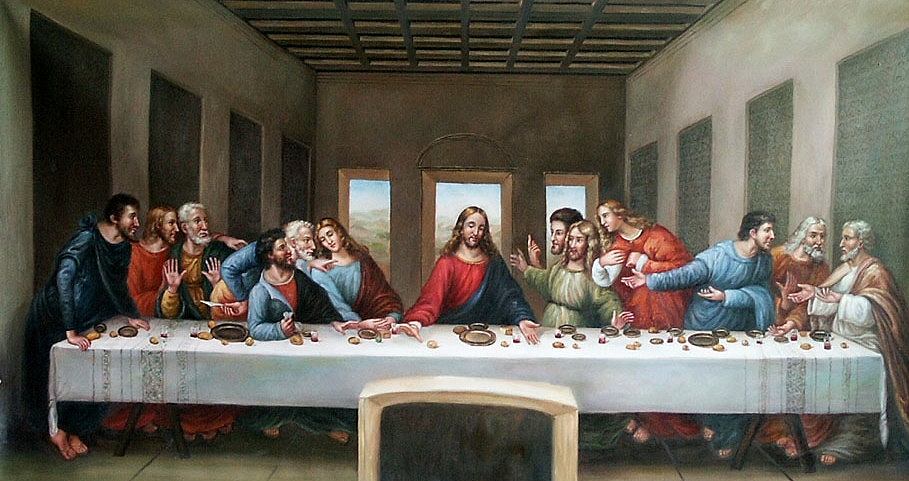
Log in or sign upLeonardo da Vinci was commissioned by Ludovico Sforza, the Duke of Milan, to paint a mural depicting the final meal of Jesus Christ with his twelve apostles in the refectory of Santa Maria delle Grazie. Work on the painting began around 1495 and was largely completed by 1498. Rather than using traditional fresco technique, which required the artist to work quickly on fresh wet plaster, Leonardo experimented with a slower-drying mixture of tempera and oil applied to dry plaster. This allowed him to rework passages repeatedly, achieving a subtlety of expression impossible in true fresco, but it also made the painting highly vulnerable to deterioration. Within decades of its completion, it had already begun to flake and fade. It suffered further damage from floods, a doorway cut through the lower portion of the wall, and the actions of Napoleon soldiers who used the refectory as a stable. Extensive restoration efforts over the twentieth century, culminating in a major project completed in 1999, have stabilized the surface and clarified our understanding of the original color and composition. Despite its fragile state, the painting remains one of the most visited and studied works in the world.
Leonardo organized the composition around a single vanishing point located at the center of the horizon line, directly behind the head of Christ, a deliberate use of mathematical perspective that draws every line in the architecture toward that focal figure. The twelve apostles are arranged in four groups of three on either side of Christ, creating a rhythmic structure that allows each small group to express its own emotional reaction to the announcement that one among them will betray him. Leonardo was famously meticulous in capturing differentiated facial expressions, using gesture, posture, and the angle of each figure to reveal individual psychological states. The framing device of three windows behind Christ creates a kind of halo of light without recourse to the traditional golden disc, integrating the sacred into a naturalistic setting. The long table running parallel to the picture plane serves as a visual barrier that separates the sacred space of the scene from the physical space of the viewer standing in the refectory. The warm tones of the figures contrast with the cool blue-grey of the room, keeping attention focused on the human drama at the center.
The Last Supper captures the precise moment described in the Gospel of John when Christ announces that one of his companions will betray him. The visual representation of that charged moment, with its combination of guilt, shock, denial, and grief spread across thirteen faces, transformed how European artists approached the painting of narrative. It elevated the expressive potential of group composition, showing that a crowd of figures could be organized to tell a story rather than simply fill a space. The image has been reproduced, referenced, and reinterpreted more frequently than almost any other religious painting in the Western tradition. It continues to function in contemporary culture as a template for depicting communal meals and moments of collective reckoning, appearing in films, music videos, and political imagery across the world. Within the religious context for which it was made, it serves as a meditation on trust, betrayal, and the willingness to accept sacrifice, themes that carry weight far beyond any single historical or theological moment.
Enjoyed this story?
Save articles to your collection
Log in or create a free account, and this article will be waiting in your Private Collection.
Log in or sign up