Loading cart…
No products in the cart.

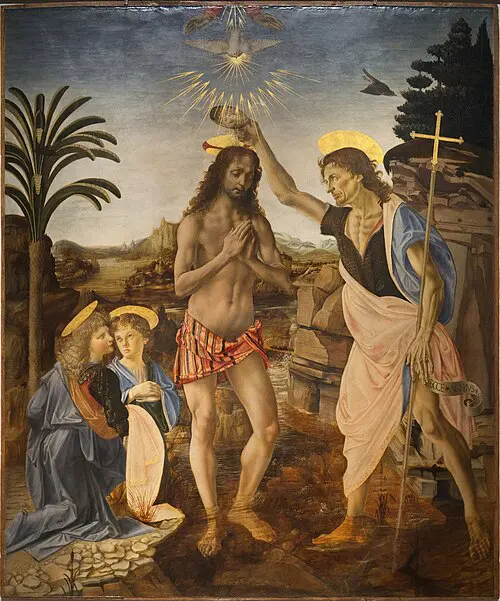
c. 1472-1475 · Tempera and oil on wood panel · Uffizi Gallery, Florence, Italy
Save articles to your collection
Log in or create a free account, and this article will be waiting in your Private Collection.
Log in or sign upThe Baptism of Christ was primarily executed by Andrea del Verrocchio, in whose Florentine workshop Leonardo da Vinci trained during the late 1460s and early 1470s. According to Giorgio Vasari, writing decades later, Verrocchio was so impressed by the portion of the painting completed by the young Leonardo that he resolved to never paint again, acknowledging that his pupil had surpassed him. While this account is likely embellished, it reflects a genuine recognition that the sections attributed to Leonardo display a quality and technique markedly superior to the rest of the painting. The most widely accepted attribution assigns to Leonardo the angel on the far left of the composition, as well as the landscape background visible between and behind the figures. Scientific analysis of the painting, including infrared reflectography and detailed examination of paint layers, has confirmed that the angel attributed to Leonardo was executed using oil paint rather than the egg tempera used for the rest of the work, indicating a different hand with access to different materials and techniques. This distinction is significant because oil painting was still relatively unusual in Florence at this time and suggests that Leonardo was already experimenting with techniques he may have encountered through contact with Flemish painting. The painting has been in the collection of the Uffizi Gallery in Florence for several centuries and is considered an important document of the transitional moment in Leonardo development from workshop assistant to independent artist.
The contrast between the portions of the painting executed by Verrocchio and his workshop and those attributed to Leonardo is immediately apparent to the careful observer. The figures of Christ and John the Baptist, as well as the angel on the right side, are rendered with a competent but relatively flat and conventional style typical of Florentine workshop production of the 1470s. The angel on the far left, attributed to Leonardo, is noticeably different in its handling of volume, light, and expression. The face is turned in a three-quarter view with softly modeled features and a sense of weight and presence that the other figures do not quite achieve. The hair flows in the characteristic spiraling curls that would become a recurring element in Leonardo work throughout his career. The landscape background, also attributed in large part to Leonardo, demonstrates his early interest in naturalistic rock formations, water, and atmospheric haze. The distant mountains dissolve into a soft blue-gray, anticipating the fully developed aerial perspective he would employ in later works. The reflections in the water at the base of the composition show an attention to optical phenomena that was unusual in Italian painting of the period. Taken together, these contributions represent a significant stylistic departure from the surrounding painted surfaces, and they provide art historians with a valuable baseline for understanding how Leonardo visual language developed during his formative years in the Verrocchio workshop.
The Baptism of Christ carries the standard theological meaning associated with this subject in Christian iconography, depicting the moment described in the Gospels when John the Baptist poured water over the head of Jesus in the Jordan River, and the Holy Spirit descended in the form of a dove while a voice from heaven proclaimed Jesus as the Son of God. In the visual tradition of the fifteenth century, this scene served as both a devotional image and a theological statement about the nature of Christ and the sacrament of baptism. The presence of two angels witnessing the event elevates it beyond a simple narrative depiction into a celestial occasion attended by heavenly beings. The particular meaning of Leonardo contribution to this painting extends beyond the immediate subject matter. The angel he painted looking back over its shoulder toward the viewer creates a subtle connection between the sacred scene and the person standing before the painting, drawing the viewer into the event as a witness. This device of the figure who mediates between the painted world and the real world of the viewer would become a recurring strategy in Leonardo later work. Furthermore, the painting as a whole documents a moment of artistic transmission, the passing of skill and knowledge from one generation to the next, with the student visibly and measurably exceeding the achievements of the teacher in certain areas of the shared canvas.
Enjoyed this story?
Save articles to your collection
Log in or create a free account, and this article will be waiting in your Private Collection.
Log in or sign up