Loading cart…
No products in the cart.

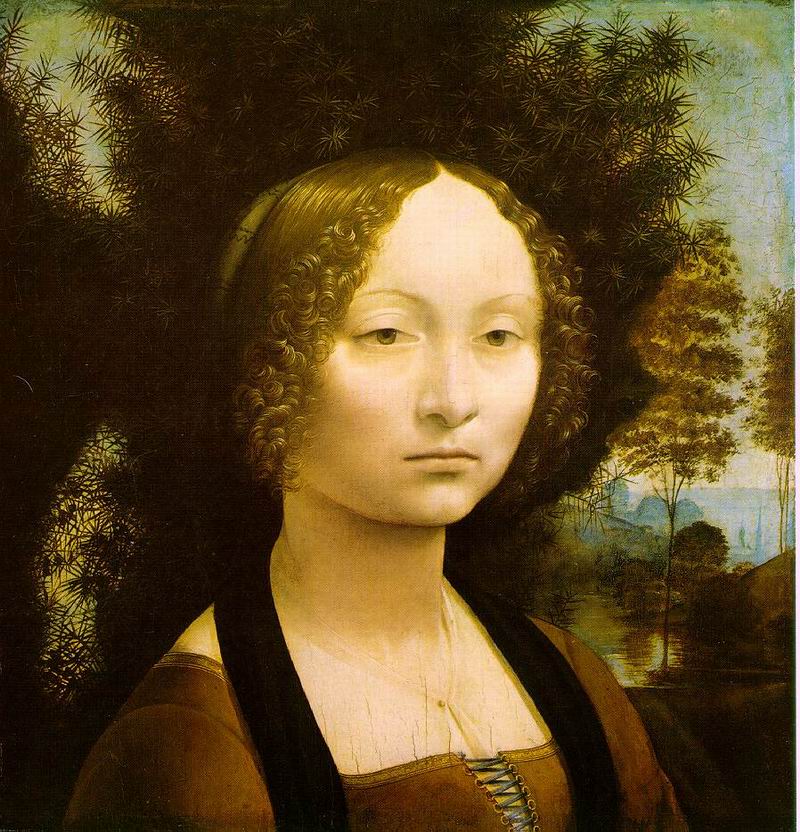
c. 1474-1478 · Oil on panel · National Gallery of Art, Washington D.C., United States
Save articles to your collection
Log in or create a free account, and this article will be waiting in your Private Collection.
Log in or sign upGinevra de Benci was painted by Leonardo da Vinci during his formative years in Florence, likely between 1474 and 1478, when he was still working under the influence of Andrea del Verrocchio. The subject is Ginevra de Benci, a young Florentine woman from a wealthy banking family who was celebrated in her time for her intellectual qualities and poetic sensibility. The portrait is widely believed to have been commissioned in connection with her betrothal or marriage, following a tradition of commemorating significant life events through portraiture. It is the only painting by Leonardo currently held in the Americas, and it entered the collection of the National Gallery of Art in Washington D.C. in 1967, purchased from the Princely House of Liechtenstein. The reverse of the panel bears a sprig of juniper surrounded by laurel and palm branches, along with the Latin motto VIRTUTEM FORMA DECORAT, meaning beauty adorns virtue. This inscription reinforces the connection between the sitter physical appearance and her intellectual and moral character. The juniper plant visible behind Ginevra in the portrait serves as a visual pun on her name, since the Italian word for juniper is ginepro. The painting originally extended further downward, and scholars believe the lower portion, which likely depicted her hands, was cut off at some point in the past. Infrared reflectography has revealed detailed underdrawings beneath the paint surface, offering valuable insight into Leonardo working method during this early period of his career.
From a technical standpoint, Ginevra de Benci reveals Leonardo remarkable skill in rendering surface textures and atmospheric effects even at an early stage of his development. The treatment of her skin is exceptionally smooth, achieved through the application of very fine, almost invisible brushstrokes that create a porcelain-like quality. This approach contrasts sharply with the rough, detailed texture of the juniper branches behind her, demonstrating Leonardo ability to differentiate materials through paint handling alone. The cool, silvery light that falls across her face gives her a reserved, contemplative appearance that sets this portrait apart from more conventionally idealized Florentine portraits of the period. The composition is notable for placing the sitter in a three-quarter view against a naturalistic landscape background, a device that would become far more common in Italian portraiture in subsequent decades. The dark juniper bush acts as a kind of halo or frame around her pale face, creating a strong visual contrast that draws the viewer attention directly to her expression. The distant landscape, rendered with soft atmospheric haze, reflects Leonardo early experimentation with aerial perspective. Her direct gaze, unusual for portraits of women in this era, suggests a psychological complexity and self-possession that anticipates the more famous introspective qualities found in his later portrait subjects.
The meaning of this portrait operates on multiple levels, combining personal identity, social status, and humanist ideals. Ginevra de Benci was admired by Bernardo Bembo, the Venetian ambassador to Florence, and many scholars believe the portrait was connected to their documented Platonic relationship, which was celebrated within the conventions of courtly love poetry. The juniper on the reverse of the panel, alongside the motto linking beauty to virtue, positions Ginevra not merely as a desirable young woman but as a figure of moral and intellectual worth. This reflects the Florentine Renaissance ideal that outward beauty should be a reflection of inward virtue. The somber expression on Ginevra face carries an emotional weight that resists simple interpretation. Rather than presenting a celebratory or decorative image, Leonardo has created a portrait that invites contemplation of the inner life of the sitter. This psychological depth was unusual for its time and reflects the broader Renaissance interest in individualism and the complexity of human experience. The painting stands as an important document of how portraiture was evolving in the late fifteenth century, moving away from purely heraldic or commemorative functions toward a more nuanced representation of personality and identity.
Enjoyed this story?
Save articles to your collection
Log in or create a free account, and this article will be waiting in your Private Collection.
Log in or sign up