Loading cart…
No products in the cart.

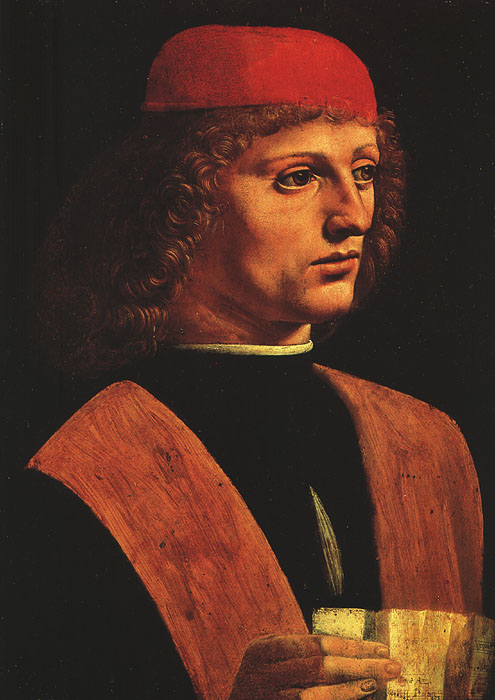
c. 1483-1487 · Oil on wood panel · Pinacoteca Ambrosiana, Milan, Italy
Save articles to your collection
Log in or create a free account, and this article will be waiting in your Private Collection.
Log in or sign upThe Portrait of a Musician was painted during Leonardo da Vinci first extended period of residence in Milan, where he served at the court of Ludovico Sforza from around 1482 onward. The identity of the sitter has been the subject of considerable scholarly debate, with proposed candidates including Franchino Gaffurio, the cathedral choirmaster of Milan, as well as other musicians and courtiers connected to the Sforza court. The sheet of music visible in the lower portion of the painting was only discovered in the nineteenth century during a cleaning that removed overpaint that had covered the sitter hand and the scroll he holds. Before this discovery, the figure was sometimes misidentified as a portrait of a duke or nobleman rather than a musician. The painting has remained in Milan since its creation and is housed today in the Pinacoteca Ambrosiana, one of the oldest public libraries and art galleries in Europe. The attribution to Leonardo has been widely accepted by scholars on the basis of stylistic comparison with his other works and the quality of the painted surface, particularly in the face and hair of the sitter. However, some portions of the painting, particularly the lower areas including the hand and musical scroll, are thought to have been completed by a member of Leonardo workshop rather than by the artist himself. This mixture of hands is not uncommon in Renaissance workshop practice and does not diminish the significance of the work as a whole.
The face of the young musician in this portrait represents some of the finest portrait painting attributable to Leonardo from his Milanese period. The skin is rendered with extraordinary subtlety, using the sfumato technique to create soft transitions from the illuminated cheek to the shadowed jaw and neck. The hair falls in loose, spiraling curls that Leonardo has painted with a sense of natural movement, each strand following its own path while contributing to the overall flowing mass. The eyes of the sitter are alert and directed slightly off the central axis, giving the figure a dynamic quality as if caught in a moment of thought or anticipation rather than posed formally for the viewer. The composition places the figure close to the picture plane, filling the frame in a way that creates a sense of immediate presence. The plain, dark background focuses all attention on the face and the upper body, with the warm tones of the flesh contrasting against the neutral ground. The piece of music held in the sitter hand adds a narrative dimension to the portrait, identifying his profession and suggesting an active engagement with his art. The unfinished quality of certain areas of the painting, while sometimes seen as a limitation, also provides valuable evidence of Leonardo painting process, showing how he built up layers of paint from a prepared ground and how he approached the modeling of form through carefully graduated tonal transitions.
The Portrait of a Musician reflects the elevated status that music and musicians held at the Sforza court during the 1480s. Ludovico Sforza maintained an exceptionally sophisticated musical establishment and employed some of the leading composers and performers of the period. By portraying a musician with the same gravity and psychological depth that was typically reserved for portraits of rulers and nobility, Leonardo was participating in a broader Renaissance project of elevating the status of the arts and their practitioners. The presence of the written music connects the visual art of painting to the intellectual and mathematical dimensions of musical composition, reinforcing the idea that both disciplines required deep learning as well as manual skill. The introspective expression of the sitter invites reflection on the inner life of the creative individual. Unlike more ceremonial portraits that emphasized external markers of rank and authority, this painting directs attention toward the personality and mental state of the subject. The slight tension around the eyes and the compressed, thoughtful set of the mouth suggest a mind engaged with abstract problems of sound and structure. This focus on psychological interiority was a defining characteristic of Leonardo approach to portraiture and distinguishes his work from that of many of his contemporaries, who were more concerned with surface beauty or heraldic symbolism than with the representation of individual character.
Enjoyed this story?
Save articles to your collection
Log in or create a free account, and this article will be waiting in your Private Collection.
Log in or sign up