Loading cart…
No products in the cart.

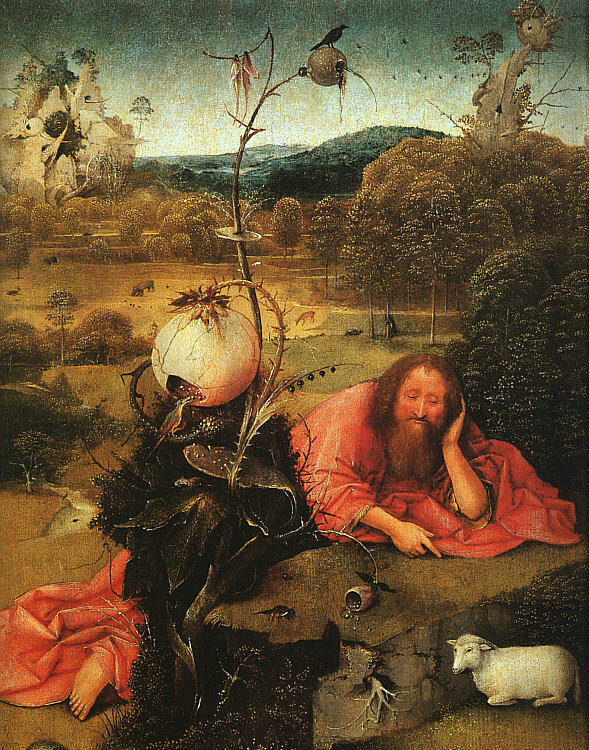
c. 1513 to 1516 · Oil on walnut panel · Louvre Museum, Paris, France

Save articles to your collection
Log in or create a free account, and this article will be waiting in your Private Collection.
Log in or sign upSaint John the Baptist is widely considered to be among the last paintings that Leonardo da Vinci completed before his death in 1519, produced during the final years of his life when he was living in Rome under the patronage of Giuliano de Medici and subsequently in France at the court of King Francis I. The precise circumstances of the commission are not fully documented, but the painting was recorded in the royal French collection by the seventeenth century and eventually entered the Louvre, where it remains today. Leonardo worked slowly and selectively in his later career, and the concentrated attention evident in every passage of this relatively small panel reflects the deliberate pace of his late working method.
The painting has a complex historiography, partly because its unusual mood and ambiguous iconography led some early scholars to question whether it truly depicted John the Baptist or another figure entirely. Some researchers have proposed connections to a figure sometimes called Bacchus, and a related drawing in the royal collection at Windsor shows a similar figure in a landscape setting that may represent an earlier conception of the composition. The definitive identification as Saint John rests on the presence of the reed cross and the upward-pointing gesture, both conventional attributes of this saint in Italian Renaissance iconography. The painting passed through several royal collections and survived the upheavals of the French Revolution to remain one of the central works in the Louvre's Italian painting collection.
The painting presents a single male figure rising from an almost entirely dark background, with light falling selectively on the face, neck, chest, and the raised right arm. This extreme use of chiaroscuro, the contrast between light and shadow, reaches a degree of intensity in the Saint John that surpasses most of Leonardo's earlier work and reflects the influence of his sustained experimentation with tonal modeling throughout his career. The background is so uniformly dark that it offers no spatial information, creating an effect of the figure existing in an undefined void rather than a described environment. This treatment is markedly different from the landscapes and architectural settings typical of Renaissance portraiture and devotional painting.
The figure is rendered with the soft, blended sfumato technique applied to the transitions between light and shadow across the skin, so that the form appears to breathe and turn in space rather than being described by a hard contour line. The curling hair and the slight smile on the face have invited comparisons to the Mona Lisa, and both works share a quality of psychological ambiguity that resists simple interpretation. The reed cross held in the left hand is rendered more summarily than the flesh, suggesting that Leonardo's primary interest lay in capturing the physical and psychological presence of the figure rather than elaborating its symbolic attributes. The upward-pointing index finger, which reappears in several Leonardo compositions, directs attention toward a divine realm beyond the picture plane.
The pointing gesture that defines the Saint John the Baptist carries a specific theological meaning rooted in the role of John as the forerunner of Christ. In Christian tradition, John the Baptist was the prophet who announced the coming of the Messiah, and the gesture of pointing upward or outward was a conventional way of representing this function in visual form. By isolating this gesture against a nearly featureless background, Leonardo stripped the image of narrative context and concentrated the viewer's attention on this single act of proclamation. The result is an image that functions less as a scene from sacred history than as a meditation on testimony and faith.
The ambiguity of the figure's expression adds a layer of complexity to this theological message. The slight smile and the direct gaze create a sense of personal engagement with the viewer that transforms the painting from a straightforward devotional image into something more introspective. For viewers in Leonardo's time, a figure who both smiles and points upward would have communicated the joy of the prophetic calling alongside its urgency. For later audiences, the psychological depth of the expression has suggested a broader range of meanings, and the painting has been interpreted as a reflection on mortality, on the relationship between the earthly and the divine, and on the nature of spiritual knowledge itself.
Enjoyed this story?
Save articles to your collection
Log in or create a free account, and this article will be waiting in your Private Collection.
Log in or sign up