Loading cart…
No products in the cart.

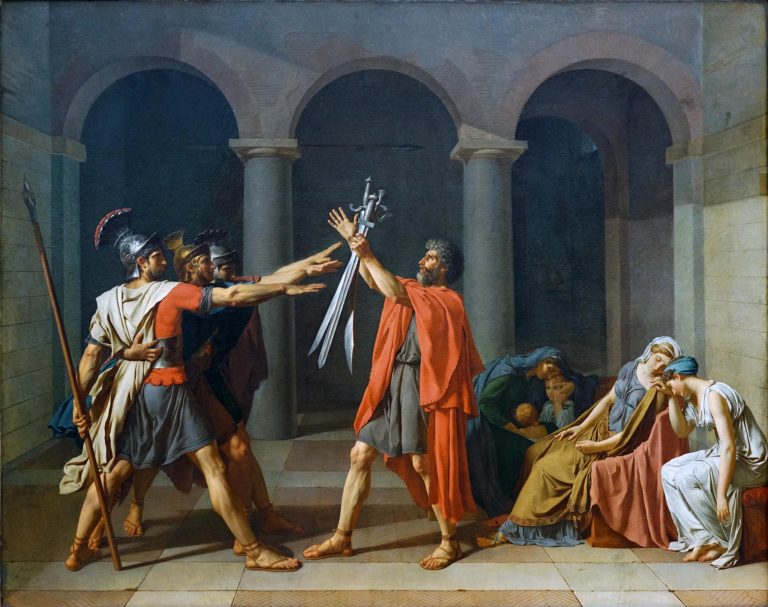
1784 (dated); completed 1785 · Oil on canvas · Musée du Louvre, Paris
Save articles to your collection
Log in or create a free account, and this article will be waiting in your Private Collection.
Log in or sign up Explore the artistJacques-Louis David →
Three brothers reach toward three swords. Their father lifts the weapons between them. At the right, the women do not join the gesture. They bend toward one another, already carrying the grief that the men’s promise will bring.
Jacques-Louis David’s Oath of the Horatii is often introduced as an image of patriotic duty. It is also a picture in which duty has a visible cost. The outstretched arms occupy the centre of attention; the seated family makes that confidence harder to accept without question.
The large oil painting belongs to the Louvre in Paris. It is dated 1784 in David’s inscription, although the museum’s current provenance research places its completion in Rome in 1785. That distinction explains why the familiar date and the account of its first exhibition do not fit into one calendar year.
The subject comes from the legendary conflict between Rome and Alba Longa. Rather than settle the war through a larger battle, each side appoints three champions: the Roman Horatii and the Alban Curiatii.
The family connections make the encounter tragic. Camille, a sister of the Horatii, is engaged to a Curiatius; Sabine is married to a Horatius. A victory for one city will therefore bring a loss within the same family network. The women’s grief is not simply a general fear of fighting.
The Louvre’s educational account connects David’s subject with Livy’s Roman history and Corneille’s play Horace. It also stresses that the exact oath scene appears to be David’s invention. He chooses a moment that can gather an entire moral problem into a few directed gestures.
We see neither the fight nor its outcome. The blades have not yet been taken. The painting holds the family at the instant when intention becomes a public commitment.
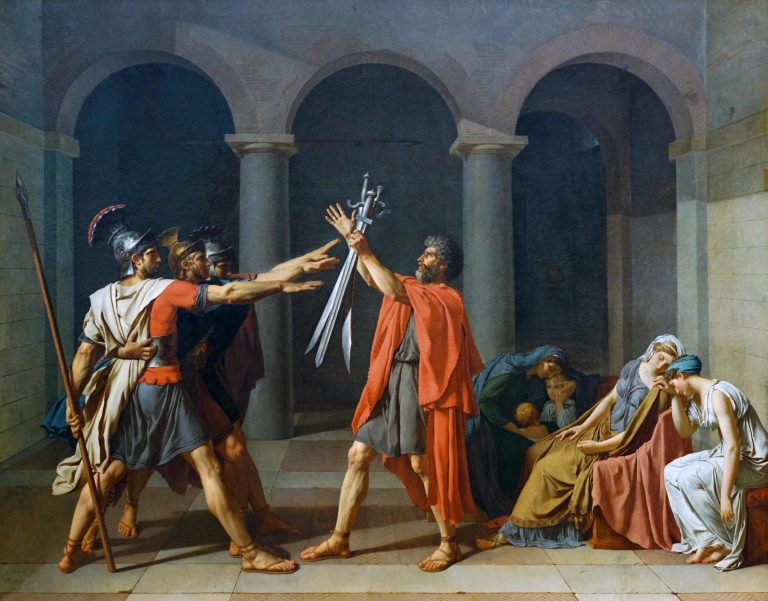
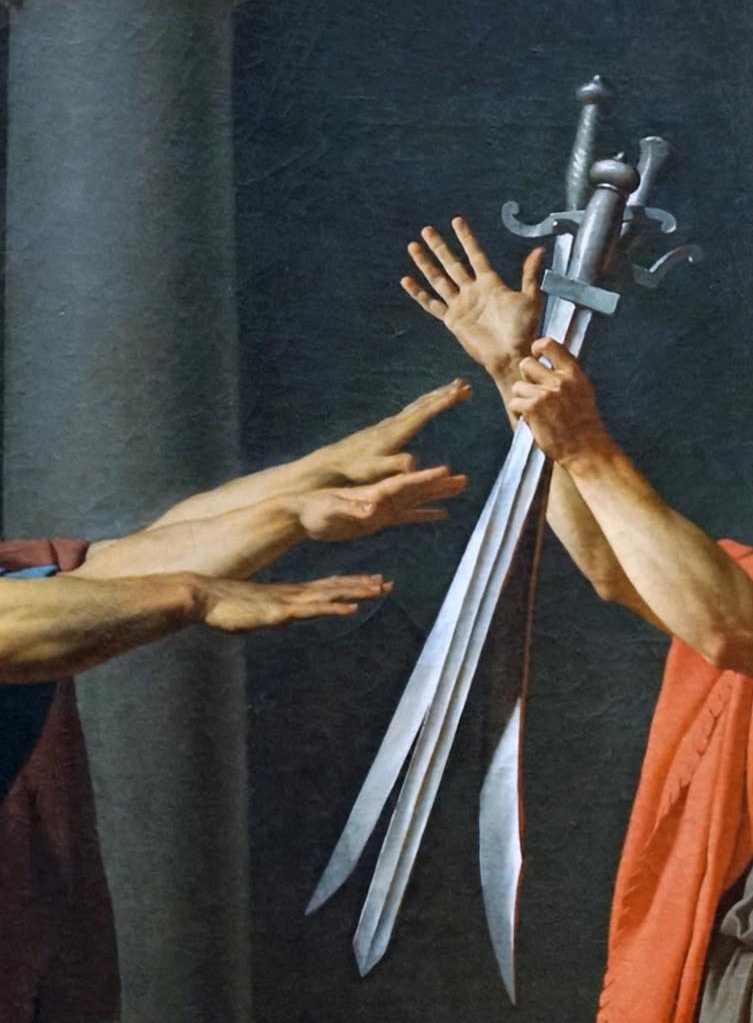
Follow the brothers’ fingers across the dark space. Their hands do not close on the hilts. They reach toward weapons still controlled by their father, whose raised arms lift the promise into the light.
The steel blades point downward while the hands reach upward. That opposition makes the compact central group more active than it first appears. Bright metal catches the eye, but the skin around it supplies the emotional pressure.
David leaves enough darkness behind the swords for the shapes to remain distinct. He does not surround them with decorative objects or explain them with an inscription. The empty interval is essential: we can follow the movement from sons to father without losing the direction of their attention.
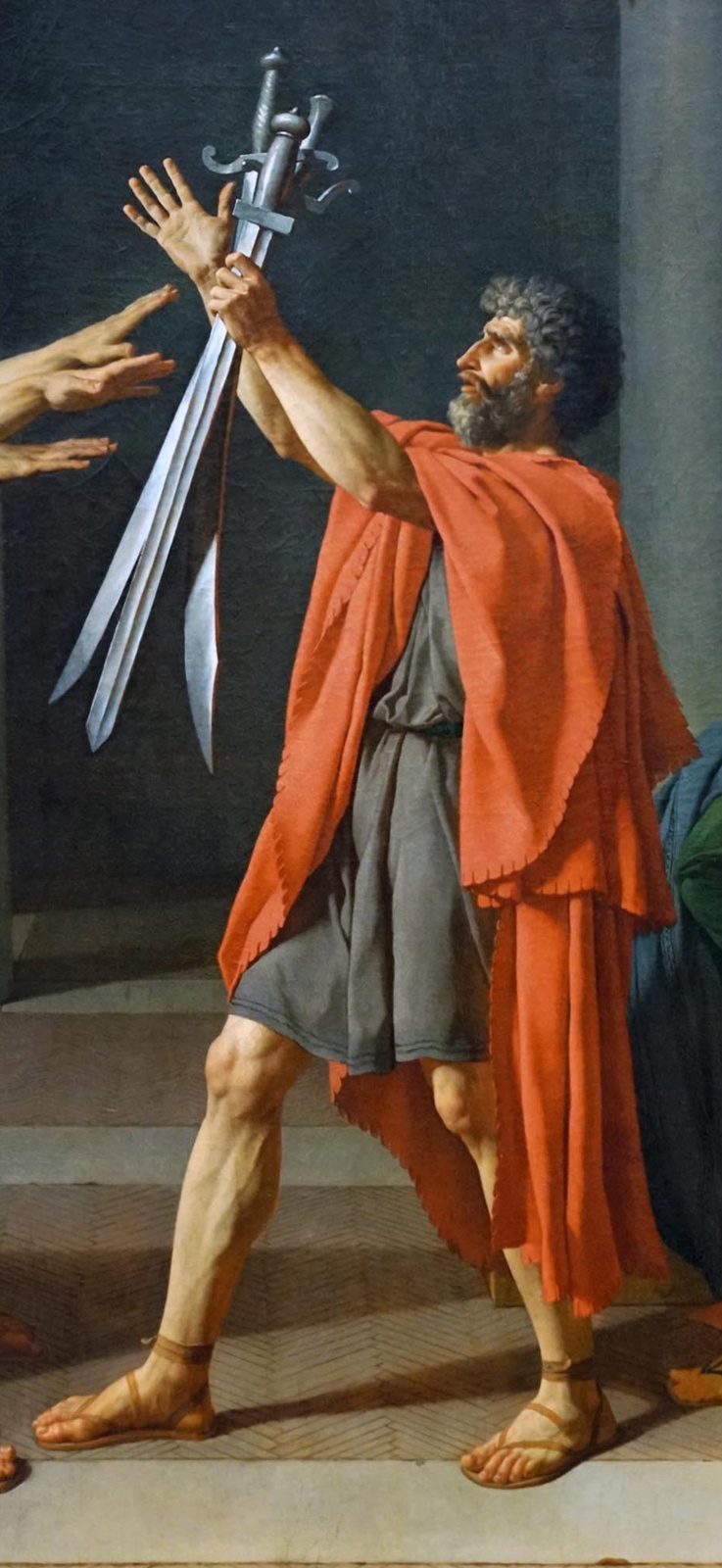
The father has two roles within the image. He is part of the family, but his position also separates the oath from the mourners. The red cloak expands his silhouette and gives the central act a larger visual weight.
His feet spread across the floor beneath the lifted swords. The raised arms carry the gesture upward, while the planted legs make it feel supported. Seen together, they give the father a different kind of firmness from the brothers’ repeated forward reach.
He looks towards the weapons. The sons approach from one side and the grieving family gathers at the other, but his attention remains fixed on the act between his hands. The central figure joins the groups spatially without resolving their emotional division.
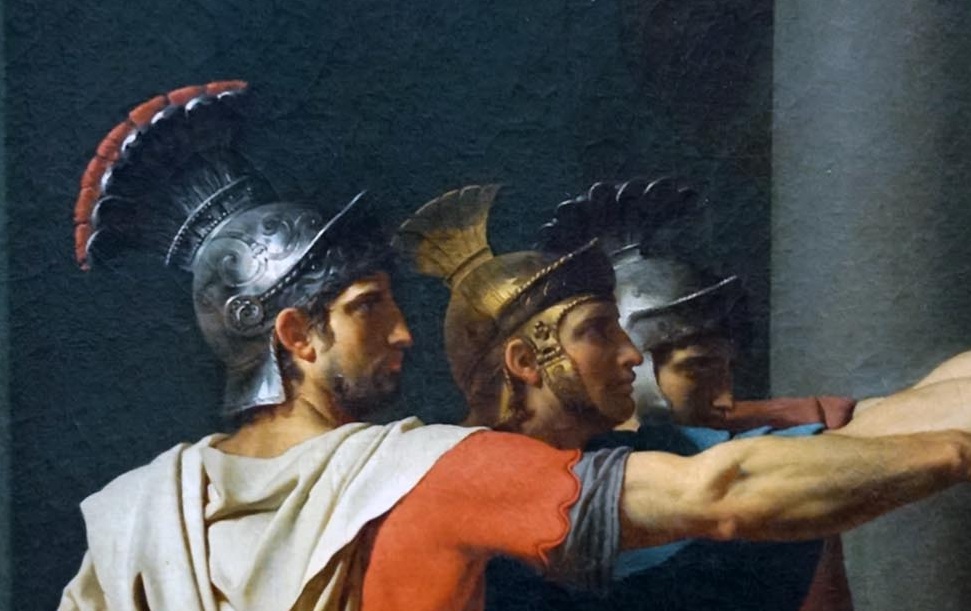
The heads overlap, one helmet appearing behind another. Their faces share a direction, and their extended arms form a closely packed group. Individual differences remain, but David makes their collective purpose easier to see than their separate personalities.
The embrace behind the foremost brother adds another kind of connection. One body supports or contains another even while all three reach away from themselves. The oath is presented as a shared act, not three unrelated decisions.
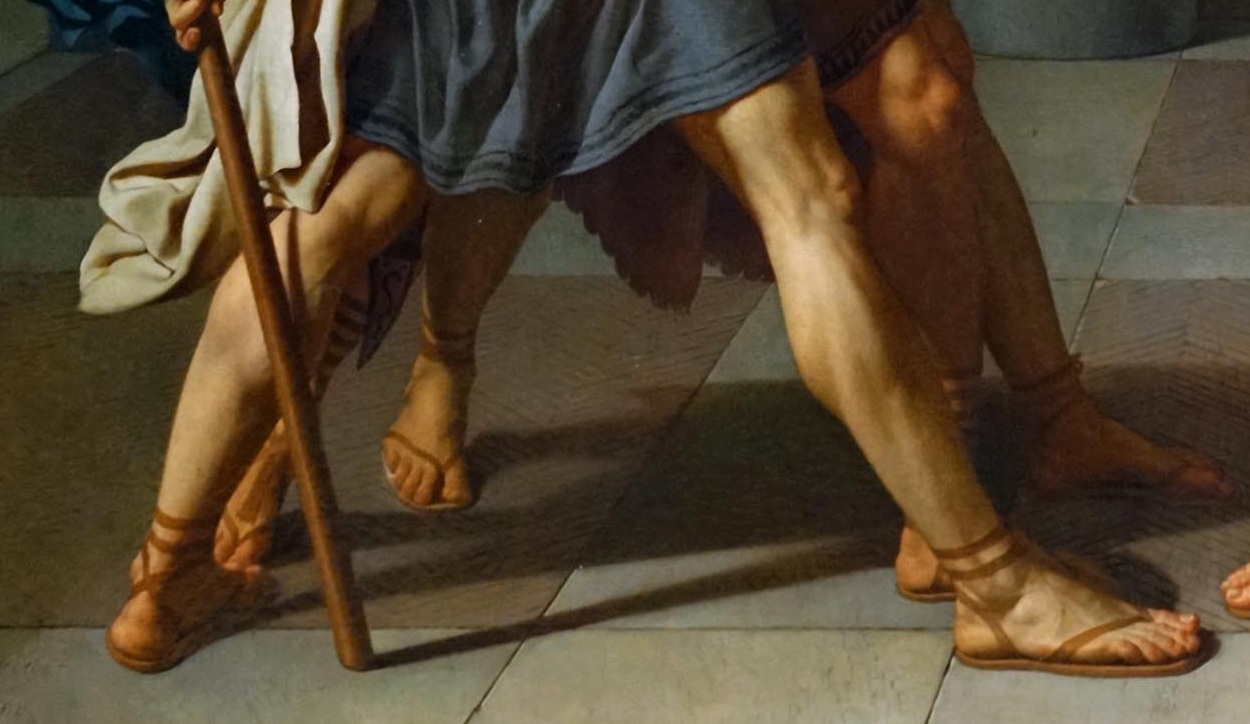
Below, the spread legs form a sequence of diagonals. Sandals press against the pale floor, and the long upright weapon at the left gives the group another firm line. The bodies appear planted before they appear ready to move.
That stability has been carefully built. The scene might easily become a tangle of six legs and reaching arms. Instead, clear changes of colour and light allow the figures to overlap without collapsing into confusion. Their resolve is expressed through an arrangement of weight.
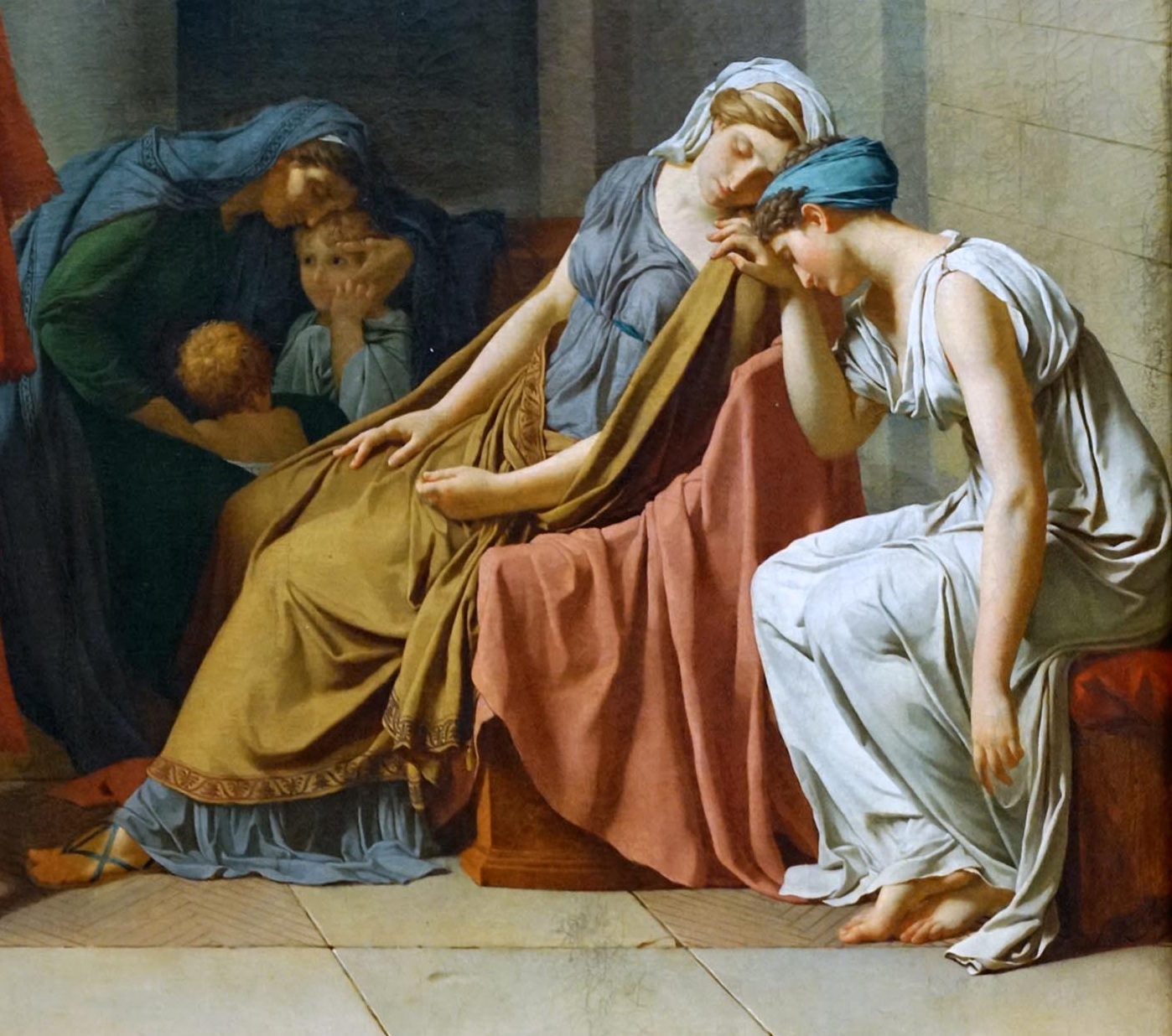
At the right, heads incline rather than rise. A hand falls toward a knee. The pale clothing spreads over the seat and floor, giving the figures curved, yielding outlines beside the brothers’ straight limbs.
The women are placed within the same room, but they seem to occupy a different emotional time. The oath is happening now; their bodies anticipate what will follow. David allows foreknowledge of loss to sit beside a declaration of courage.
The children deepen that difference. They are sheltered within the smaller family group, close to the older woman rather than the lifted swords. Their scale and dependence interrupt the image’s heroic register. What the men call duty will also shape the lives of people who do not take part in the promise.
This is a distinction staged by David, with the gendered expectations of his own period. It need not be accepted as a universal claim about how men and women respond to danger. Within the painting, it gives public honour and private attachment visibly different forms.
Three plain arches divide the wall behind the figures. The brothers, father and seated family fall into a broad three-part arrangement. The architecture creates order without supplying a fully furnished Roman interior.
Floor lines recede into the room, but the important action stays close to the front. There are few distractions between the viewer and the figures. Empty tiles at the bottom give the feet room to stand and the skirts room to fall.
These choices help explain the painting’s association with Neoclassicism: an antique subject, disciplined arrangement and clearly drawn bodies. The term describes useful formal qualities, but it should not make the picture sound emotionally cold. Its precision brings the conflict between the two groups into sharper focus.
The painting began as a royal commission under Louis XVI. It was shown at the Paris Salon in 1785, before the French Revolution. Calling it a painting commissioned by the Revolution would reverse that history.
Its later political resonance is easier to understand. An oath, willingness to sacrifice and attachment to a cause could acquire meanings beyond the original commission. David himself would become deeply involved in revolutionary politics. The painting’s subsequent reputation and its first circumstances are related, but they are not identical.
The tension remains inside the room. The men give their promise with apparent certainty. The women and children show what that certainty leaves unresolved. Looking from the swords to the seated group keeps the moral question open.
David stages a conflict between duty to Rome and family attachments. The brothers’ pledge and the women’s grief make both sides visible.
Its antique subject, restrained setting, clear contours and ordered grouping are characteristic of the Neoclassical approach associated with David.
The canvas is inscribed 1784 and is usually catalogued with that date. The Louvre’s current history records completion in Rome in 1785 and exhibition at that year’s Salon.
The Louvre in Paris holds the painting discussed here, inventory INV 3692, measuring 330 by 425 centimetres.
Jacques-Louis David, Oath of the Horatii, dated 1784, Louvre, INV 3692. Faithful photographic reproduction via Wikimedia Commons, public-domain historical artwork.
Enjoyed this story?
Save articles to your collection
Log in or create a free account, and this article will be waiting in your Private Collection.
Log in or sign up
Man Writing a Letter
Gabriel Metsu, c. 1664
The gallery list
Every painting is already 50% off. Join the list and we will send you an extra $15 code, plus first access to new collections.
No spam. Unsubscribe anytime. · Privacy Policy
Welcome
Your $15 code is on its way. Explore the gallery while you wait.