Loading cart…
No products in the cart.

1800 to 1801 · Oil on canvas · Château de Malmaison, Rueil-Malmaison
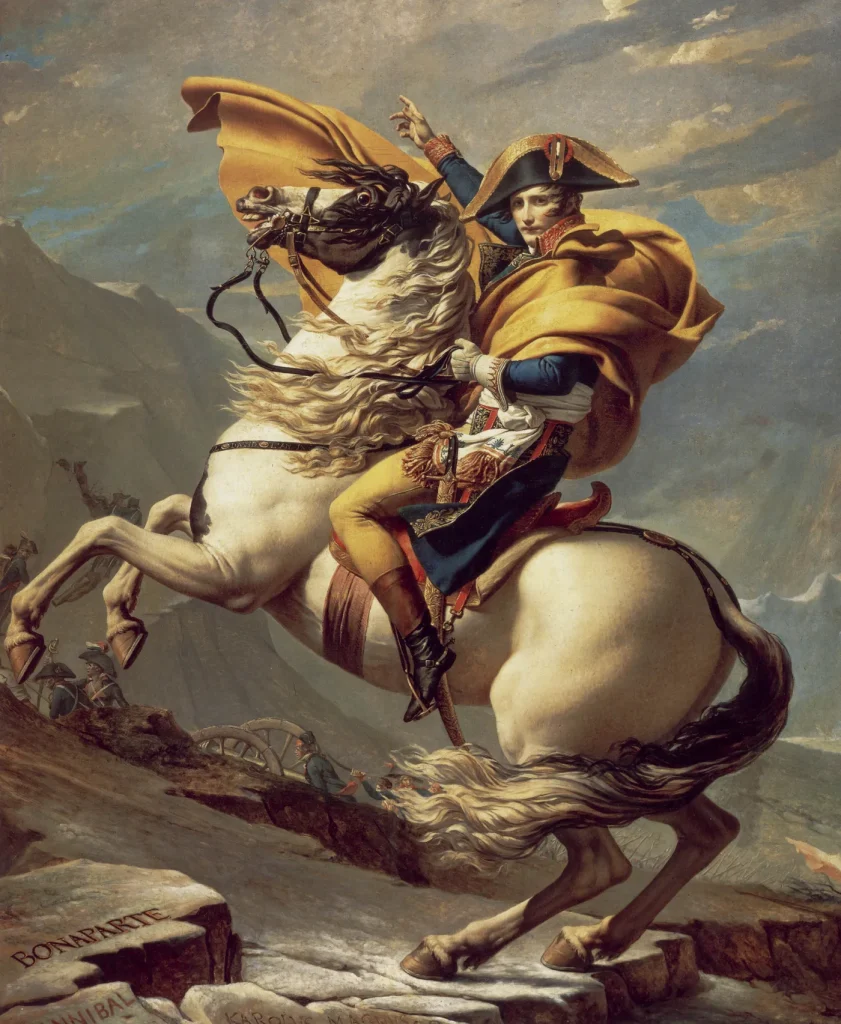
In May 1800 Napoleon Bonaparte, First Consul of France for six months, took an army of around 40,000 men over the Great St Bernard Pass into Italy to fall on the Austrians from behind. It was a real feat. The snow was still deep. The cannon were dragged up in hollowed tree trunks. The monks of the hospice at the top fed the columns as they came through. A month later he won at Marengo, and France was his.
He did not cross on a rearing stallion. He crossed a few days after the main army, on a mule, led by a local guide, in a plain grey coat. The guide, Pierre-Nicolas Dorsaz, was paid for his trouble and later given a farm. Napoleon himself said he had crossed on a mule. Nobody involved in this painting thought otherwise.
So the question is not whether the picture is true. It is what Napoleon wanted instead of the truth, and how David gave it to him. The weather, for the record, was fine.
The commission came in the summer of 1800, and not from Napoleon. King Charles IV of Spain wanted a portrait of the First Consul for a gallery of great commanders in the royal palace in Madrid, and asked David, the most famous painter in Europe, to make it. David asked Napoleon to sit. Napoleon refused. According to David's pupil Delécluze, who was in the studio, he said:
Nobody asks whether the portraits of great men are good likenesses. It is enough that their genius lives in them.
Napoleon to David, 1800, as recorded by Delécluze
What he did ask for was to be shown calme sur un cheval fougueux, calm on a fiery horse. That one phrase is the whole design.
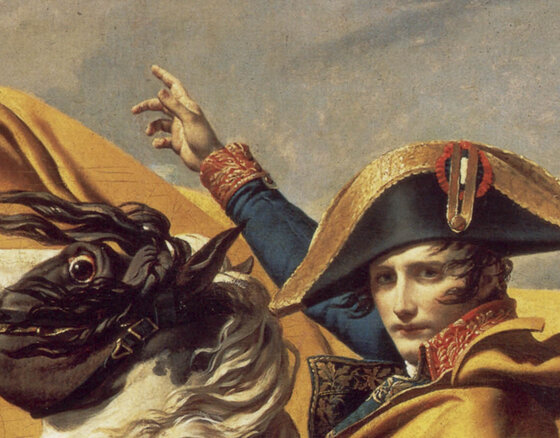
David worked from an earlier drawing of the face and from the uniform Napoleon had worn at Marengo, which was sent to the studio and put on a mannequin. His son posed on a ladder for the seat, and two real horses stood in for the one in the picture: a piebald mare called La Belle and Marengo, the grey that had carried Napoleon through the battle. The face that came out of it is the quietest thing in the painting: Napoleon turns to look at us, not at the mountain, with an expression that gives nothing away, and his gloved hand points up the pass. It is not effort. It is an order.
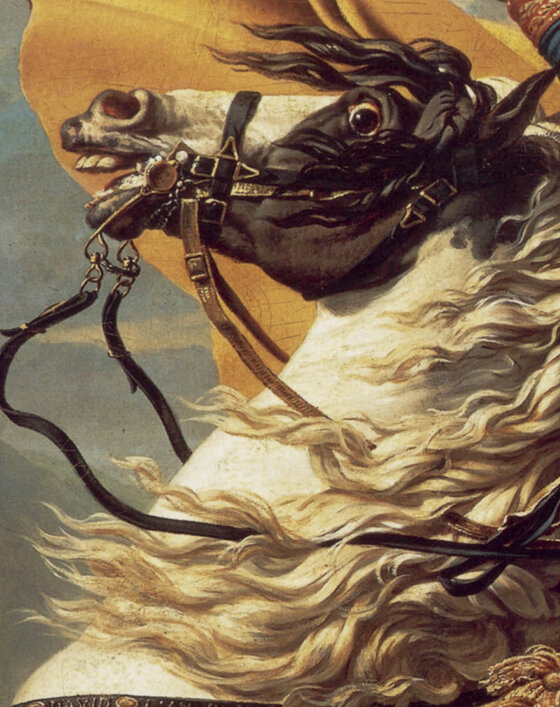
Now look at everything around the face. The horse rears, its mane whipped forward, its eye rolled white. The cloak flies up and back in a great orange loop. Clouds race across the sky, and the wind that drives them comes from the same direction as the pointing hand. The whole world is in a storm, and the man at its centre is not.
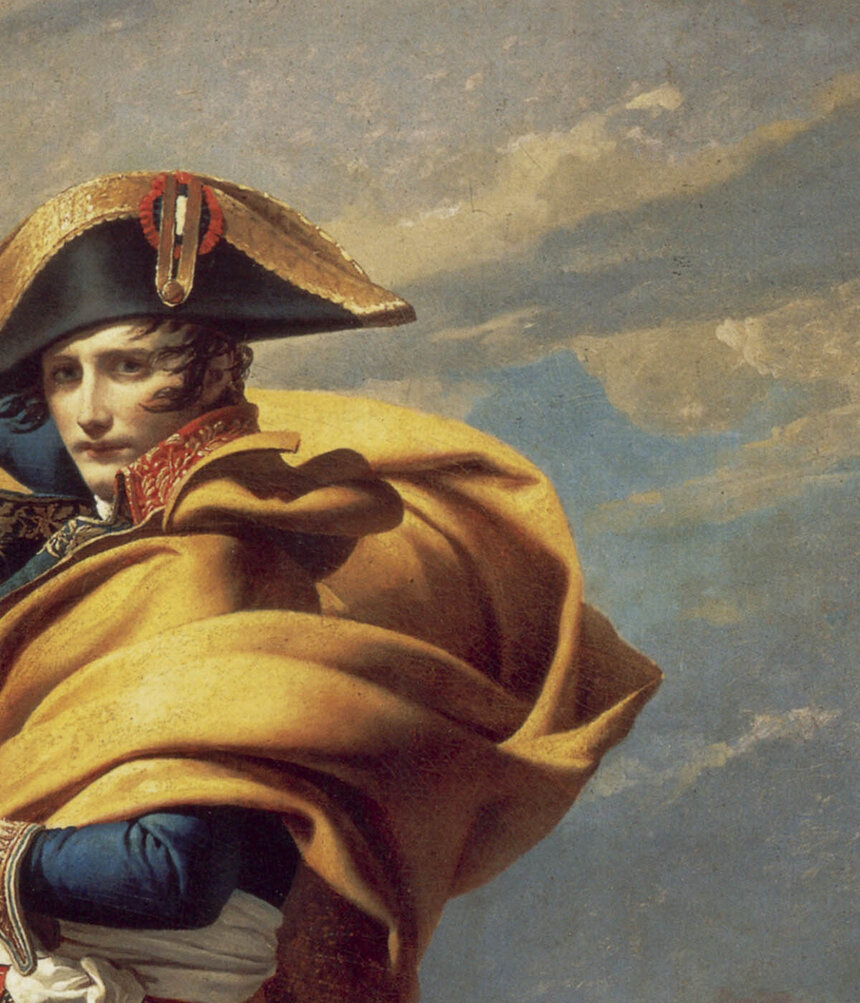
David built every line of movement, the cloak, the mane, the tail, the clouds, the slope of the rocks, to sweep up and to the left, and set the rider's body and gaze still against them. The cloak is the largest single shape, and in this version its warm orange-yellow is the brightest thing against a grey sky and a pale horse. It lifts the eye from the shoulders into the storm and brings it back down along the pointing arm.
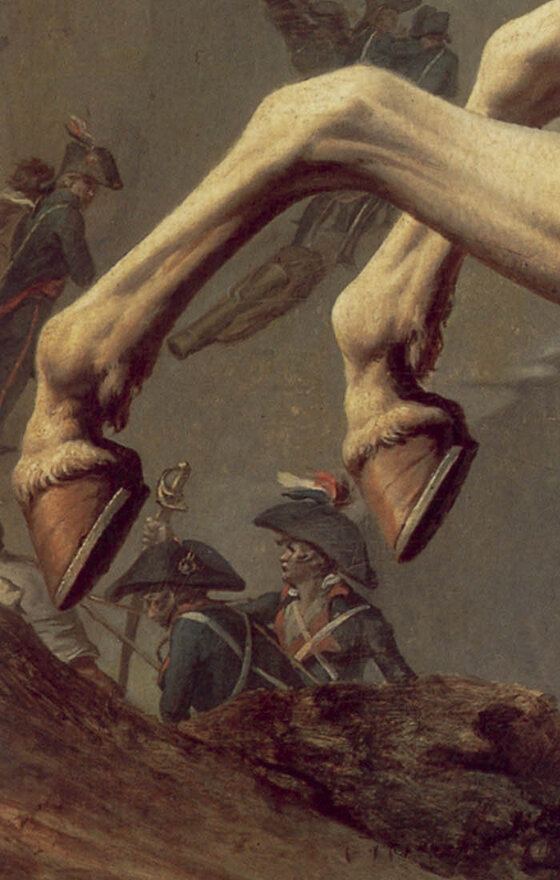
And behind the horse, tiny and almost colourless, the real crossing is happening: a column of soldiers hauling a gun up the slope, a tricolour leaning into the wind. The men who got the cannon over the Alps are a detail in the corner of their commander's portrait. David had spent the 1790s painting the Revolution and its people. This is the picture where his art turned to one man.
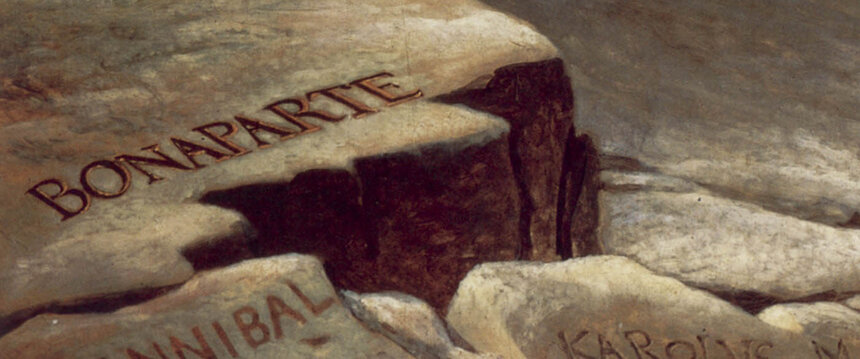
Under the horse's hooves, three names are carved into the stone. BONAPARTE, sharp and new. Below it, weathered, ANNIBAL: Hannibal, who brought his army and his elephants over the Alps in 218 BC. And KAROLUS MAGNUS IMP: Charlemagne, who crossed in 773 on his way to conquer Lombardy.
This is the painting's caption. Two commanders in history have crossed these mountains with an army, and a third has just added his name on top. It is not subtle and it was not meant to be. Napoleon was thirty. The picture was arguing for his place in history before history had made up its mind.
Note that the name is Bonaparte, not Napoleon. In 1801 he was still the First Consul of a republic. The emperor would come three years later, and David would paint him too.
When Napoleon saw the finished canvas in David's studio he ordered three more, and David's workshop later made a fifth. So there are five originals, and they are easy to tell apart by the cloak and the horse:
The face, the pose and the pointing hand never change. David had made an image, not a portrait, and an image can be printed as many times as the client needs.
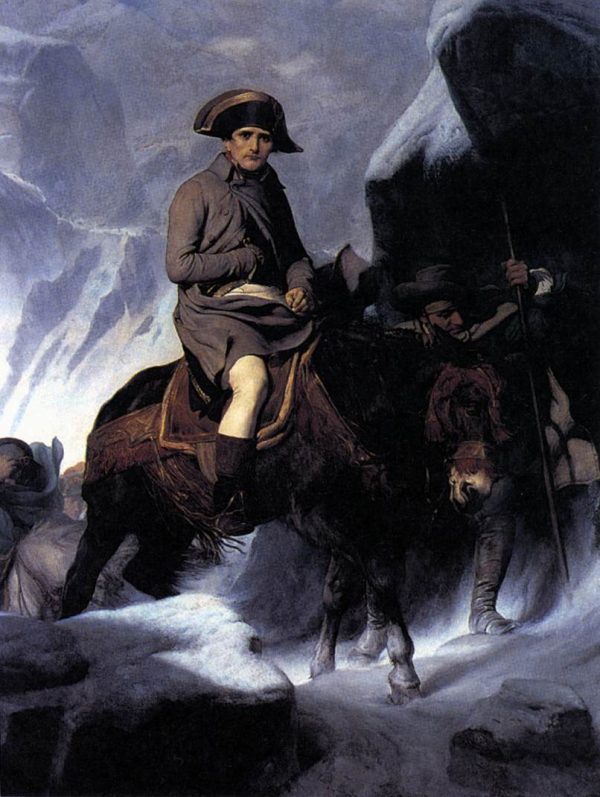
Half a century later, in 1850, the painter Paul Delaroche was asked to paint the crossing again, and he painted the mule. His Bonaparte Crossing the Alps shows a tired man in a grey coat on a sure-footed animal, led by a peasant guide, the snow blowing in his face. It is careful, honest and rather moving. Delaroche said he wanted to show the man rather than the hero.
Nobody puts Delaroche's version on a poster. David's is the one on book covers, biscuit tins, and the walls of people who have never read a word about Marengo. That is the difference between a record and an image, and Napoleon understood it before either painter did.
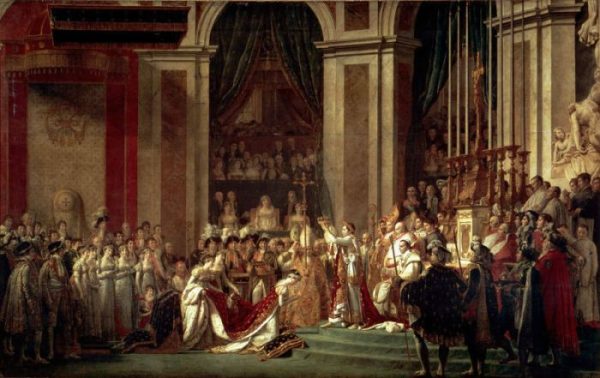
David went on to paint the emperor twice more: the enormous Coronation of Napoleon of 1807, and the quiet, sleepless Napoleon in His Study of 1812, where the same man stands beside a guttering candle at four in the morning, having worked all night on the laws of France. Put the three side by side and you have the whole career, as Napoleon wanted it told.
The first version went to Madrid as planned. In 1808 Napoleon put his brother Joseph on the Spanish throne; in 1812 Joseph lost it and left in a hurry, and took the painting with him. It crossed the Atlantic to his exile at Point Breeze, New Jersey, came back to Europe with his heirs, and in 1949 was bequeathed to the Château de Malmaison, the house outside Paris where Napoleon and Josephine had lived when the picture was new. It hangs there today, oil on canvas, 261 by 221 centimetres, horse and rider larger than life.
Our hand-painted reproduction of Napoleon Crossing the Alps is painted in oil on canvas from this Malmaison version, orange cloak and all, in the original proportions. It is a tall picture and wants height on the wall, so the horse has somewhere to go. The rocks with the three names sit at the bottom left; give them light.
See the rest of our Jacques-Louis David collection, including The Oath of the Horatii and The Death of Marat, and the wider Neoclassicism archive.
Visible details, documented facts and interpretation are kept separate throughout this article. Napoleon's words are given as Delécluze recorded them.