Loading cart…
No products in the cart.

1805 to 1807 · Oil on canvas · Musée du Louvre, Paris
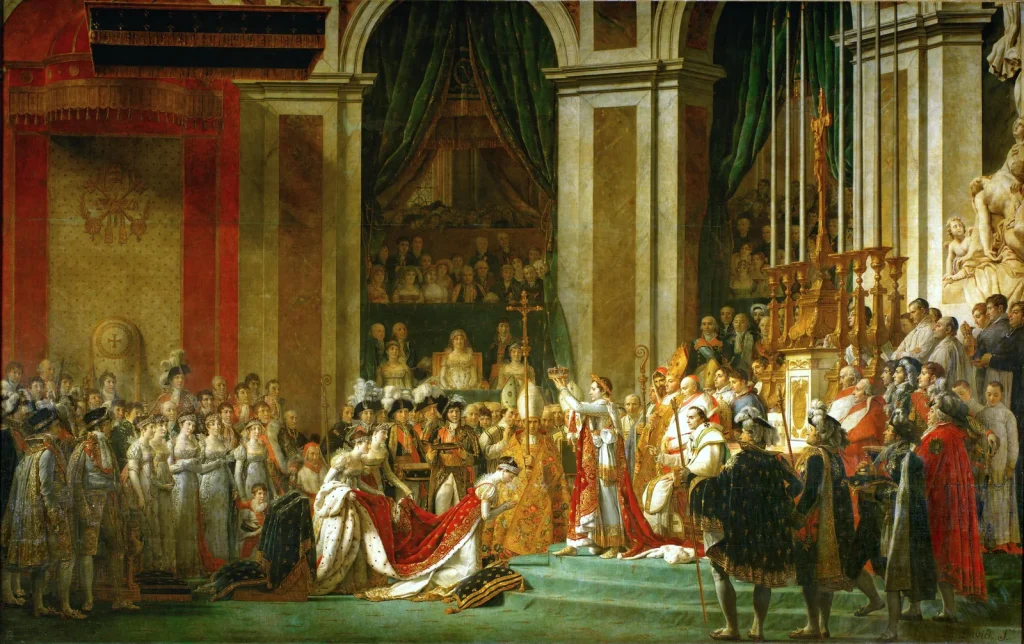
When Napoleon came to David's studio in January 1808 to see the finished painting, he stood in front of it for a long time. Then, according to the pupils who were there, he took off his hat to the painter and said:
This is not a painting. One walks in this picture.
Napoleon to David, January 1808
He was right about the scale. The canvas is six metres high and nearly ten wide, the second largest painting in the Louvre, and the figures at the front are life size. Stand close and you are in the cathedral, in the crowd, at the height of the kneeling empress. It is the biggest piece of theatre ever painted, and Napoleon had directed it.
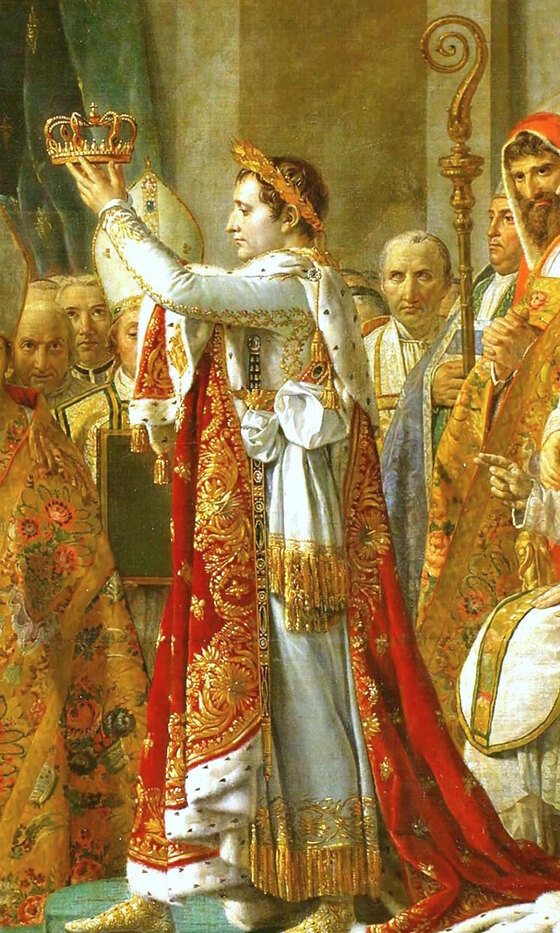
On 2 December 1804, in Notre-Dame, Napoleon Bonaparte was crowned Emperor of the French. The Pope had come from Rome to do it. At the moment of crowning, Napoleon took the crown from the altar and put it on his own head himself, then crowned his wife.
David's first idea was to paint the first moment: the general crowning himself, the Pope sitting behind him with nothing to do. A drawing of it survives in the Louvre. Then he thought better of it, or was told to. A man crowning himself looks like a usurper. A man crowning his wife looks like a king. So the finished painting shows the second crown, held high in both hands over the kneeling Josephine, and everyone in the cathedral watching it.
It changes the whole meaning. The picture is no longer about the Emperor's power, which was the true subject of the day. It is about his generosity, and it centres on a woman. That is the kind of decision David was paid for.
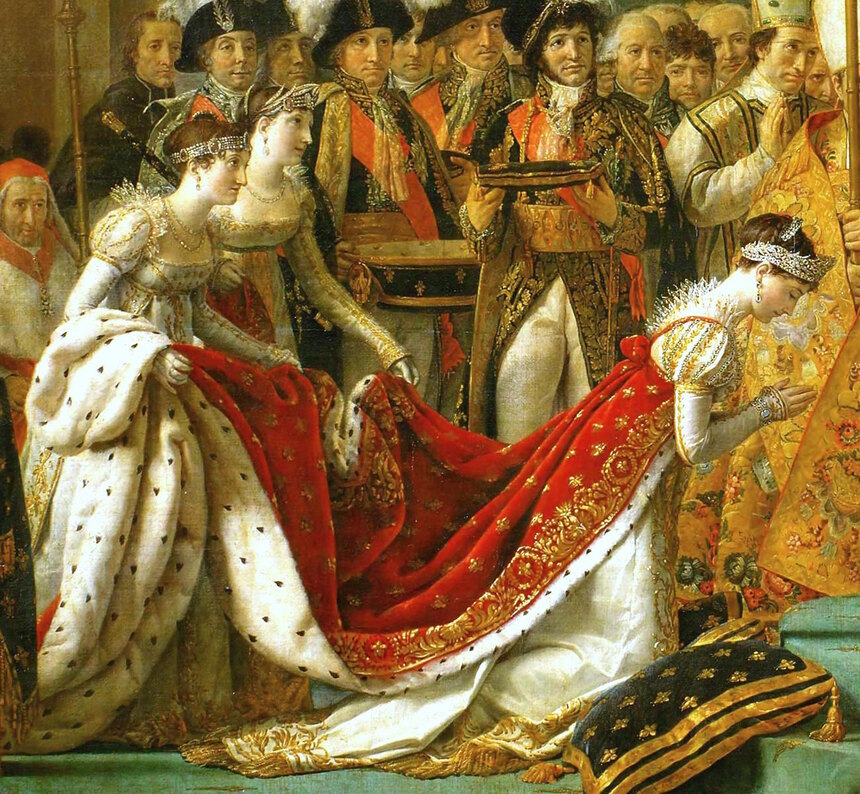
The Empress kneels on a cushion in a white satin dress under a mantle of red velvet and ermine embroidered with the golden bees Napoleon had chosen as his emblem. Her hands are joined. The light falls on her neck and her train, and the train is being held up by two of Napoleon's sisters, who according to the memoirs had to be ordered to do it and did it with bad grace.
Josephine was forty-one. David gave her the face and neck of a woman of twenty-five, and she is the loveliest thing in the picture. It was a kindness with a purpose: five years later Napoleon divorced her because she could not give him an heir, and the painting became the only place where the marriage looked like this.
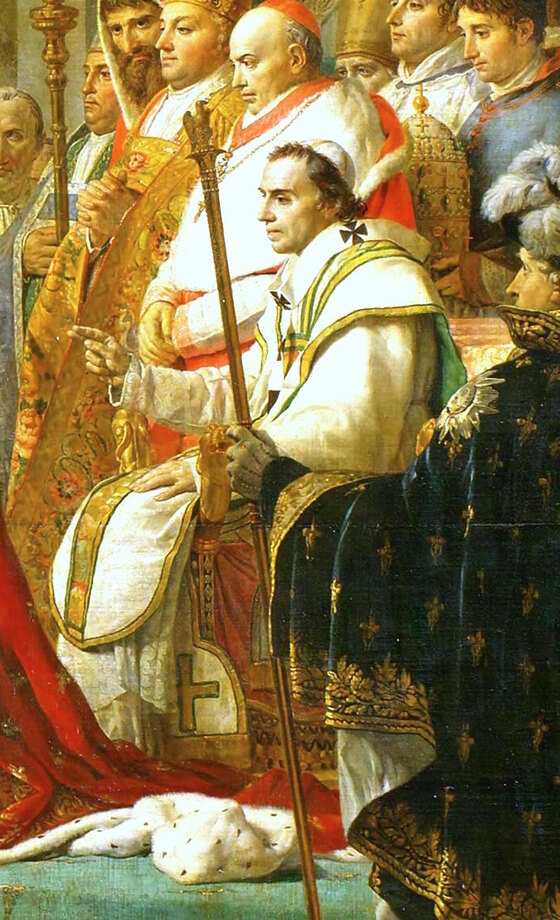
Behind Napoleon sits Pope Pius VII, an old man in white, who had travelled from Rome in winter to consecrate an emperor and had then been made to watch him crown himself. In David's first version he sat with his hands in his lap, doing nothing, which was true. Napoleon saw it and objected. He had not, he said, brought the Pope all that way to do nothing. David raised the hand into a blessing.
So the Pope blesses a coronation he did not perform, and the painting records a ceremony that was slightly better than the one that happened. That is what a state painting is for, and David, who had painted the Revolution's martyrs fifteen years earlier, did it without visible complaint.
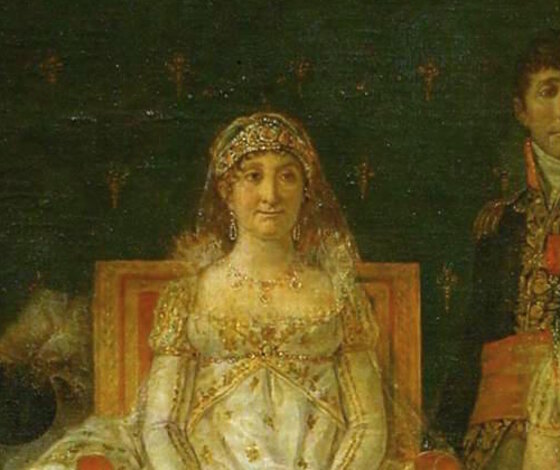
In the middle of the picture, in the tribune above the altar, sits a dignified woman in white: Letizia Bonaparte, Madame Mère, the Emperor's mother. She has the best seat in Notre-Dame. She was not there. She had quarrelled with her son over his treatment of his brother Lucien and stayed in Rome. Napoleon told David to paint her in, and David gave her the place of honour.
Once you know that, the tribune becomes a study in who got to be at the coronation. The family is arranged around her: sisters, brothers, in-laws, most of them soon to be kings and queens of somewhere. To the left, in the crowd of officers, Marshal Murat holds a cushion. Talleyrand stands in red. Cambacérès and Lebrun, the other two consuls, carry the sceptre and the hand of justice. David's painting is a group portrait of the new regime, and every face was checked.
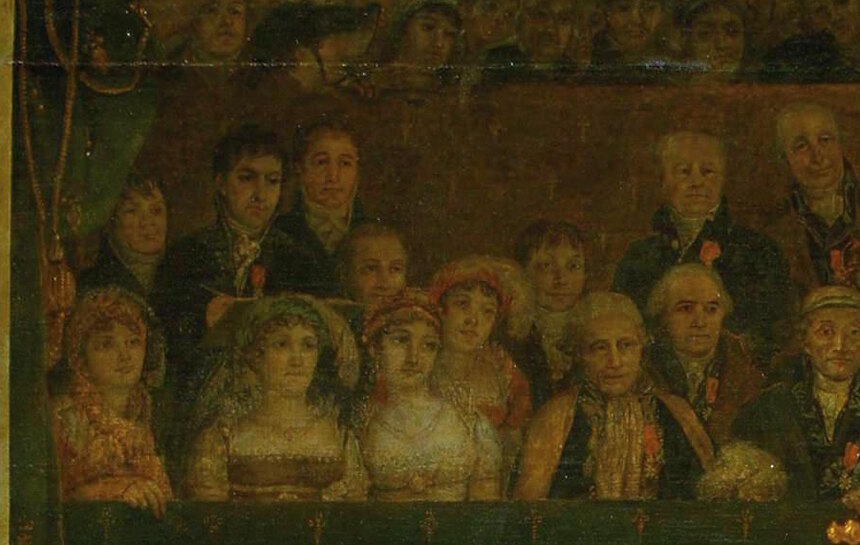
Look up, above Madame Mère, to the upper gallery. Among the spectators a man with a sketchbook is drawing the scene. That is David. Around him he painted his wife, his daughters and his pupils, and, further along, the painter Vien, his old teacher. He had been given a place in the cathedral that day, and he used it, filling notebooks with the costumes, the light and the faces. The painting took him three years, with a scale model of the cathedral built in the studio and the actual robes borrowed from the wardrobe.
It is a small vanity in a picture full of larger ones, and it is also a signature: the man who had voted for the death of one king was now recording, from a good seat, the making of another.
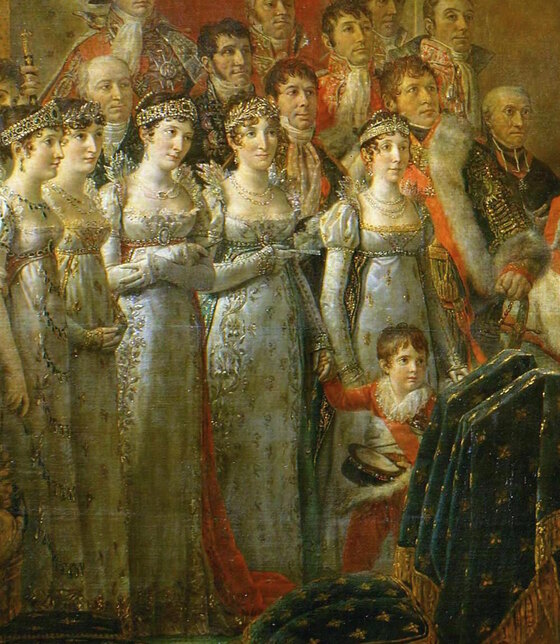
Behind Josephine stand the women of the family: Napoleon's sisters Caroline, Pauline and Élisa, his stepdaughter Hortense with her small son, and the ladies of the court. The sisters held the train that day and, by every account, resented it.
David painted the picture twice. The second version, begun in 1808 and finished in exile in Brussels in 1822, is almost identical except that Pauline's dress has changed from white to pink, which David, or legend, put down to a private affection for the Emperor's favourite sister. The second version is at Versailles. The first is in the Louvre, and it is the one described here.
It means exactly what it was commissioned to mean: that the Empire is legitimate, blessed, magnificent and permanent. Every choice, the crown for Josephine, the Pope's hand, the mother's chair, the borrowed robes, serves that. It is the most expensive advertisement ever painted, and the client approved every frame.
What David could not control is what the painting looks like now that the Empire has been gone for two centuries. It looks like a pageant frozen at the moment before it fell apart: the wife about to be divorced, the sisters about to lose their kingdoms, the Pope about to be Napoleon's prisoner, the Emperor ten years from Saint Helena. The faces David checked so carefully are the faces of people who did not know. That is what makes it more than propaganda: history got into the picture after it was finished.
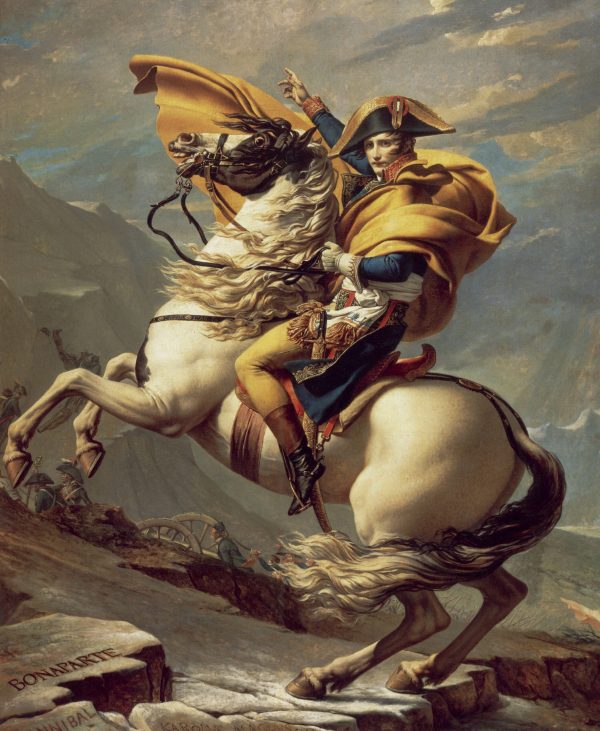
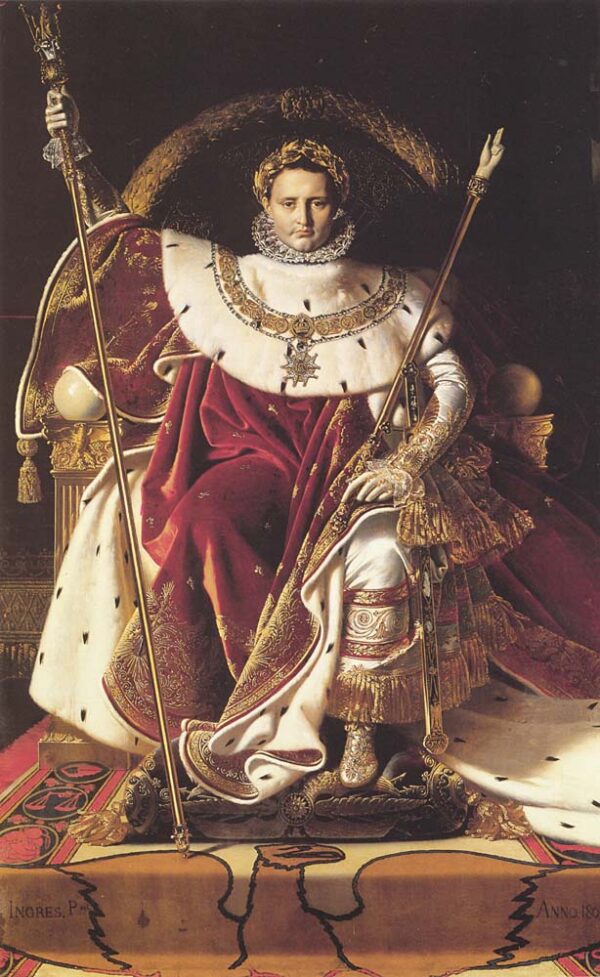
Put it beside Napoleon Crossing the Alps, the young general on the rearing horse, and Ingres' Napoleon enthroned like a Byzantine god, and you have the three faces of the same man in seven years: the hero, the emperor, the icon. The Coronation is the middle one, and the only one with other people in it.
In the Louvre, Paris, in the Daru room among the large French paintings, near Géricault's Raft of the Medusa and Delacroix's Liberty. It is oil on canvas, 621 by 979 centimetres. It was shown at the Salon of 1808, kept at Versailles for most of the nineteenth century and has been in the Louvre since 1889.
Ten metres of cathedral do not fit in a house, but the design does. The painting reads as a wide stage with a bright centre, and at a metre and a half across the crown, the kneeling empress and the red and gold still carry. Our hand-painted reproduction of The Coronation of Napoleon is painted in oil on canvas from the Louvre version, and it is one of the most demanding pictures our painters take on: a hundred and fifty faces, each of them somebody. It wants a long wall, a gilt frame and a room where people stand.
More David in our Jacques-Louis David collection, and the wider Neoclassicism archive.
Visible details, documented facts and interpretation are kept separate throughout this article. Napoleon's words are given as Delécluze recorded them; the story of Pauline's pink dress is reported as the legend it is.