Loading cart…
No products in the cart.

1793 · Oil on canvas · Royal Museums of Fine Arts of Belgium, Brussels
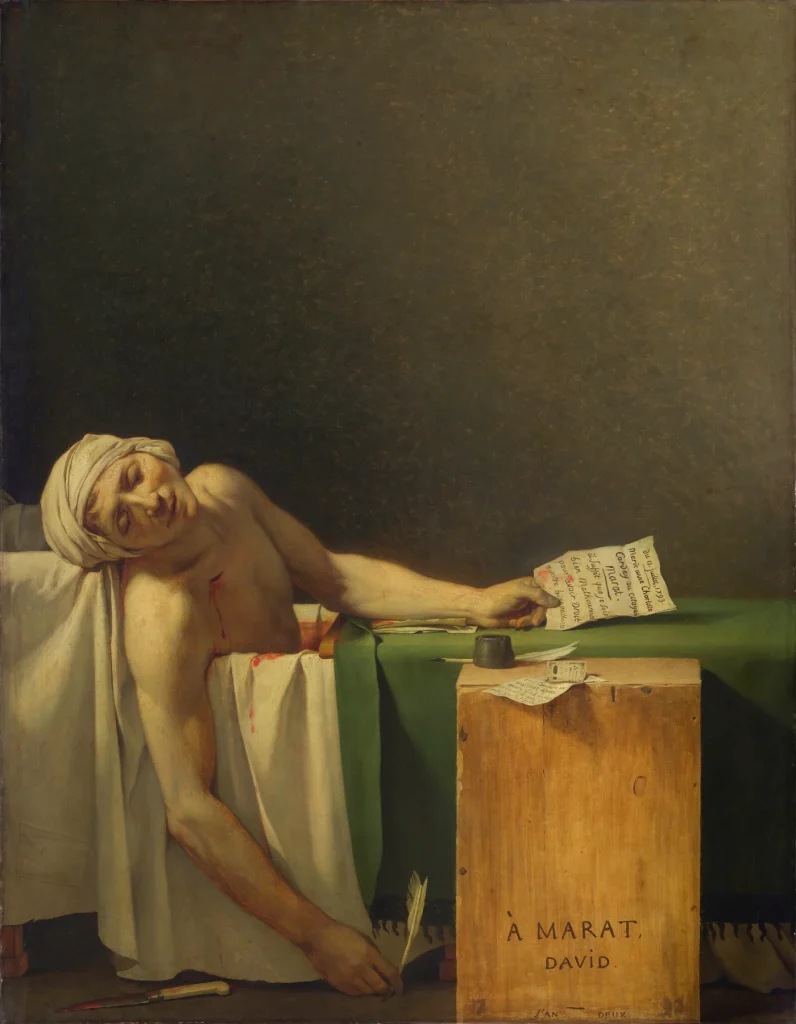
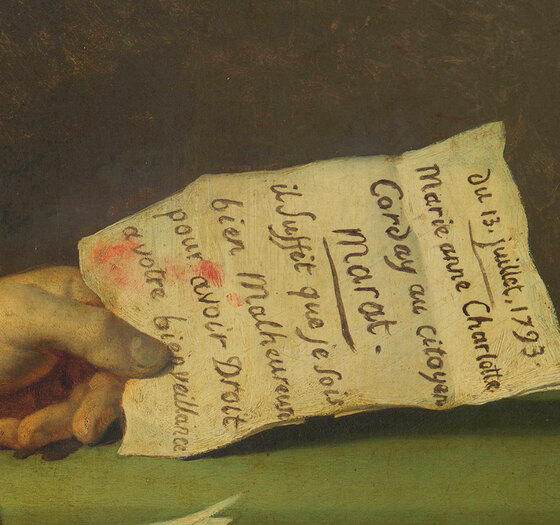
Begin with the piece of paper. The dead man is holding a letter, and David painted it so that you can read every word:
13 July 1793. Marie Anne Charlotte Corday to citizen Marat. It is enough that I am truly unhappy to have a right to your kindness.
The letter painted in Marat's hand
That is how she got in. Charlotte Corday, twenty-four, from Normandy, came to Paris to kill the man she blamed for the Terror. Jean-Paul Marat, doctor, journalist, deputy of the Convention, spent his days in a medicinal bath because of a skin disease, and received petitioners there. She wrote asking for his help, was let in on the evening of 13 July, and stabbed him once in the chest with a kitchen knife. He died in the water.
The real letter was not in his hand. David put it there, and wrote its text out in his own careful script, so that the murder weapon and the trick that made it possible are both in the picture. The knife is on the floor. The lie is in the hand.
Jacques-Louis David was not a neutral observer. He was a Jacobin deputy, a friend of Robespierre, a member of the Committee of General Security that signed arrest warrants, and a friend of Marat. On 12 July he had visited him, and later told the Convention what he saw: Marat in his bath, a board across it for a desk, writing his last thoughts for the good of the people.
The day after the murder the Convention asked David to organise the funeral and to paint the dead man. He did both. The funeral was a Roman spectacle, with the body displayed half naked on a bier, the wound showing. The painting took him three months. He presented it to the Convention in November 1793 with a speech, and it hung in the assembly hall beside his other murdered deputy, Lepeletier, as a pair of revolutionary altarpieces.
So this is not a painting about a death. It is a painting made by a man who had been in that room, for a government that needed a martyr, in the same year that government was cutting off heads by the hundred. Knowing that does not make it less beautiful. It makes it stranger.
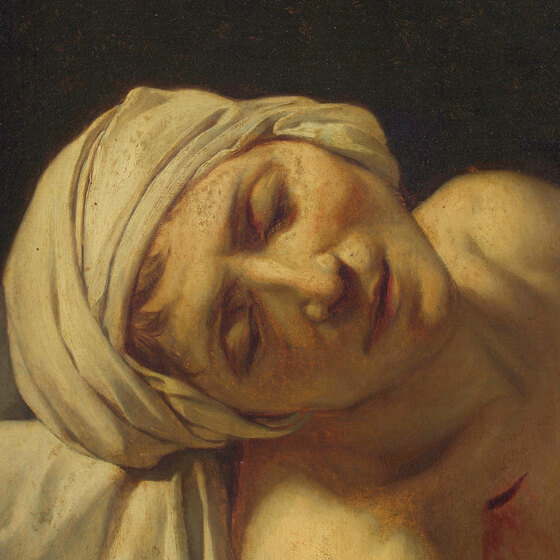
Marat's face is tipped toward us, eyes shut, mouth just open, wrapped in a white cloth. The cloth was real: he soaked it in vinegar to ease the itching of his disease. In the painting it becomes something between a turban and a bandage, and the face under it is calm, smooth and young. Marat was fifty and his skin was ruined. David gave him the face of a sleeping saint.
The light comes from the upper left and falls on the face, the shoulder and the arm, the way light falls on a dead Christ in a Renaissance Pietà. The wound under the collarbone is small and clean. The blood is a thin line down the sheet and a stain in the water. Everything that would be disgusting about a stabbed man in a bathtub has been removed, and everything that could be tender has been kept.
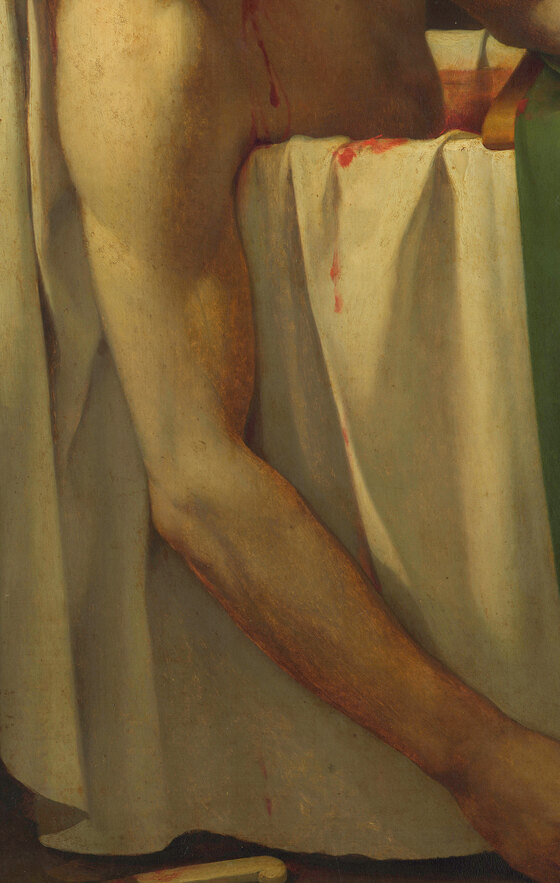
The right arm hangs over the side of the bath, and the fingers still hold the quill pen. He died writing. David had studied in Rome and knew Caravaggio's Entombment, where the dead Christ's arm hangs exactly like this. He borrowed it on purpose. The Revolution had closed the churches; David gave it a Pietà of its own.
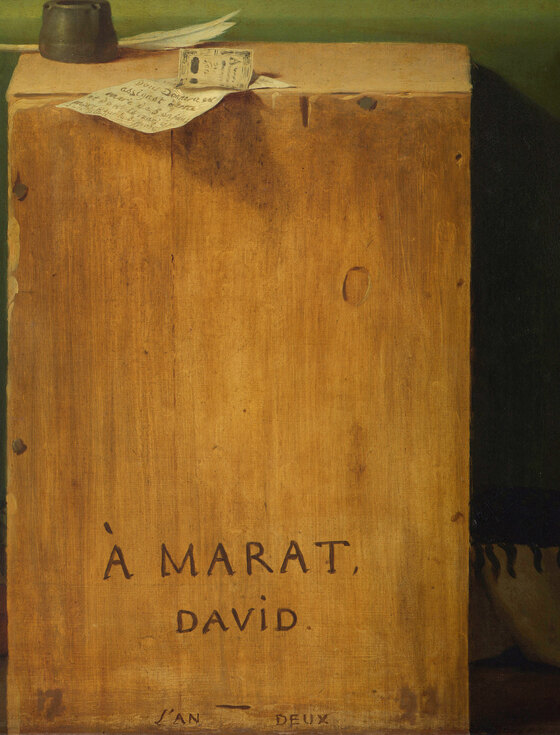
Beside the bath stands a rough wooden packing crate that Marat used as a desk. On top of it: an inkwell, a second pen, and a banknote with a note in Marat's hand saying that it is to be given to a mother of five children whose husband died for the country. The last thing the dead man did, the painting says, was give money to a widow.
On the front of the crate, cut as if into stone: À MARAT. DAVID. L'AN DEUX. To Marat, from David, Year Two of the Republic. The crate is a tombstone, and the painter has signed it the way a friend signs a wreath.
Above all this there is nothing. The upper half of the painting is an empty brown wall, lit from the left, taking up almost as much canvas as the body. David could have painted the room, the window, the visitors, the murderer being seized. He painted a void. It is the most modern thing in the picture, and it is why the picture is unbearable to look at for long: there is nowhere else to look.
The painting's fortunes followed the Revolution's. In 1794 Robespierre fell, David was jailed, and the cult of Marat collapsed. The painting was taken down from the Convention and returned to David, who kept it rolled up. When he went into exile in Brussels after Napoleon's fall, he took it with him, and it stayed with his family for sixty years.
In 1846 the poet Charles Baudelaire saw it in a Paris exhibition and wrote the lines everyone has quoted since:
As cruel as nature, this painting has all the fragrance of the ideal. Where is the ugliness that holy Death so quickly wiped away with the tip of its wing?
Charles Baudelaire, Salon of 1846
That is the paradox in a sentence. The painting is reportage, a real man in a real bath on a real date with a real letter, and it is also an idealised nude with the light of a Pietà. Baudelaire understood that David had not chosen between the two. He had welded them.
The Royal Museums of Fine Arts of Belgium bought it from David's heirs in 1893, and it has been the most famous painting in Brussels ever since. Copies made in David's studio hang in the Louvre, Versailles, Reims and Dijon, which is why the picture turns up in several museums, but the one David painted is in Belgium.
In 1793 it meant one thing: a martyr of the people, murdered by a royalist, deserving of vengeance. The painting was propaganda, and it was engraved and copied and hung in Jacobin clubs across France.
Two centuries later it means something harder. Marat was not a saint; he called for heads, and got them. Corday was not a monster; she thought she was ending a slaughter, and went to the guillotine four days later saying so. David painted the murdered man as innocent because that was his side. The painting has outlived the argument, and what is left is the form: a body, a letter, a crate, a wall, and a stillness that no war painting before it had managed.
That is why it keeps being reused. Edvard Munch painted his own Death of Marat with a naked woman standing over the body. Picasso drew it. It has been photographed with rock stars in the bath and painted with politicians of every colour. It is the template for what a political death looks like when someone decides to make it beautiful.
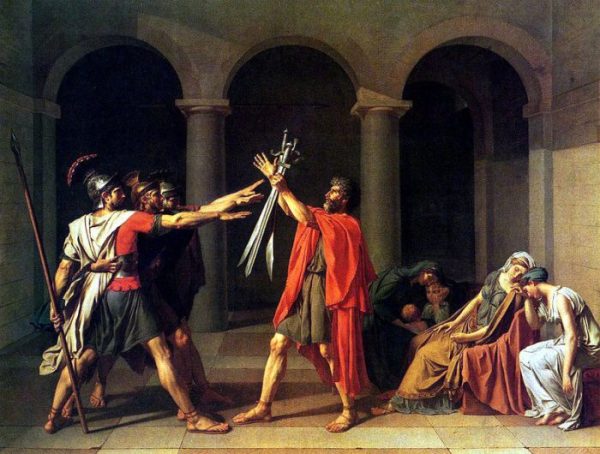
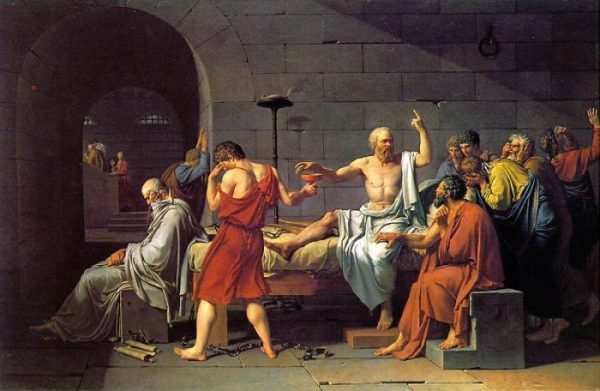
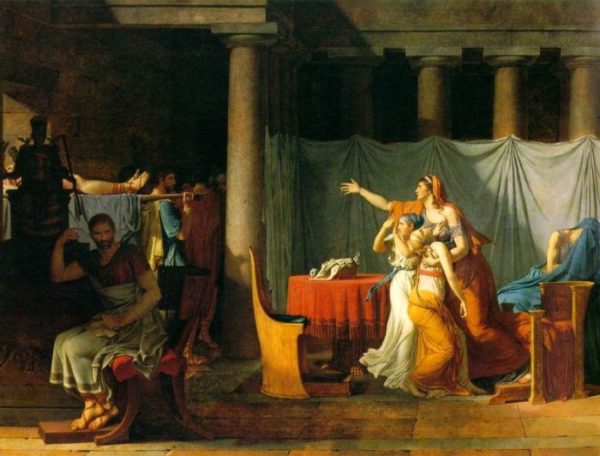
Marat sits at the hinge of David's career. Before it, the great Roman paintings of the 1780s: the Oath of the Horatii, the Death of Socrates, the Lictors bringing Brutus the bodies of his sons. Moral dramas from antiquity, painted for a monarchy that did not see what was coming. After it, ten years later, David was First Painter to an emperor, painting Napoleon Crossing the Alps and the Coronation. Marat is the one painting where the Roman virtue and the living politics are the same thing, and it is the best painting he ever made.
In the Royal Museums of Fine Arts of Belgium in Brussels, the same building as Bruegel's Fall of Icarus. It is oil on canvas, 165 by 128 centimetres, so the figure is close to life size. Through the winter of 2025 to 2026 it was lent to the Louvre for the big David exhibition, and has now gone home.
It is a painting for people who want to be asked about it. It works in a study or a hallway, and it wants a plain, dark frame and a wall with nothing else on it, because the empty upper half is part of the design. Our hand-painted reproduction of The Death of Marat is painted in oil on canvas from the Brussels original, letter, crate and inscription included, and the lettering is done by hand.
More David in our Jacques-Louis David collection, and the wider Neoclassicism archive.
Visible details, documented facts and interpretation are kept separate throughout this article. The texts on the letter and the note are given as David painted them, not as historical documents.