Loading cart…
No products in the cart.

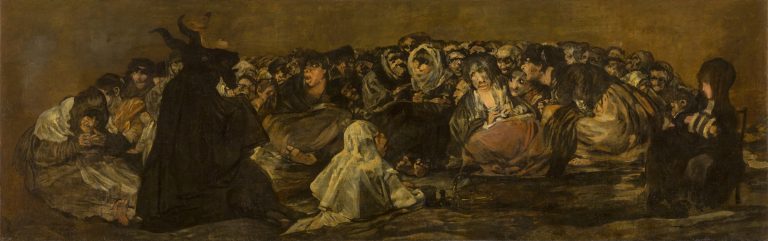
c. 1820 to 1823 · Oil on plaster, transferred to canvas · Museo Nacional del Prado, Madrid
Save articles to your collection
Log in or create a free account, and this article will be waiting in your Private Collection.
Log in or sign up Explore the artistFrancisco de Goya paintings →
The goat is almost a hole in the painting. Its dark back rises in front of a crowd whose eyes, mouths and headcloths catch the little available light. Everyone seems drawn toward the same presence. Yet the image gives us no clear words, no identifiable ceremony and no reassuring distance from the people listening.
Francisco de Goya’s The Great He-Goat, also called Witches’ Sabbath, belongs to the Black Paintings. Painted around 1820 to 1823, it is now in the Museo del Prado. Its fear comes as much from the gathering as from the horned figure: attention has become a collective act, and the crowd seems unable to look elsewhere.
This is the long, late mural with the seated woman at the right. It is a different work from Goya’s smaller Witches’ Sabbath of 1798. The shared subject and English title can make the two easy to confuse.
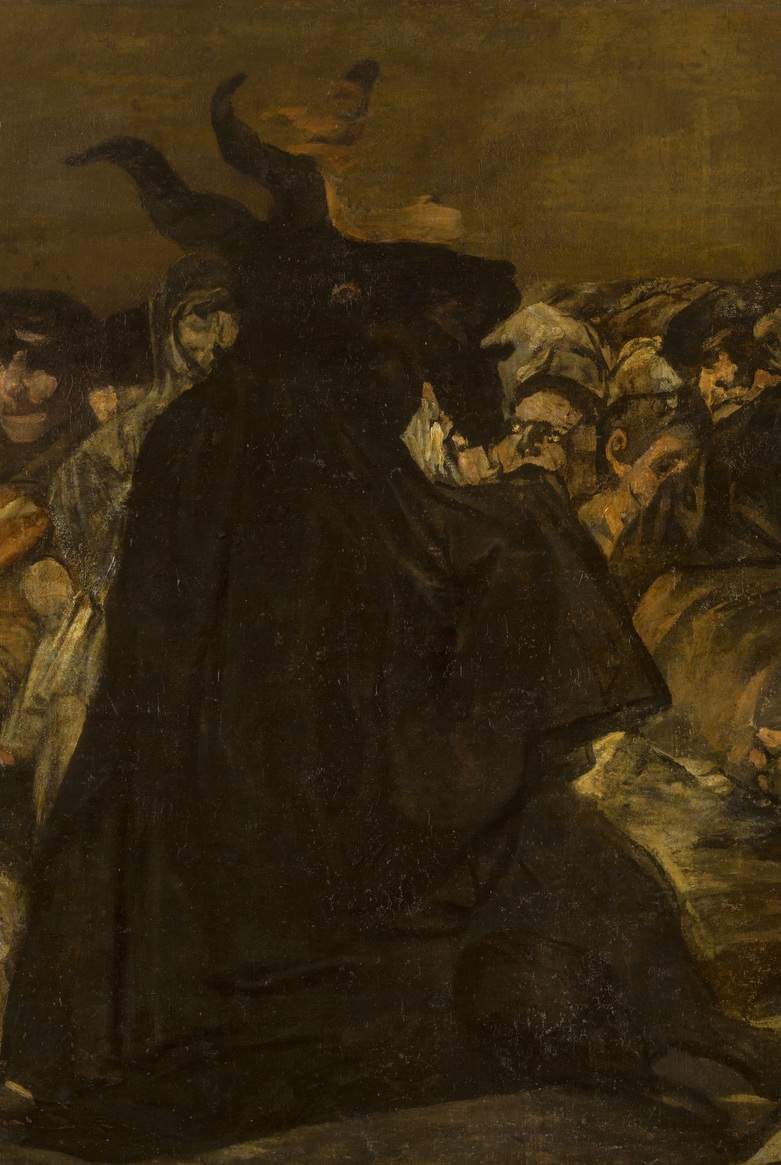
A he-goat is a male goat. Here the horns, pointed muzzle and enormous dark body identify the presiding creature, while its upright posture gives it the bearing of a speaker. The Fundación Goya catalogue identifies it as the devil in goat form at a witches’ gathering.
The animal does not spring at anyone. It occupies its place with an unsettling lack of effort. The horns stand out against empty brown space, while the lower body merges with the ground. Human faces have to struggle for visibility around it; the goat needs only its silhouette.
That arrangement makes authority visible before it makes violence visible. We can read the figure as a demonic leader within the scene, while also noticing how Goya has constructed its power through scale, position and the direction of the listeners’ faces. The image does not require us to believe in the apparition in order to understand the pressure it exerts.
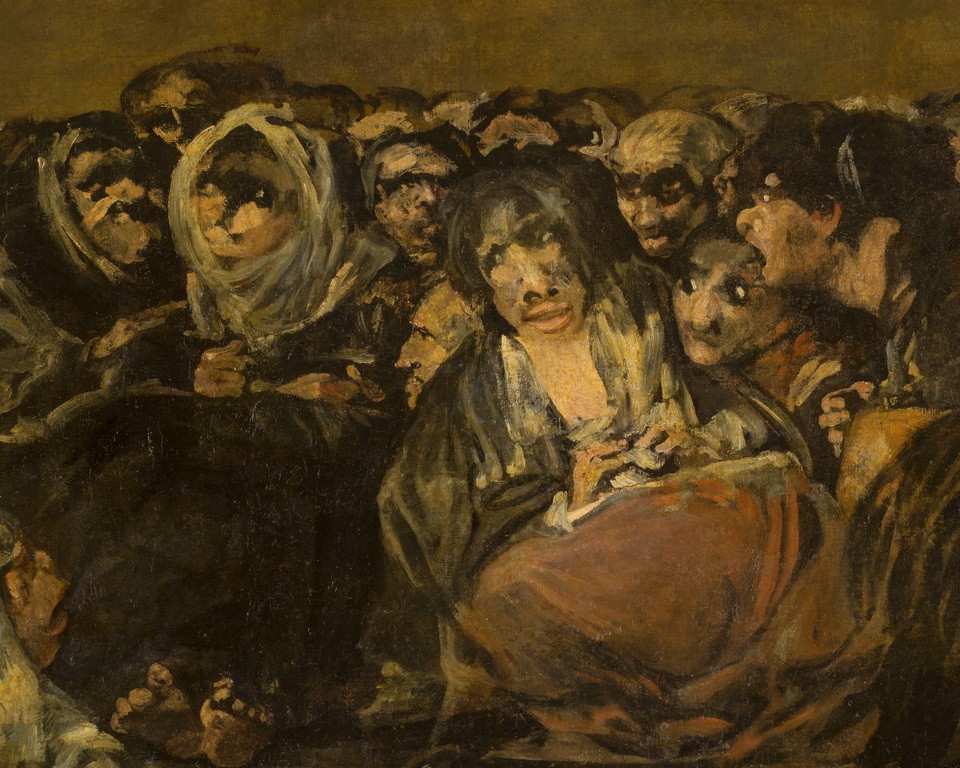
The crowd is not a row of interchangeable monsters. Some mouths hang open; some faces lean forward; others retreat into the folds around their heads. A pale face near the middle looks almost blank beside the more sharply angled features around it. Moving from one to another, the viewer keeps encountering a different response to the same unseen message.
Goya packs these expressions into a shallow strip. There is little room to step back and assess what is happening. Heads overlap, clothing loses its boundaries and bodies become difficult to separate. The gathering seems to generate its own enclosure without walls or a roof.
One possible reading is an attack on credulity: the people lend power to what they fear. Another stresses domination, with a crowd organized around an intimidating presence. These interpretations can coexist, but neither gives us a documented transcript of Goya’s intention. His image is more disturbing than a simple illustration of foolish people believing a foolish story. The fear has weight, and the people caught inside it remain human.
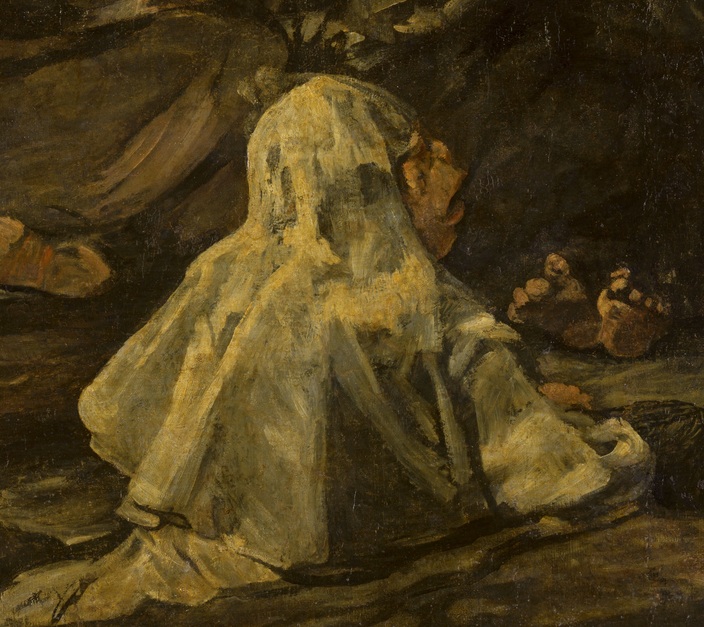
A light-coloured hood or cloth breaks the foreground darkness. The figure beneath it turns away from us and toward the gathering. We cannot inspect its expression as we inspect the faces behind it. Instead, the back of the head becomes an obstacle between the viewer and the circle.
The rough strokes of pale paint give the cloth a restless surface. They also help to separate this figure from the dense knot of listeners. It sits close enough to the goat to participate, but its concealed face prevents a confident account of its identity or feelings.
The catalogue discusses an attendant beside the demon. That identification belongs to the painting’s established interpretation, rather than to an inscription on the figure. The visible evidence is more limited and more effective: somebody is close to the centre of the ceremony, and we are denied their face.
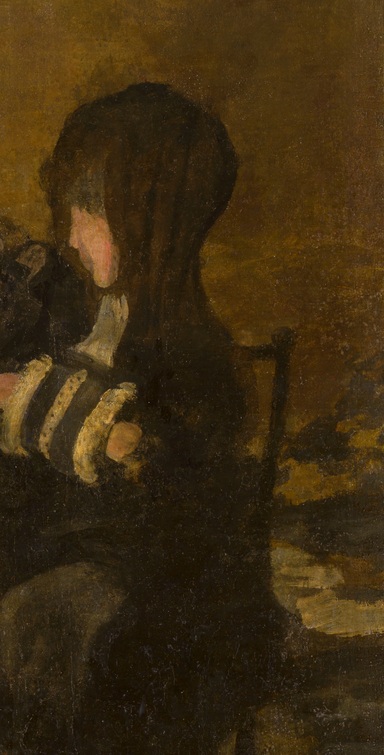
The seated young woman is one of the few figures with space around her. Her dark head covering, pale profile and folded arms create a quieter shape than the crowded faces to her left. She appears to attend the same gathering, but she has not dissolved into its mass.
She is often described as a prospective initiate. That reading offers a possible narrative: a newcomer waits while the group carries out its ritual. It should remain a possibility, because Goya supplies neither a name nor an explicit explanation of what she is about to do.
Her separation changes our experience of the crowd. We can imagine looking toward it from outside rather than being pressed into it. She becomes a point of comparison for the viewer, even though her own attitude remains unreadable. Does her stillness suggest obedience, apprehension or a refusal to move closer? The painting leaves the question active.
The present composition is not the complete original mural. The Fundación Goya records that photographs taken before the work was transferred from the wall show a substantial section, almost a metre and a half, subsequently lost at the right. With that space intact, the seated woman would have occupied a less marginal position.
That history matters when interpreting the picture. The extreme imbalance we now see cannot simply be treated as every inch of Goya’s original decision. Today the woman feels stranded at the edge; the earlier arrangement gave the gathering and its surrounding emptiness a different relationship.
A reproduction can preserve the surviving painting, but it cannot restore the missing wall by guesswork. The full image above therefore shows the extant composition without an invented extension. Its damaged history is part of what we are looking at.
The work began as oil painting on plaster at Goya’s Quinta del Sordo, rather than as an independent canvas. It occupied a long wall on the lower floor, opposite The Pilgrimage to San Isidro. The surviving painting measures approximately 140.5 by 435.7 centimetres and is now supported on canvas.
Its wide shape makes more sense when imagined along a room rather than on a small screen. The listeners form an almost continuous band, and the goat’s height interrupts that band like a dark column. The upper area is largely empty, leaving the human activity compressed beneath it.
The Black Paintings also include Saturn Devouring His Son. The works share darkness and physical unease, but darkness alone does not turn them into evidence for a medical diagnosis or one neatly stated political message. Here the most useful starting point remains what Goya made visible: a leader, an audience and the disturbing intimacy between them.
At a distance the crowd seems to resolve into individual people. Close up, much of that recognition depends on abrupt marks: a streak becomes the bridge of a nose, a dab becomes an eye, a broken pale shape becomes an open mouth. Clothing and flesh sometimes seem to be made from the same dirty light.
This handling keeps the scene unstable. The faces are vivid enough to hold our attention but too roughly assembled to become comfortable portraits. Their expressions appear to shift as we move between the group and the separate marks of paint.
The darkest areas work differently. The goat is not described with the same nervous accumulation of facial particulars. Its broad shadow absorbs them. The crowd is agitated; the thing receiving its attention is comparatively still.
The late Black Painting is known by both names. Goya also painted a separate Witches’ Sabbath in 1798, now in the Museo Lázaro Galdiano. The date, collection and long horizontal format distinguish the Prado work discussed here.
It is generally dated around 1820 to 1823. The surviving mural, transferred to canvas, belongs to the Museo Nacional del Prado in Madrid.
It should not be treated as documentary evidence of a ceremony. The supernatural subject supports interpretations about fear, belief and authority, while specific identities and intentions remain uncertain.
Compare this late gathering with Witches’ Flight, where figures resist fear by covering their ears or hiding beneath a cloth. Our guide to 20 famous witch paintings places both works alongside other ways artists imagined magical power.
The surviving composition is available as a hand-painted oil reproduction of The Great He-Goat. Explore the wider Magic and Witchcraft collection for related paintings.
Collection records supply catalogue facts; interpretive possibilities are identified in the text. Full images and detail crops reproduce the historical painting without reconstruction. Collection ownership does not guarantee current display.
Enjoyed this story?
Save articles to your collection
Log in or create a free account, and this article will be waiting in your Private Collection.
Log in or sign up
Man Writing a Letter
Gabriel Metsu, c. 1664
The gallery list
Every painting is already 50% off. Join the list and we will send you an extra $15 code, plus first access to new collections.
No spam. Unsubscribe anytime. · Privacy Policy
Welcome
Your $15 code is on its way. Explore the gallery while you wait.