Loading cart…
No products in the cart.

1819 to 1823 · Oil on plaster, transferred to canvas · Museo del Prado, Madrid
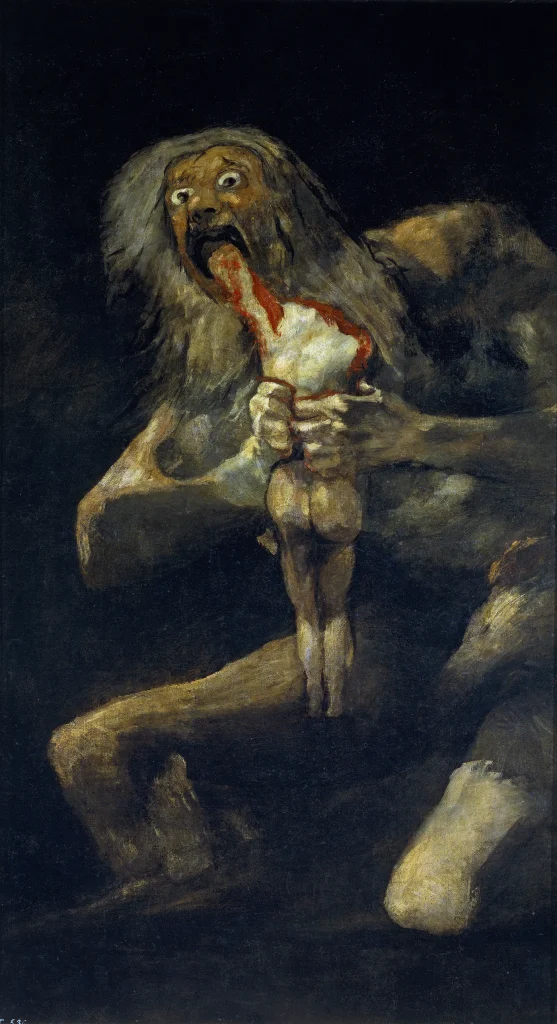
Nobody commissioned this. Nobody was meant to see it. Goya painted it directly onto the plaster of the ground-floor dining room of his own house, and he ate his meals in front of it.
In 1819, aged seventy-three, he bought a farmhouse on the outskirts of Madrid that the locals already called the Quinta del Sordo, the Deaf Man's House, after a previous owner. Goya had been deaf himself since an illness in 1793, so the name fitted. That winter he nearly died of another illness. When he recovered, he began covering the walls of two rooms with paintings in oil straight onto the plaster: fourteen of them, dark, strange and private. He gave them no titles and left no explanation. We call them the Black Paintings, and this is the one everybody knows.
It faced a portrait of Leocadia Weiss, the woman who lived with him, across the dining room. In the same room were a witches' sabbath, a pilgrimage turned into a march of the damned, and two old men eating soup. That was where he ate.
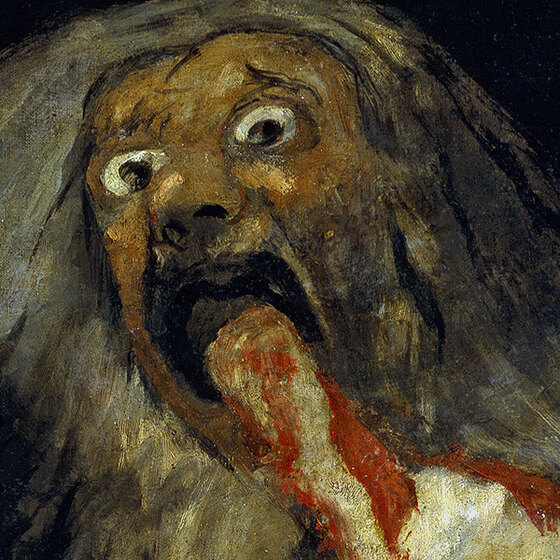
Most people remember the mouth. The thing to look at is the eyes. They are huge, white-ringed, staring out of the dark not at his victim but past it, at nothing, at us. This is not the face of a monster enjoying a meal. It is the face of someone who cannot stop what he is doing and knows it.
That is what separates Goya's Saturn from every other one. The god is not cruel. He is frightened, and the fear has made him mad. His hair stands out from his head, his fingers dig into the body until they draw blood, and he crouches in the dark like something that has been caught.
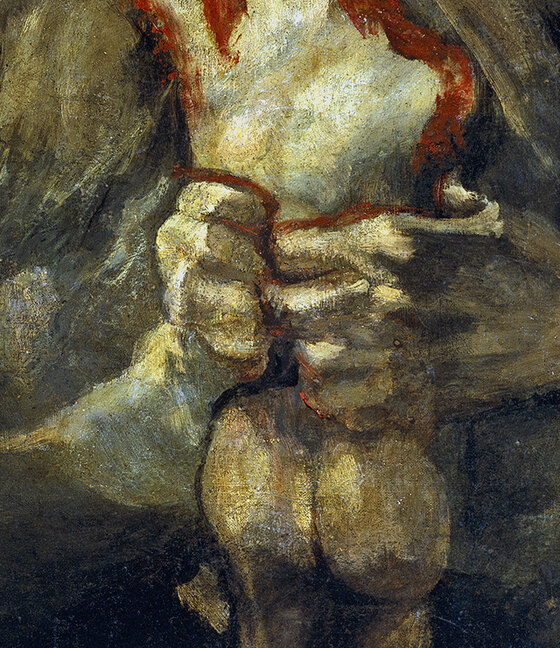
In the myth Saturn eats his children as infants. Look at what Goya painted: the body has adult proportions, a grown back, hips, buttocks and legs. The head and one arm are already gone; he is working on the other arm. Blood runs where he has torn the shoulders open.
Many viewers, from the nineteenth century on, have read the body as a woman's. Goya gives no answer, and that is typical of these paintings: the one clear thing in the picture is the act, and everything around it is uncertain. Some accounts also claim that the figure of Saturn was originally painted with an erection, later covered over when the mural was moved. Photographs of the wall before the transfer are not clear enough to settle it, and the Prado does not confirm it. It is repeated so often that you should know it exists, and know that it is not established.
Saturn, Cronus to the Greeks, was told that one of his children would overthrow him as he had overthrown his own father. So he swallowed each child as it was born. His wife hid the sixth, Jupiter, and gave Saturn a stone wrapped in cloth instead. Jupiter grew up, forced his father to vomit up his brothers and sisters, and took his throne. The prophecy came true because Saturn tried to stop it.
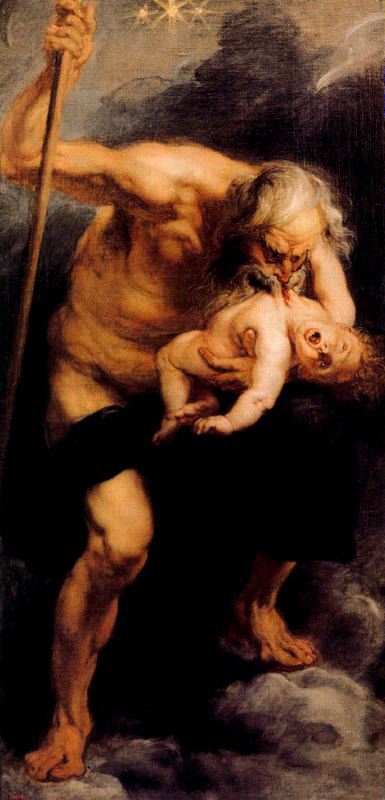
Goya knew a very particular painting of this story. Rubens' Saturn, painted in 1636 for the Spanish king, hung in the royal collection in Madrid where Goya, as court painter, saw it for decades. It shows a muscular old god biting into the chest of a screaming baby while the child's arms flail. It is horrible and it is completely composed: the god is beautiful, the light is clear, the baby is a baby.
Put the two side by side and you can see what Goya did. He took away the composure. The god is no longer beautiful, the light no longer clear, the child no longer a child. Rubens painted a myth. Goya painted what it would feel like to be inside it.
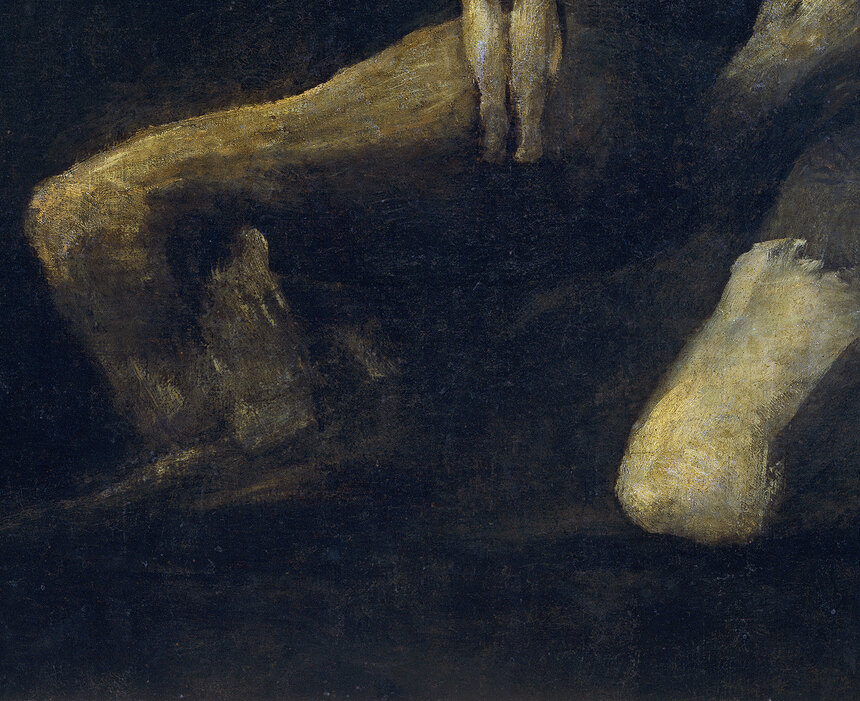
By Goya's time Saturn had long been confused with Chronos, Time, and pictures of him carried the old meaning as well as the myth: time eats its children, everything that is born is consumed. An old man who had just nearly died, painting in a house whose name announced his deafness, knew exactly which meaning he was choosing.
In 1820, the year after the illness, Goya painted himself half-conscious in bed, held up by the doctor who saved him, with an inscription thanking Dr Arrieta for his skill. The Saturn is the other side of that gratitude. He had looked at death from very close and come back, and what he brought back was this.
There is a political reading as well, and it is not wrong. Ferdinand VII had returned to the throne in 1814 and spent the next years hunting down the liberals Goya counted as friends. A Spain that devours its own children was not a distant idea in 1820. But the painting does not need the politics. It is enough that the man who painted it was seventy-four and could hear nothing.
Goya left the house in 1824, went into voluntary exile in Bordeaux and died there four years later. The paintings stayed on the walls for fifty years, seen by almost nobody, through several owners of the farmhouse.
In 1873 a French banker, Baron Émile d'Erlanger, bought the property and had the murals cut from the plaster and transferred to canvas by the Prado's restorer, Salvador Martínez Cubells. The operation was rough. Paint was lost, edges were trimmed, some passages were repainted, and what survives is a damaged copy of whatever Goya put on the wall. D'Erlanger showed them at the Paris World's Fair of 1878, found no buyers, and in 1881 gave them to the Spanish state. They have hung in the Prado since 1889.
So the Saturn you see in Madrid, and in every reproduction including ours, is a mural that has been through a saw, a glue pot and a restorer's brush. The darkness around the figure is partly Goya's and partly the century since. Nobody alive has seen the original in its room.
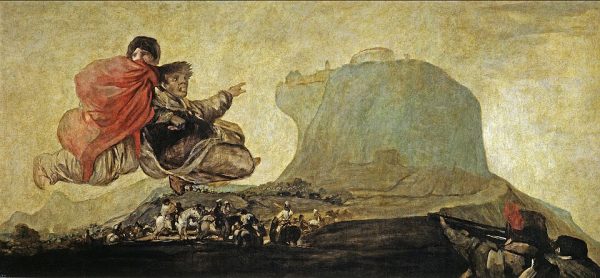
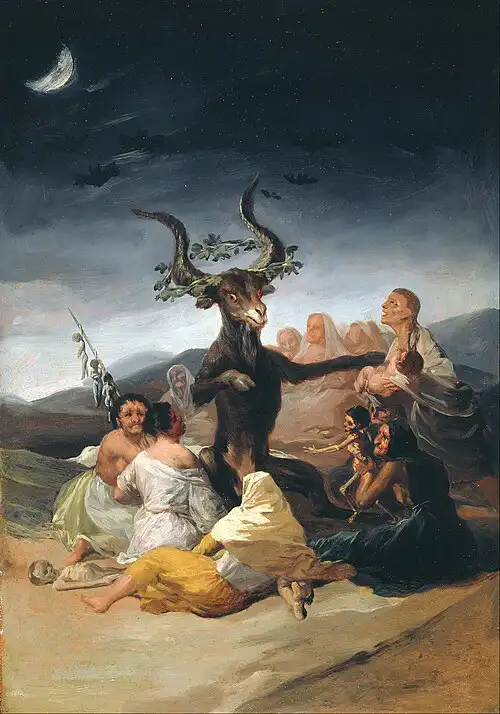
Saturn is the most famous of the fourteen, but it is one of a set. On the same floor were the Witches' Sabbath, with its great he-goat preaching to a crowd of hags; Two Old Men Eating Soup; a Pilgrimage to San Isidro that turns a festival into a procession of the damned; and, upstairs, Asmodea, two figures flying over a battlefield, and the half-buried Dog looking up at an empty sky. Goya had painted witches before, in the bright, satirical Witches' Sabbath of 1798; the Black Paintings are what those jokes look like after a war.
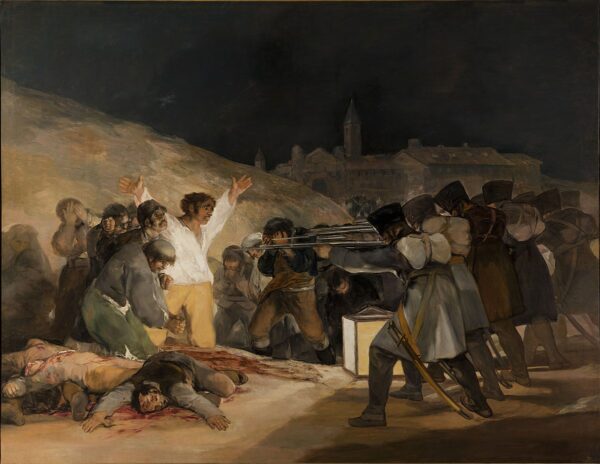
If you want to understand how a painter gets from the public horror of The Third of May 1808 to the private horror of the Saturn in five years, the answer is in that room.
In the Museo del Prado, Madrid, in the rooms given over to the Black Paintings, catalogue number P000763. It is oil on plaster transferred to canvas, 143.5 by 81.4 centimetres, taller than it looks in reproduction and narrower: a doorway, not a window.
People who order this painting know what they are ordering. It goes in studies, in collectors' hallways, in the homes of people who like to be asked about it. Our hand-painted reproduction of Saturn Devouring His Son is painted in oil on canvas from the Prado composition, and the painter's job here is mostly darkness: the greys of the flesh against the black, the one red passage, and the eyes. Hang it where the light is low and give it a plain dark frame. It does not need help.
The rest of Goya, from the Majas to the war, is in our Francisco de Goya collection.
Visible details, documented facts and interpretation are kept separate throughout this article. The sex of the victim and the claim of an overpainted erection are reported as unsettled.