Loading cart…
No products in the cart.

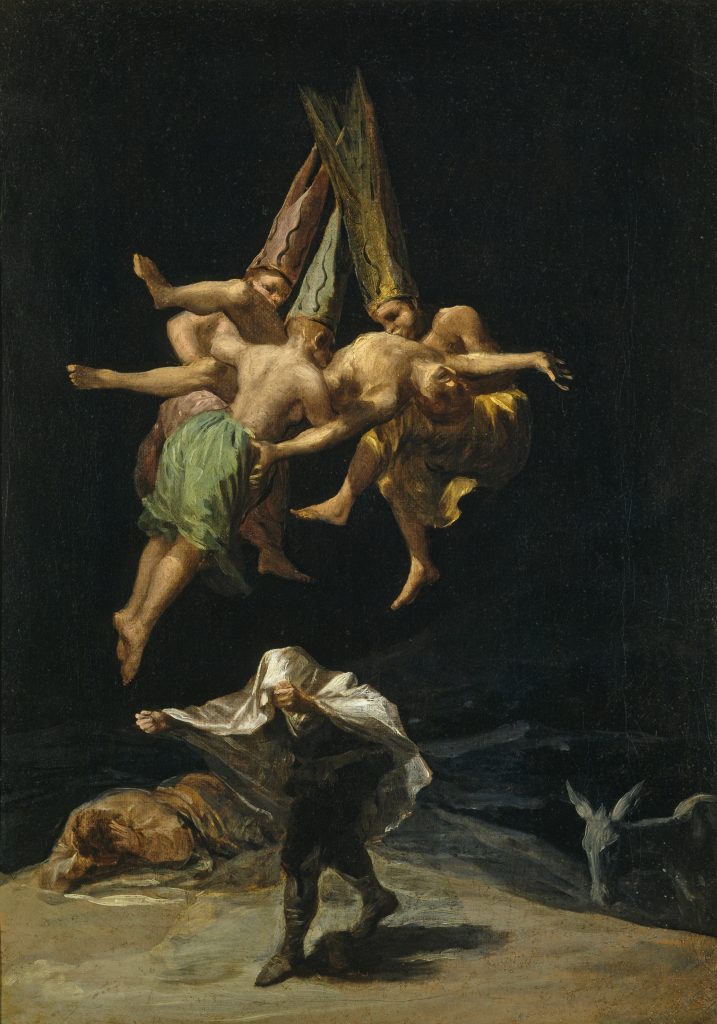
c. 1798 · Oil on canvas · Museo Nacional del Prado, Madrid, Room 036
Save articles to your collection
Log in or create a free account, and this article will be waiting in your Private Collection.
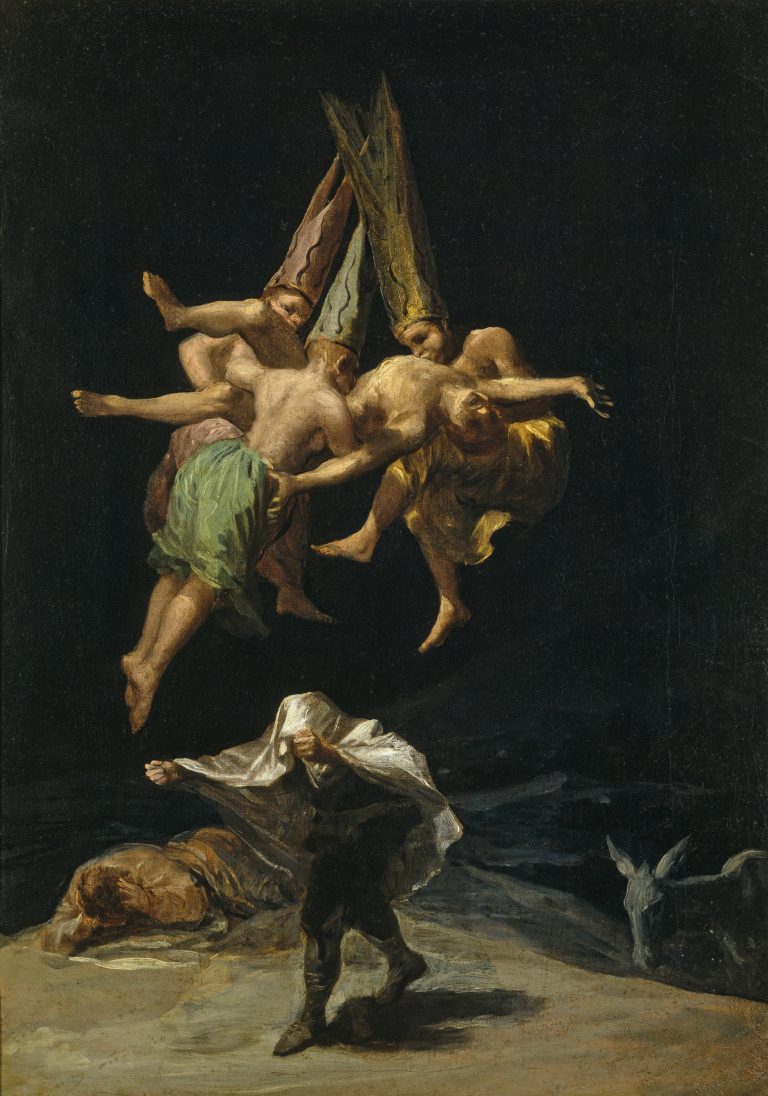
Log in or sign upThree men hover in a black sky, their bare chests and long pointed caps caught by a hard light. They support a fourth nude figure whose body hangs across their arms. Below them, one man has collapsed and pressed his hands over his ears. Another runs away under a white cloth. At the lower right, a donkey's head emerges from the darkness.
Goya gives us no landscape to explain where the group is going. The sky is almost empty, the ground is barely visible, and the figures occupy separate worlds. Above, the ritual appears controlled and deliberate. Below, the witnesses react with panic. That split is the key to the painting: belief seems powerful in the air because fear has already taken hold on the ground.
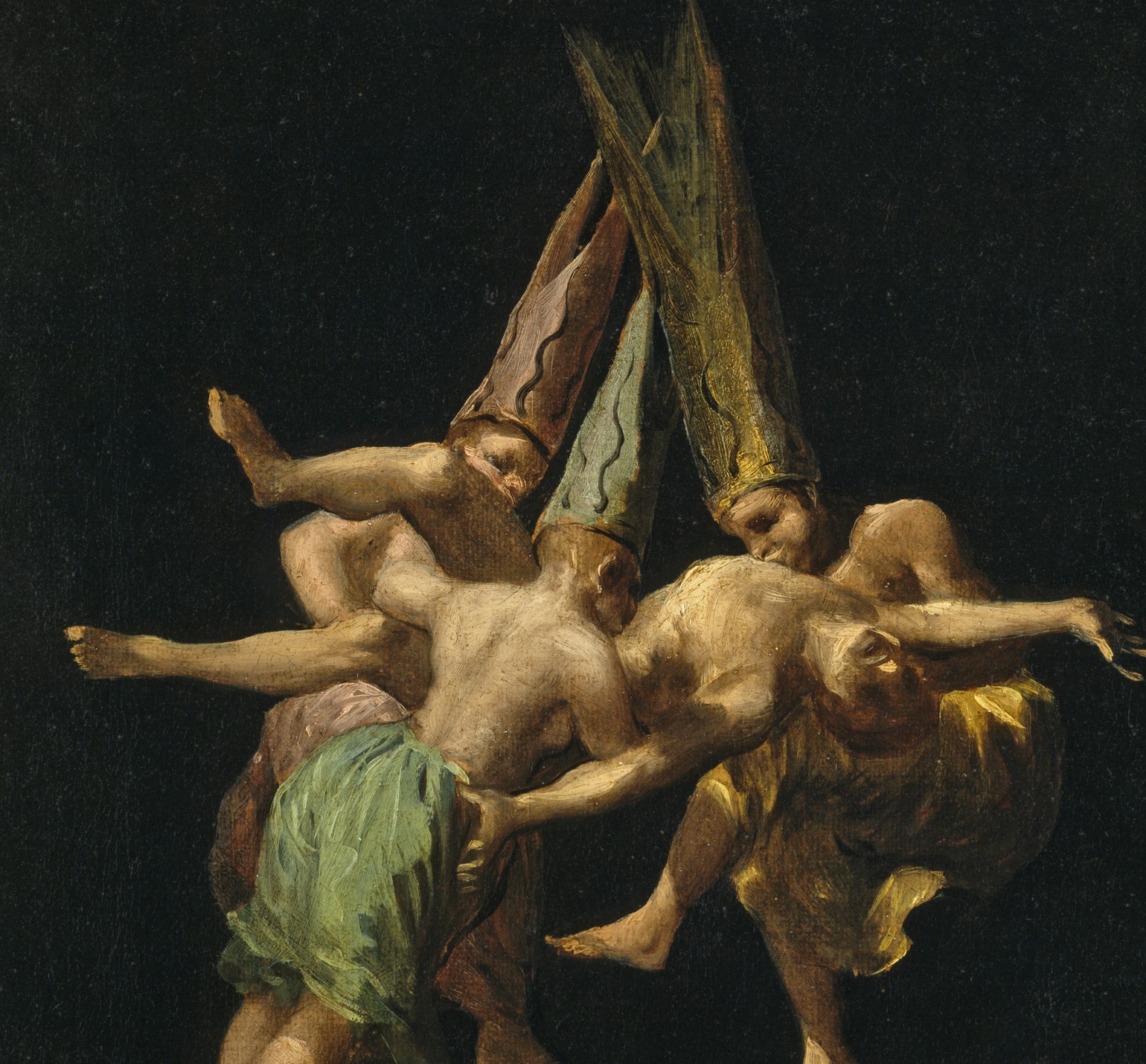
The Museo del Prado describes the three bare-chested figures as characters wearing dunce caps. They are usually identified as witches or sorcerers because the painting belonged to a group of witchcraft scenes and because flight was one of the supernatural powers long attributed to witches. Their close formation makes them look like a single ritual machine. One holds the victim's legs, another supports his torso, and the third bends toward his upper body.
Goya does not give them the exaggerated claws or animal bodies of conventional demons. They look human. That choice makes the scene less like a fantasy illustration and more like an act carried out by people who have accepted a shared delusion. Their gravity-defying flight is impossible, yet their concentration is ordinary.
The suspended figure is limp, his head tilted back and one arm stretched outward. The three men appear to breathe, bite, or press their mouths toward his body, but the painting does not clearly show what they are doing. Descriptions often call the moment a sacrifice or a ritual. The safest conclusion is that he is powerless and being carried or acted upon.
That uncertainty is deliberate. Goya stops before an outcome. He gives us the physical fact of a helpless body and lets the black space around it fill with what the viewer fears might happen next. Like many of his most disturbing images, the painting works through suggestion rather than a complete story.
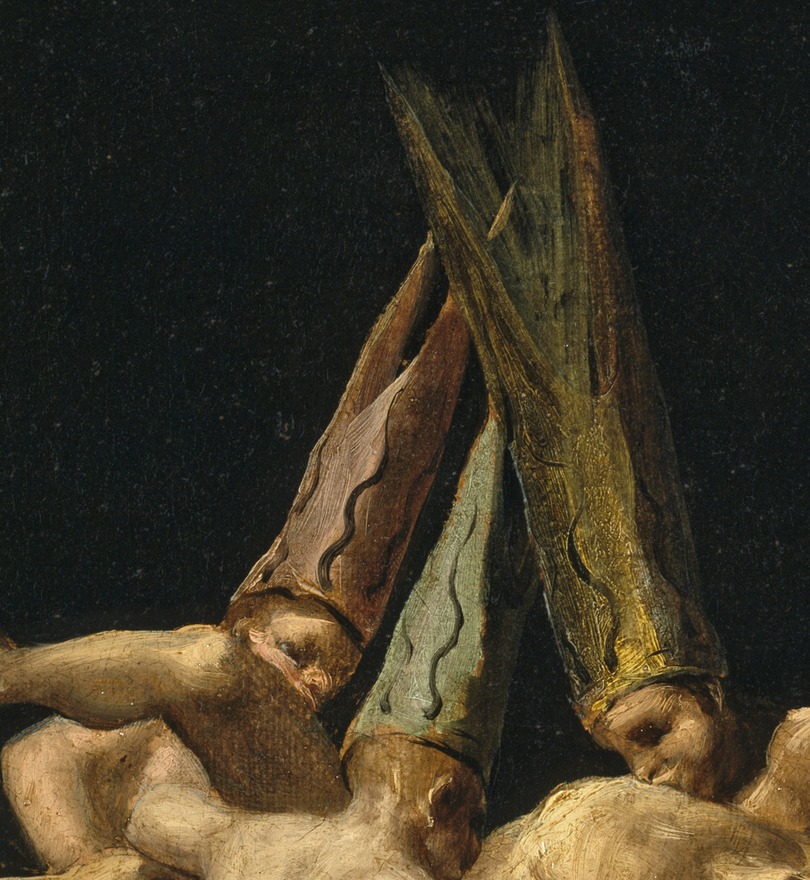
The caps are among the painting's most conspicuous details. The Prado calls them dunce caps. Their tall, tapering shape also recalls the penitential garments used in images connected with the Spanish Inquisition, although the painting does not label them as official capirotes or corozas. Goya leaves the association open.
Visually, the caps turn three heads into three sharp verticals. Their tips converge above the figures, binding the group together and making it resemble a dark parody of a religious composition. If the caps suggest shame, punishment, or folly, the irony is severe: the figures wearing them believe themselves powerful enough to fly.
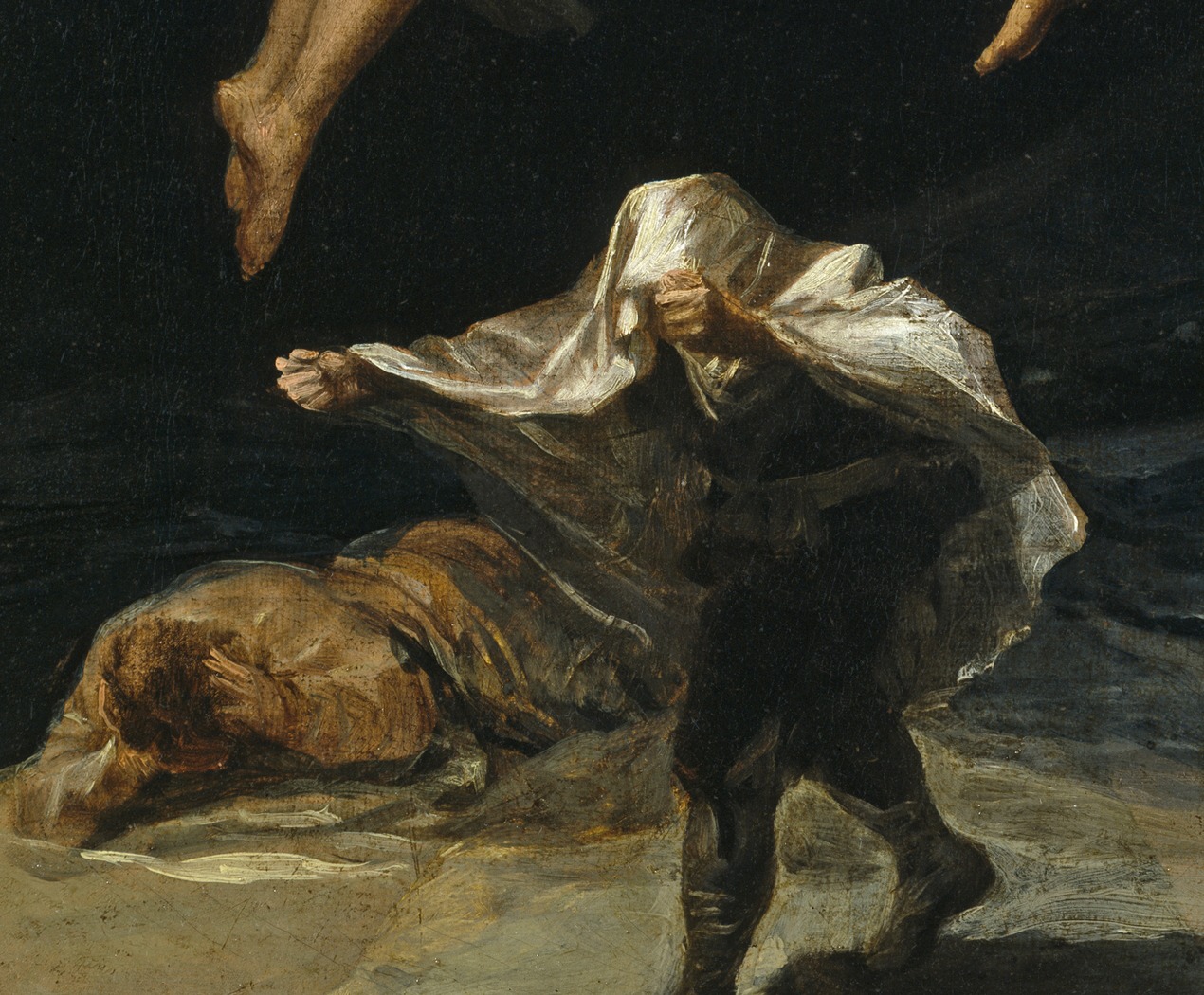
The man on the ground has folded into himself and covered his ears. The standing figure throws a white cloth over his head as he runs. Together they make a compact image of refusal: one will not hear and the other will not look.
They may be escaping the witches, but their gestures also show how superstition protects itself. Fear discourages close examination. The impossible event remains powerful because the witnesses turn away from evidence. Goya had spent years among Spanish Enlightenment thinkers who criticized ignorance, credulity, and the institutions that profited from them. The painting can therefore be read as more than a supernatural scene. It becomes a study of how terror controls attention.
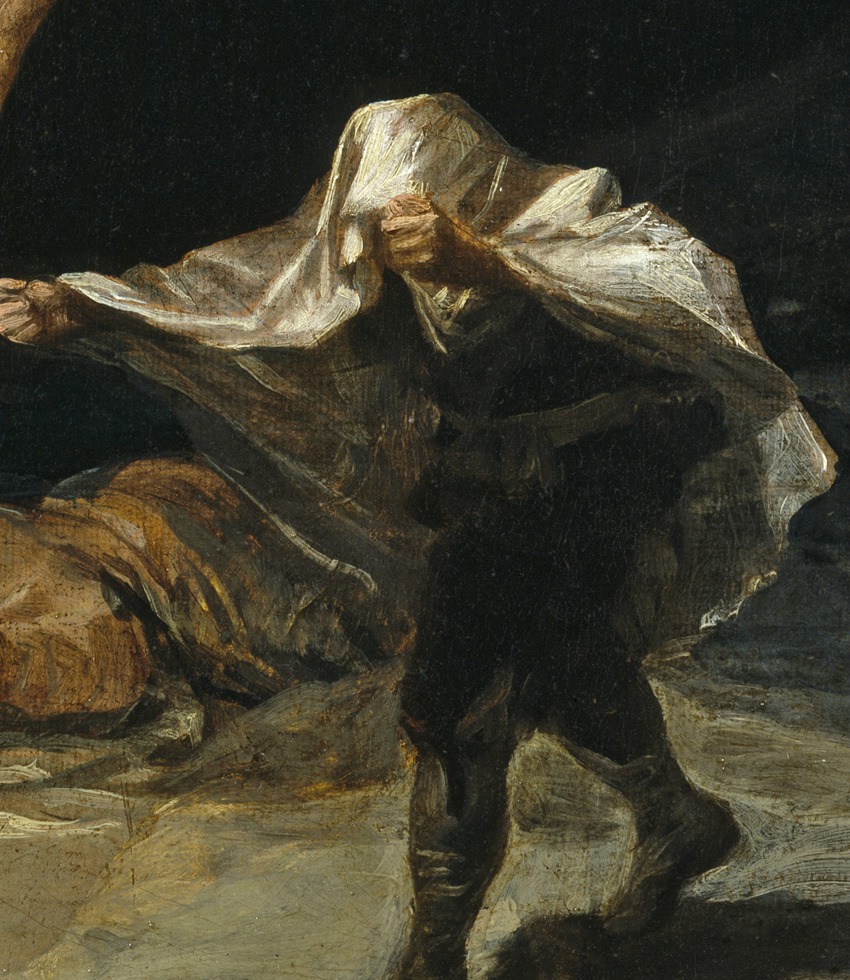
The fleeing figure extends one hand with the fingers arranged in a protective sign. The Prado identifies it as a gesture against the evil eye. He is not simply running. He is trying to defend himself with another piece of folk belief.
This is one of Goya's sharpest visual jokes. A man confronted by an irrational vision answers it with a superstitious charm. The gesture does not free him from fear. It confirms the world that fear has created.
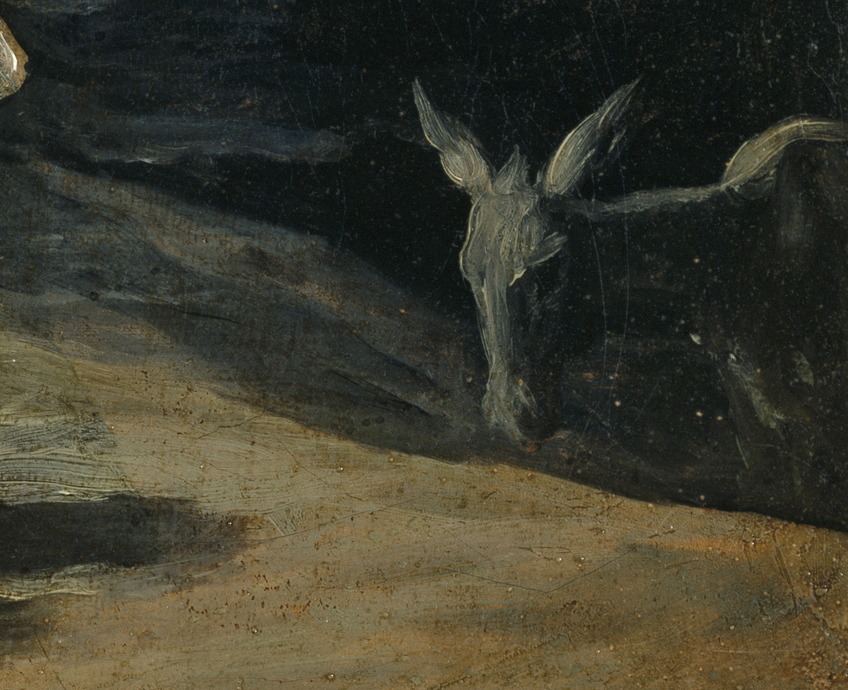
The donkey is almost hidden, but Goya placed its pale muzzle where it catches the same light as the human figures. In his Caprichos, donkeys repeatedly stand for ignorance, vanity, and people who mistake foolishness for learning. The animal here may carry the same association, though the painting offers no caption to make that meaning certain.
It also provides a quiet counterpoint to the panic. The people hide, gesture, and flee. The donkey simply looks. Goya lets the supposedly foolish animal become the calmest witness in the picture.
The evidence strongly supports that reading, provided it is stated as interpretation rather than a single fixed answer. Witches' Flight was painted at the same moment that Goya was preparing the Caprichos, his print series attacking folly, hypocrisy, bad education, and irrational belief. Witches appear repeatedly in those prints as grotesque teachers, flying bodies, and symbols of a world in which reason has failed.
Yet the painting does not feel like a simple joke. Goya understood that imaginary beliefs can have real consequences. The flight may be impossible, but the terror below is genuine. His subject is not only whether witches exist. It is what people do when they believe that they do.
This places the work close to Goya's Witches' Sabbath, painted for the same commission, and anticipates the darker world of Saturn Devouring His Son. It does not belong to the later Black Paintings, but it shows Goya already using darkness as a psychological space.
Goya sold six small paintings of witchcraft to the Duke and Duchess of Osuna in 1798. They were intended for their country estate at La Alameda, outside Madrid. The Osunas were major patrons of the arts and associated with Enlightenment culture, so the pictures were not devotional images or proof of belief in witches. They were sophisticated, unsettling cabinet paintings made for viewers who could recognize superstition as a social subject.
The group included scenes now known as Witches' Flight, Witches' Sabbath, The Spell, and The Devil's Lamp, with the surviving works now dispersed among different collections. Seen together, they show Goya testing different forms of fear: ritual, sacrifice, apparitions, enchanted interiors, and bodies that defy gravity.
The original is in the Museo Nacional del Prado in Madrid, where it is displayed in Room 036. It is smaller than its visual impact suggests: 43.5 by 30.5 centimetres, oil on canvas. The Prado acquired it around 1999 to 2000 with funds from the Villaescusa legacy.
For a work of this size, Goya creates an enormous depth of night. The figures seem to float beyond the limits of the canvas, while the ground is compressed into a narrow ledge of fear. Our hand-painted oil reproduction of Witches' Flight preserves the original vertical proportions and can be ordered in several sizes. Continue with our guide to famous scary paintings or explore more works in Magic and Witchcraft Paintings.
Enjoyed this story?
Save articles to your collection
Log in or create a free account, and this article will be waiting in your Private Collection.
Log in or sign upDocumented facts and visual interpretation are identified separately throughout this article. Artwork images are in the public domain.