Loading cart…
No products in the cart.

1911-1912 · Oil on canvas · Osterreichische Galerie Belvedere, Vienna, Austria
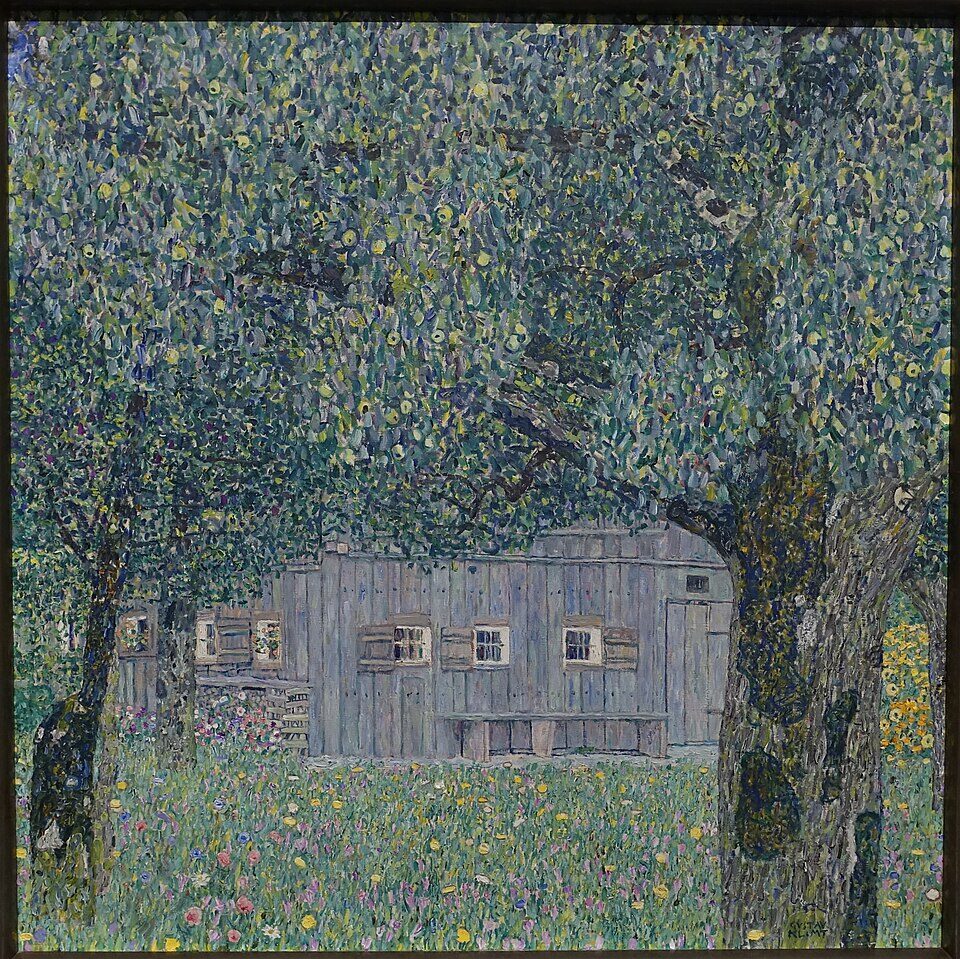
Gustav Klimt painted Farmhouse in Upper Austria during the summers he spent at Lake Attersee in the Salzkammergut region, a practice he maintained for many years as a retreat from his intensive studio work and social obligations in Vienna. These summer painting excursions were an essential part of his working life, and the landscapes he produced during them form a substantial and distinctive body of work that is often overshadowed by the more celebrated figurative and allegorical paintings. Klimt would use a small viewing device, similar to a telescope, to isolate sections of the landscape and select his compositions, which accounts for the characteristic cropped and compressed quality of his landscape paintings. The farmhouse depicted in this painting is believed to be one of the agricultural buildings in the villages surrounding Lake Attersee, which Klimt visited consistently from around 1900 until the years just before his death in 1918. The painting was completed between 1911 and 1912 and is now held in the permanent collection of the Belvedere in Vienna. These landscape works were not commissioned but were undertaken for Klimt's own pleasure and as a counterbalance to the demanding symbolic and figurative work he produced in Vienna. They reveal a dimension of his artistic practice that was less theoretical and more directly sensory, rooted in close observation of light, color, and vegetative texture.
The formal characteristics of Farmhouse in Upper Austria are immediately recognizable as products of Klimt's mature landscape approach. The canvas is square, a format he used consistently for his landscapes to avoid the conventional horizontal or vertical orientation associated with the genre and to create a more abstracted, icon-like sense of the scene. The farmhouse occupies the center of the composition but is almost swallowed by the surrounding vegetation, its walls and windows becoming simply another pattern within the overall tapestry of the surface. There is no sky visible, no horizon line, and no single clear focal point, which flattens the sense of depth and pushes the viewer into a purely surface-based experience of the image. Klimt built the surface of the painting through short, mosaic-like strokes of color that describe individual leaves, flowers, and blades of grass without resolving into a smooth or conventional representation of foliage. This technique reflects the influence of Pointillism and Post-Impressionism, particularly the work of Paul Signac and Georges Seurat, whose use of color as a structural element rather than a descriptive one had become widely known in Vienna by this period. The result is a surface that vibrates with accumulated small marks, creating an effect closer to tapestry or mosaic than to conventional oil painting. The colors are intense but harmonious, with greens, yellows, and occasional reds and whites distributed across the surface in a way that feels simultaneously natural and highly ordered.
The meaning of Farmhouse in Upper Austria operates differently from the symbolic density of Klimt's figurative works. Where paintings like Hope II or Judith I carry layers of literary, philosophical, and psychological reference, this landscape invites a more direct and sensory engagement. The painting can be understood as an expression of Klimt's deeply felt connection to the natural world of the Austrian countryside, a connection that sustained him emotionally and creatively throughout his career. The absence of human figures is not incidental but deliberate, the landscape is presented as complete in itself, without requiring human presence to give it meaning or scale. At the same time, the painting reflects Klimt's characteristic tendency to find pattern and order within apparent natural chaos. The farmhouse, as a human structure embedded within the landscape, serves as a quiet reminder that culture and nature exist in a relationship of mutual penetration rather than opposition. The building does not dominate the vegetation but is held within it, suggesting a vision of human habitation that is integrated into rather than imposed upon the natural world. This reading connects the landscape paintings to Klimt's broader philosophical concerns with harmony, continuity, and the relationship between the decorative and the organic. The painting ultimately argues, through purely visual means, that beauty is not the exclusive property of grand symbolic subjects but is equally available in the quiet, sunlit surfaces of an ordinary summer afternoon.