Loading cart…
No products in the cart.

1909 · Oil on canvas · Galleria d'Arte Moderna, Venice, Italy
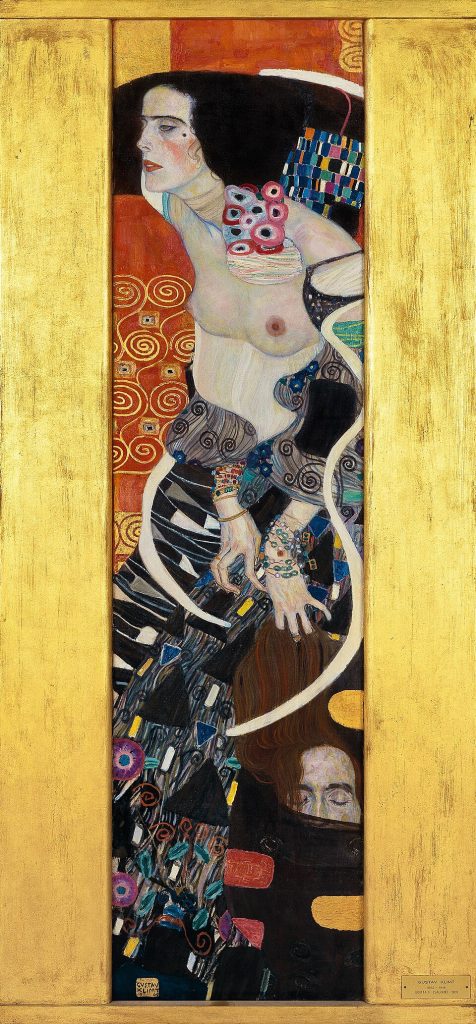
Gustav Klimt painted Judith II in 1909, several years after his first treatment of the Judith theme in 1901. The second painting was produced during a transitional period in Klimt's career, as he began moving away from the flat gold-leaf surfaces of his Golden Phase toward a more dynamic and expressively brushed style influenced in part by the work of Henri Matisse and other contemporary European painters. The work was exhibited at the ninth exhibition of the Vienna Secession and later shown in Venice, where it entered the collection of the Galleria d'Arte Moderna, also known as Ca' Pesaro. Its vertical format, at 178 by 46 centimeters, is unusual among Klimt's figurative works and gives the composition a narrow, almost friezelike quality. The painting has often been discussed in relation to its earlier counterpart, Judith I, which is held in Vienna. Together they represent Klimt's sustained engagement with the Old Testament story of Judith, the widow who seduces and beheads the Assyrian general Holofernes to save her people. In the second painting, however, the psychological tone shifts considerably. Where Judith I presents a figure of composed and sensual authority, Judith II conveys something more frantic and visceral. The work was exhibited under the title Salome in some early catalogues, reflecting contemporary uncertainty or deliberate ambiguity about whether the subject was Judith or the New Testament figure of Salome, another femme fatale associated with decapitation. Klimt himself did not resolve this ambiguity publicly.
The composition of Judith II is dominated by the vertical sweep of the central figure, whose body is angled slightly forward and whose hands grip the severed head of Holofernes at the lower right of the canvas. The figure is dressed in a richly patterned garment that contrasts with areas of exposed flesh at the torso and arms. Her head is thrown back slightly, her mouth open, and her expression conveys a state of intense arousal or ecstasy that blurs the boundary between violence and erotic excitement. This ambiguity was characteristic of Symbolist representations of powerful women and reflects a wider cultural anxiety about female sexuality and agency that circulated in fin-de-siecle Vienna. The brushwork in Judith II is noticeably looser and more gestural than in the earlier gold-leaf works, and the background is rendered in swirling, animated forms that push against the figure and amplify the sense of movement and agitation throughout the composition. The color palette is more varied and emotionally charged than in the Golden Phase paintings, featuring deep purples, muted greens, and warm ochres that collectively create an atmosphere of darkness and intensity. The clawlike quality of the hands holding the severed head is a detail that many commentators have highlighted as particularly striking, suggesting not merely a trophy being carried but something grasped with possessive and almost animal force.
Judith II engages with one of the most charged archetypes in Western art and literature, the woman who uses her sexuality as a weapon and who enacts lethal power over the male body. Klimt was deeply interested in this archetype throughout his career, and the Judith paintings represent his most sustained exploration of it. In the context of Viennese Modernism, the figure of Judith carried specific cultural weight as a symbol of the dangerous, emancipated, and sexually autonomous woman, a figure who both fascinated and unsettled the male-dominated intellectual and artistic establishment of the time. By depicting Judith not as a pious heroine but as a figure of barely contained erotic energy, Klimt situated her within the Symbolist tradition of the femme fatale. The ambiguity surrounding whether the subject is Judith or Salome enriches the symbolic resonance of the work, because both figures share the same narrative structure of seduction, beheading, and triumph. This deliberate blurring of identity suggests that Klimt was less interested in illustrating a specific biblical episode than in exploring a broader archetype of female power. The narrow vertical format reinforces this reading by giving the figure an imposing, towering presence that dominates the viewer's field of vision. The painting invites reflection on the cultural construction of femininity, on the relationship between desire and danger, and on the ways in which art both reflects and shapes social anxieties about gender and power.