Loading cart…
No products in the cart.

1913 · Oil on canvas · National Gallery Prague, Prague, Czech Republic
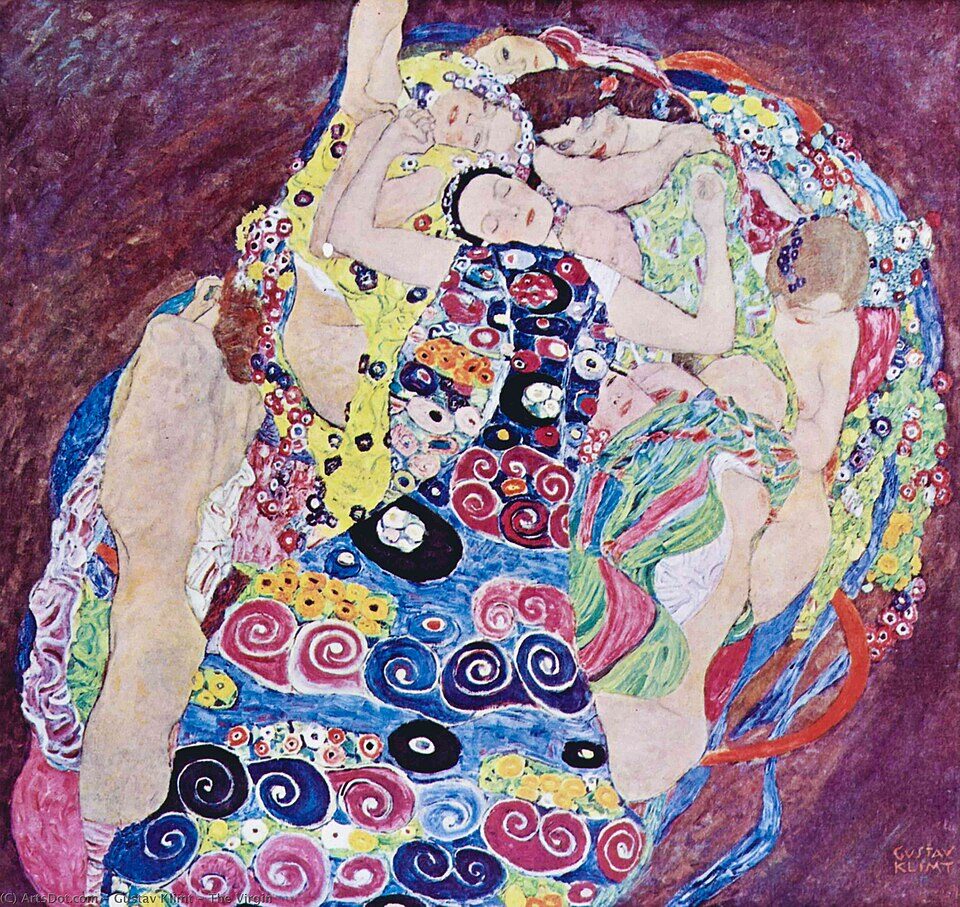
Gustav Klimt painted The Virgin in 1913, a period in his career when he was moving gradually away from the dense gold ornamentation of his earlier Golden Period toward a looser, more painterly approach influenced by the work of younger artists, including Egon Schiele, who had become part of his immediate circle. The painting was commissioned and completed during a time of significant personal and artistic transition for Klimt. He had recently concluded his work on several large-scale allegorical commissions and was returning to a more intimate exploration of the female figure as a subject. The work was acquired by the National Gallery in Prague, which holds one of the most significant collections of Klimt paintings outside of Vienna. The Virgin occupies an important position in Klimt scholarship because it demonstrates the evolution of his approach to depicting groups of female figures. Earlier works such as the Beethoven Frieze had arranged female forms in procession or confrontation, but here Klimt adopted a more centripetal composition, drawing all the figures inward toward a shared center of gravity. The painting was exhibited during the artist's lifetime and received considerable critical attention for its departure from the hard-edged decorative clarity of his Golden Period works. It reflects the broader shifts occurring in Viennese art during the years immediately preceding the First World War, when the certainties of the Secession era were beginning to dissolve.
The composition of The Virgin is organized around a spiraling mass of female bodies and fabric that fills the canvas from edge to edge. Unlike the symmetrical formats Klimt favored in his Golden Period, this painting has a centrifugal energy, the forms appear to radiate outward from a compressed center where the central young woman lies in a state of awakening. She is distinguished from the other figures by her slightly more individualized face and by an expression that suggests a transition between sleep and consciousness. The surrounding figures, rendered in varying degrees of definition, seem to represent stages of dream or unconscious femininity that the central figure is in the process of leaving behind. The surface handling in The Virgin differs markedly from earlier works such as The Kiss. Gold leaf is largely absent, replaced by rich layering of pigment in pinks, blues, greens, and whites. The patterning of the robes remains elaborate and characteristic of Klimt, but the overall effect is softer and more atmospheric. The figures blend into one another at the edges, making it difficult to determine where one body ends and another begins. This formal blurring serves the thematic content of the painting, suggesting that individual feminine identity is both emerging from and continuous with a broader collective feminine experience. The relatively dark and unspecified background pushes the clustered figures forward and concentrates the viewer attention on the tangle of fabric, skin, and expression.
The meaning of The Virgin centers on the threshold moment between girlhood and womanhood, between unconscious existence and self-aware femininity. The central figure is not simply sleeping but appears to be on the verge of an irreversible transition, a moment of awakening that carries with it the weight of everything she is about to become. The surrounding figures, who seem to share her dream space, can be read as projections of possible futures or as the communal inheritance of feminine experience that she is in the process of joining. Klimt was deeply interested in these threshold states, moments of transition that are neither fully one thing nor another, and The Virgin presents such a moment with unusual psychological nuance. The painting also participates in broader Symbolist and Secession-era debates about the nature of feminine consciousness and the relationship between the individual woman and some larger, almost mythological feminine principle. By surrounding the central awakening figure with other women who are more deeply asleep or more dissolved into the decorative surface, Klimt suggested that becoming a conscious woman involves both a gain and a loss. Something of the undifferentiated collective dream must be relinquished in order for individual identity to emerge. This reading gives The Virgin a melancholy undercurrent beneath its lush visual surface, transforming what might otherwise appear as a celebration of femininity into a more ambivalent meditation on what awareness costs.