Loading cart…
No products in the cart.

1904-1907 · Mixed media on parchment · Österreichische Galerie Belvedere, Vienna, Austria
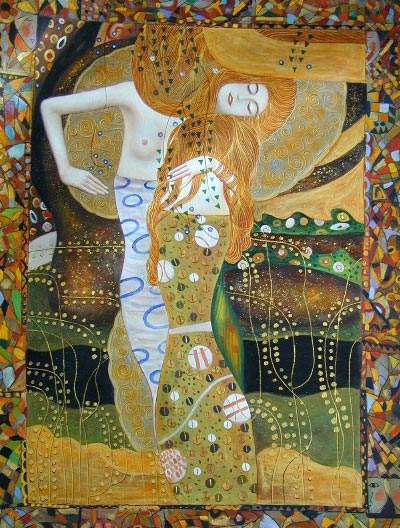
Gustav Klimt worked on Water Serpents I between approximately 1904 and 1907, producing it on parchment rather than canvas, which gives the work an unusually intimate and luminous quality. The small scale and the use of parchment suggest that it was conceived as a precious object as much as a traditional easel painting, reflecting the influence of the Wiener Werkstatte and the Arts and Crafts movement on Klimt and his circle during this period. The Vienna Secession, which Klimt had helped establish in 1897, promoted the idea that there was no fundamental hierarchy between fine art and decorative art, and works like Water Serpents I embody that philosophy by deliberately occupying a space between painting and decorative object.
The work belongs to a group of paintings in which Klimt explored female figures in aquatic settings, a theme that also appears in his larger compositions such as Moving Water and Goldfish. Water as a symbolic environment held particular appeal for Symbolist artists because of its associations with the unconscious, with erotic transformation, and with the boundary between the known and the unknown. Klimt returned to these themes across multiple works, suggesting a sustained imaginative investment in the figure of woman as a creature both of the natural world and of a deeper mythological realm. Water Serpents I was acquired by the Österreichische Galerie and has remained in Vienna, where it is considered one of the more refined small-scale works in the collection.
The composition of Water Serpents I is organized along a pronounced vertical axis, shaped by the narrow parchment support. Two female figures are shown entwined, their bodies curving against each other and against the flowing forms of water plants and decorative tendrils that fill the surrounding space. The upper figure turns toward the viewer with closed eyes and a languid expression, while the lower figure is more fully absorbed into the surrounding patterns. Both figures are rendered with careful attention to the softness and luminosity of skin, achieved through the delicate properties of parchment as a support, which absorbs pigment differently from canvas or board.
The surrounding decorative field is built up from a combination of gold leaf, fine line drawing, and thin washes of color that create a shimmering, underwater atmosphere. The water plants and abstract forms that envelop the figures are drawn with precise, jeweler-like attention to detail, and they recall the sinuous organic forms of Art Nouveau design as practiced by contemporaries such as Alphonse Mucha and Jan Toorop. However, Klimt integrates these decorative elements more fully with the figuration than most Art Nouveau artists, so that the boundary between the bodies and the environment becomes permeable and ambiguous. The two figures seem to be both swimming through the decorative field and emerging from it, as though they are themselves expressions of the same natural force that generates the patterns around them.
Water Serpents I explores the theme of female intimacy within a mythological and elemental context. The two figures are clearly engaged in a state of physical and emotional closeness, and their intertwined postures suggest an erotic bond that Klimt renders without prurience or sensationalism. By situating this intimacy within an aquatic world populated by plant forms and abstract patterns rather than in any recognizable domestic or social setting, Klimt removes it from the realm of social judgment and places it within the domain of nature and myth. This strategy of mythologizing the erotic was characteristic of Symbolism, which frequently sought to elevate physical experience into a realm of cosmic or spiritual significance.
The title itself introduces a note of ambiguity, because water serpents in European mythology are associated with transformation, hidden knowledge, and the dangerous allure of the natural world. By naming his female figures after these creatures, Klimt aligns them with a tradition of women as mysterious and potentially dangerous forces of nature, even as the painting itself depicts them in a state of peaceful, dreamlike withdrawal from the world. This tension between danger and serenity, between the mythological associations of the title and the tender specificity of the depicted figures, gives the work its distinctive emotional complexity. It invites viewers to contemplate both the beauty of intimate connection and the deeper symbolic currents that Klimt believed ran beneath the surface of everyday experience.