Loading cart…
No products in the cart.

1508 to 1512 · Fresco · Sistine Chapel, Vatican City
Save articles to your collection
Log in or create a free account, and this article will be waiting in your Private Collection.
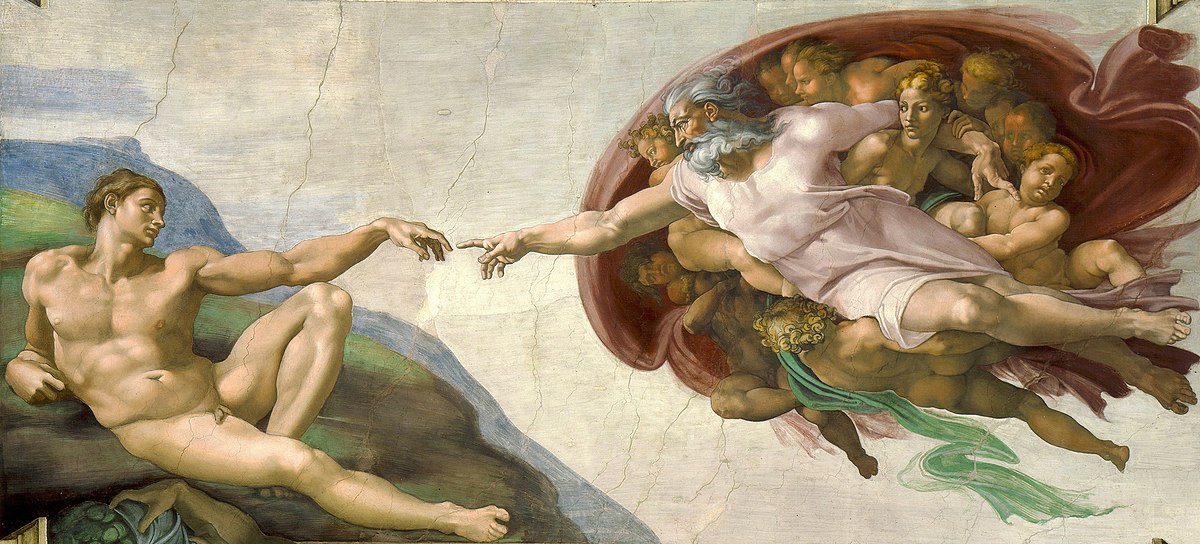
Log in or sign upThe Creation of Adam was painted as part of the vast fresco program commissioned by Pope Julius II for the ceiling of the Sistine Chapel in Rome, a project that Michelangelo undertook between 1508 and 1512. Julius wanted the ceiling repainted after earlier damage, and his initial proposal was relatively modest, calling for images of the twelve apostles in the pendentives. Michelangelo, reportedly dissatisfied with this limited scheme, negotiated a far more ambitious program covering the entire vault with scenes from the Book of Genesis, surrounded by prophets, sibyls, and other figures from the Old Testament and classical tradition. The Creation of Adam occupies the central position along the primary axis of the ceiling and is surrounded by smaller decorative figures and illusionistic architectural framing. Michelangelo worked on the ceiling largely alone, lying on scaffolding that he designed himself, in physically demanding conditions that he described in a sardonic sonnet written during the project. The panel depicting the creation of Adam was painted in the second phase of the work, after Michelangelo had removed the original scaffolding, studied the completed first half from ground level, and revised his figural scale accordingly. The result is a composition of extraordinary confidence and spatial authority.
The composition of The Creation of Adam is organized around the charged gap between the outstretched fingers of God and Adam, a space of only a few centimeters in the fresco that carries the entire theological weight of the image. Adam reclines on a rocky ledge with his body in a state of awakening languor, his left arm supported on his knee in a posture of readiness. The figure of God moves through the sky surrounded by a billowing cloak filled with angelic figures, his body leaning forward with purposeful energy that contrasts directly with the passive receptivity of Adam. Michelangelo renders both figures with an acute understanding of musculature and weight, using foreshortening in Adam to create a figure that seems to extend convincingly into the viewer's space. The color in this panel is characteristically clear and saturated, with the warm ochres and tawny flesh tones of Adam set against the cooler pinks and grays of the divine entourage. The negative space between the two hands functions almost as a third subject in the composition, drawing the eye repeatedly back to the point of potential contact. Scholars have long noted that the shape formed by the cloak and figures surrounding God bears a resemblance to the cross-section of a human brain, a detail that, whether intentional or not, reinforces the reading of God as the source of human intellect. This image is available as a hand-painted oil reproduction from ByMuseum, allowing collectors to bring this iconic composition into their homes with full fidelity to the original scale and color.
The theological content of The Creation of Adam draws from the second chapter of Genesis, but Michelangelo transforms the biblical narrative into a meditation on the relationship between human potential and divine origin that reflects the Neoplatonist ideas he encountered in the Medici circle. Rather than depicting a God who physically molds Adam from clay, as earlier artistic traditions had done, Michelangelo shows the moment of animation as a transmission of energy, almost electrical in its implication, across an unbridged gap. This choice elevates the human figure to a status of dignity and autonomy that resonates with the Humanist intellectual environment of the Renaissance, in which the capacities of the human mind and body were understood as reflections of divine order rather than expressions of fallen nature. The reciprocal posture of God and Adam, whose bodies mirror each other in their extended reach and muscular construction, suggests an equality of form that carries profound philosophical implications. In the centuries since its creation, this image has become one of the most reproduced and referenced compositions in the history of visual culture, appearing in contexts ranging from medical illustration to popular advertising, testament to the enduring power of its central idea. Owning this work as a hand-painted oil reproduction from ByMuseum is an opportunity to engage daily with one of the most consequential images in the history of Western art, rendered by skilled painters who honor the chromatic and compositional intentions of the original fresco.
Enjoyed this story?
Save articles to your collection
Log in or create a free account, and this article will be waiting in your Private Collection.
Log in or sign up