Loading cart…
No products in the cart.

1536 to 1541 · Fresco · Sistine Chapel, Vatican City

Save articles to your collection
Log in or create a free account, and this article will be waiting in your Private Collection.
Log in or sign upPope Clement VII first proposed a fresco of the Last Judgment for the altar wall of the Sistine Chapel in 1533, though the actual commission was formalized by his successor Paul III after Clement died in 1534. Michelangelo, by this time in his late fifties and long established as the preeminent artist in Rome, accepted the commission and began preparatory work around 1535. To accommodate the enormous new composition, two earlier frescoes by Perugino were destroyed, as were two lunette panels from the ceiling program that Michelangelo himself had painted decades earlier. The fresco was unveiled on October 31, 1541, the day before All Saints Day, nearly thirty years after the ceiling had been completed. The scale of the undertaking was unprecedented for a single-wall composition, encompassing approximately four hundred individual figures arranged across a turbulent field of cloud and sky. The work was controversial from the moment of its unveiling, with critics including the papal master of ceremonies Biagio da Cesena objecting to the extensive nudity of the figures. In response to these objections, Pope Paul IV later commissioned Daniele da Volterra to paint drapery over the most conspicuous figures, earning Volterra the unflattering nickname Il Braghettone, or the breeches maker. These additions were partially removed during the restoration campaign of the 1990s.
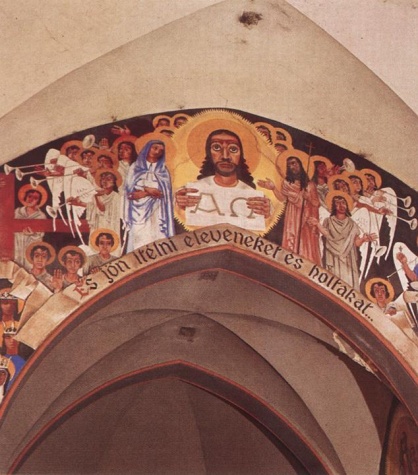
The compositional structure of The Last Judgment abandons the orderly architectural framing and narrative progression of the ceiling in favor of a single, unified field of swirling movement centered on the commanding figure of Christ. Michelangelo depicts Christ not as the gentle shepherd of earlier devotional tradition but as a young, beardless, and physically powerful judge whose raised arm initiates the sorting of souls with an authority that is almost violent in its force. The composition is organized in concentric zones radiating outward from this central figure, with the blessed rising on the left and the damned descending on the right, though the boundaries between these zones are deliberately blurred by the density and interconnection of the figures. The color palette in this fresco is notably different from the ceiling, employing deeper, murkier tones and a more restricted range that creates an atmosphere of urgency and dread. Michelangelo includes a self-portrait in the flayed skin held by Saint Bartholomew in the lower right section of the composition, a detail of extraordinary psychological complexity that art historians have interpreted as an expression of spiritual anxiety, self-deprecating wit, or both simultaneously. The fresco rewards sustained attention, as new groupings, expressions, and narrative details emerge the longer one studies its dense surface. This composition is available as a hand-painted oil reproduction from ByMuseum, offering collectors the opportunity to own a faithful rendering of this remarkable and complex work.
The Last Judgment was painted in the shadow of the Protestant Reformation and the traumatic Sack of Rome in 1527, events that had profoundly destabilized the authority and confidence of the Roman Catholic Church. The image Michelangelo produced reflects this turbulent historical context in its emotional intensity and its emphasis on divine judgment as an overwhelming and irresistible force rather than a calm administrative process. Unlike earlier depictions of the Last Judgment, which typically arranged the saved and the damned in clearly separated and relatively static zones, Michelangelo presents a scene of continuous, churning movement in which the distinction between salvation and damnation seems precarious and hard-won. This sense of spiritual uncertainty is consistent with the deeply personal religious crisis that Michelangelo experienced in the 1530s under the influence of Vittoria Colonna and the spirituali movement, a reform-minded Catholic circle that emphasized personal faith and the direct experience of divine grace. The figure of Christ as judge rather than intercessor also represents a theological statement of some boldness, replacing the merciful mediator of medieval devotion with a figure whose justice admits no appeal. For contemporary viewers, the fresco speaks to the terror and the possibility inherent in the idea of final accountability, and its visual language of bodies in motion, reaching, falling, and ascending, retains an emotional immediacy that transcends its specific historical and doctrinal context. You can own a hand-painted oil reproduction of this singular work through ByMuseum.
Enjoyed this story?
Save articles to your collection
Log in or create a free account, and this article will be waiting in your Private Collection.
Log in or sign up