Loading cart…
No products in the cart.

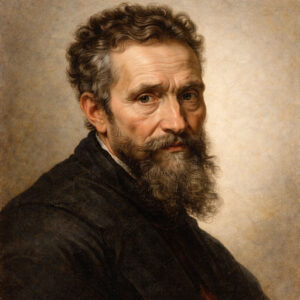
Michelangelo Buonarroti stands at the center of the Italian Renaissance not because he mastered a single discipline, but because he redefined what the human body could communicate in visual art. His painted figures breathe with a physical urgency that had…
Michelangelo Buonarroti stands at the center of the Italian Renaissance not because he mastered a single discipline, but because he redefined what the human body could communicate in visual art. His painted figures breathe with a physical urgency that had no real precedent, and his ability to merge theological ambition with anatomical precision produced images that changed the course of Western painting permanently. Though he considered himself primarily a sculptor, his contributions to the painted tradition are so substantial and so original that no serious account of European art history can proceed without him. The frescoes he created for the Sistine Chapel alone constitute one of the most studied and imitated pictorial programs in recorded history, influencing generations of painters from Raphael to Rubens and far beyond into the modern era. Born in 1475 in the small Tuscan town of Caprese, Michelangelo was the second of five sons in a family of modest means with minor noble connections. His mother died when he was six years old, and he was sent to live with a stonecutter and his wife in Settignano, an experience he later credited with instilling his lifelong passion for working with stone. Against the wishes of his father, who considered artisanal work beneath the family, the young Michelangelo entered the workshop of the painter Domenico Ghirlandaio in Florence at the age of thirteen. He quickly surpassed his training environment and came to the attention of Lorenzo de Medici, who invited him to study the remarkable collection of antique sculpture in the Medici gardens under the sculptor Bertoldo di Giovanni. This exposure to classical antiquity and to the intellectual culture of Neoplatonist philosophy at the Medici court shaped the conceptual framework that would underpin all of his mature work. After the political upheavals that followed the death of Lorenzo in 1492, Michelangelo traveled to Bologna and then to Rome, where the scale and ambition of ancient and early Christian art deepened his sense of what monumental art could achieve. Pope Julius II summoned him to Rome in 1505, and although the working relationship between the two strong-willed men was famously turbulent, it produced the Sistine Chapel ceiling, a commission that Michelangelo initially resisted and ultimately transformed into the defining pictorial achievement of the High Renaissance. He continued working until nearly the end of his long life, dying in Rome in 1564 at the age of eighty-eight.
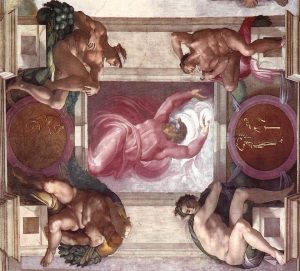
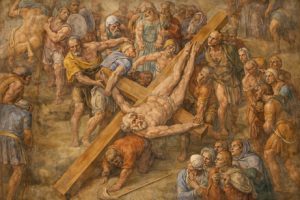
The visual language of Michelangelo is rooted in a profound and systematic study of the human body, which he regarded as the most eloquent available vehicle for expressing spiritual and emotional states. His painted figures are characterized by a quality that Italian critics of his time called terribilita, a word that captures something like awesome intensity or overwhelming force. The bodies in his frescoes are massively built, dynamically posed, and rendered with a sculptural solidity that reflects his primary identity as a worker in three dimensions. He preferred to build his figures from the inside out, beginning with a skeletal and muscular armature derived from his extensive practice of anatomical dissection, and only then clothing the form in skin and drapery. The result is a figure type that seems to exist under tremendous internal pressure, as though the painted surface is barely containing the energy beneath it. His use of foreshortening is among the most audacious in the Renaissance tradition, and he deploys it not merely as a technical display but as a means of drawing the viewer into a visceral relationship with the painted body. In terms of color, Michelangelo worked in the fresco medium with a palette that underwent a striking transformation over the course of his career. The ceiling of the Sistine Chapel, painted between 1508 and 1512, displays a range of clear, luminous colors, including acid greens, sharp oranges, cool lavenders, and pale yellows, that were deliberately chosen to remain readable at great distance and under the difficult lighting conditions of the chapel interior. These hues have a brightness and chromatic independence that anticipates aspects of Mannerist color practice and sets Michelangelo apart from the warmer, more atmospheric tonality associated with contemporaries such as Leonardo da Vinci. In the later fresco of The Last Judgment, completed in 1541, the palette becomes denser and more turbulent, reflecting both the changed cultural climate of the Counter-Reformation and the darker philosophical preoccupations of the artist in old age. Across all periods, his compositional thinking is governed by a preference for dense groupings of figures that create a sense of continuous rhythmic movement across the picture surface.
Each card links to its own article with full analysis and reproduction details.
 #1
#1
 #3
#3
 #4
#4
 #5
#5
 #6
#6
 #7
#7
 #8
#8
 #9
#9
 #10
#10
A print can reproduce colors. What it cannot reproduce is texture, depth, and the physical presence of oil paint on canvas. Michelangelo Buonarroti technique depends on these.
At ByMuseum, every reproduction is painted by hand using oil on canvas. There is no inkjet, no digital print. The brushwork is real. The result looks like a painting because it is one.