Loading cart…
No products in the cart.

1508 to 1512 · Fresco · Sistine Chapel, Vatican City
Save articles to your collection
Log in or create a free account, and this article will be waiting in your Private Collection.
Log in or sign upPope Julius II contracted Michelangelo in 1508 to repaint the ceiling of the Sistine Chapel, which had suffered from structural damage and bore only a modest decorative scheme of gold stars on a blue ground. The commission was politically and artistically complex from the outset. Julius was a forceful and impatient patron, while Michelangelo was deeply reluctant to take on a project in a medium he considered secondary to sculpture. According to accounts by Michelangelo himself and by his biographer Giorgio Vasari, the artist suspected that the commission had been arranged by rivals, including the architect Bramante, who wished to see him fail in an unfamiliar medium. Despite this resistance, Michelangelo threw himself into the work with characteristic intensity, dismissing the team of Florentine fresco assistants he had initially brought to Rome and largely completing the ceiling himself over a period of approximately four years. He worked in the buon fresco technique, applying pigment to fresh plaster in sections called giornate, each of which had to be completed before the plaster dried. The scaffolding he designed was an arching wooden bridge that left the floor of the chapel available for religious services during the painting campaign. Julius came to view the unfinished work on several occasions and reportedly struck Michelangelo with his staff when the artist repeatedly promised completion dates he could not meet. The ceiling was unveiled to general acclaim on November 1, 1512, All Saints Day.
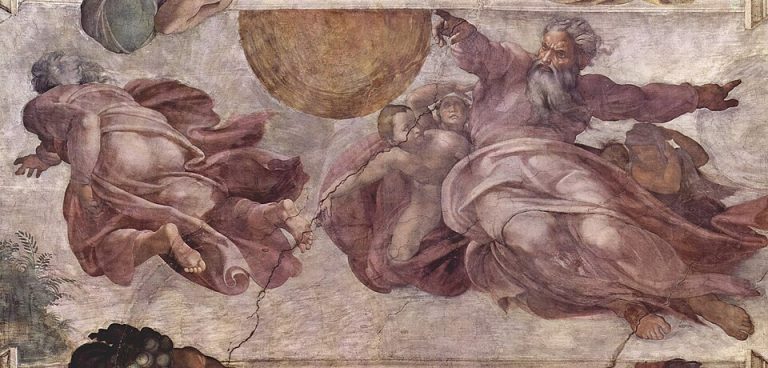
The organization of the Sistine Chapel ceiling represents one of the most elaborately conceived pictorial programs in the history of Western painting, and the internal consistency of its visual logic across more than five hundred square meters of curved surface is a remarkable intellectual and technical achievement. The nine central panels narrate the story of Genesis in three groups of three, moving from the separation of light from darkness, through the creation of the heavenly bodies, to the creation and fall of humanity, and finally to the story of Noah. These panels are flanked by alternating large and small figures seated on illusionistic thrones, the seven Hebrew prophets and five pagan sibyls who were understood in Renaissance theology as prefiguring the coming of Christ from both inside and outside the Jewish tradition. Below these figures, in the triangular spandrels and the curved lunettes at the base of the vault, Michelangelo painted the ancestors of Christ as listed in the gospel of Matthew. The figural scale increases noticeably between the first half of the ceiling, painted from the entrance end, and the second half, painted after Michelangelo had seen the completed work from ground level and adjusted his approach accordingly. The color relationships throughout are sophisticated and deliberate, with complementary hues used to articulate the draperies of the seated figures and a consistent warm light source applied from the direction of the chapel windows. A hand-painted oil reproduction of the ceiling panels, available individually through ByMuseum, allows collectors to focus on the details and color relationships that are difficult to appreciate in photographs.
The Sistine Chapel ceiling functions simultaneously as a theological statement, a display of papal authority, a Neoplatonist philosophical meditation, and a demonstration of what painting could achieve when practiced by an artist of Michelangelo's ambition and capability. The choice of Genesis as the primary subject connects the founding narrative of human existence to the institutional power of the papacy and the broader program of the chapel, which was dedicated to the Virgin and used for the most solemn rituals of the Catholic calendar including the election of popes. The inclusion of pagan sibyls alongside Hebrew prophets reflects the Neoplatonist synthesis that was central to Florentine intellectual culture of the late fifteenth century, in which all ancient wisdom traditions were understood as partial expressions of a single divine truth fully revealed in Christianity. The individual scenes, particularly the creation narratives in the central panels, established visual archetypes that became foundational to the subsequent tradition of Western religious painting. Artists working in every subsequent period from the Baroque to the nineteenth century returned to the ceiling as a source of compositional strategies, figure types, and chromatic ideas. The ceiling also established the idea of the artist as a figure of exceptional creative agency whose personal vision could legitimately shape the content of major public commissions, a shift in the cultural status of the artist that has had lasting consequences for how we understand creative practice. Own any panel from this cycle as a hand-painted oil reproduction through ByMuseum.
Enjoyed this story?
Save articles to your collection
Log in or create a free account, and this article will be waiting in your Private Collection.
Log in or sign up