Loading cart…
No products in the cart.

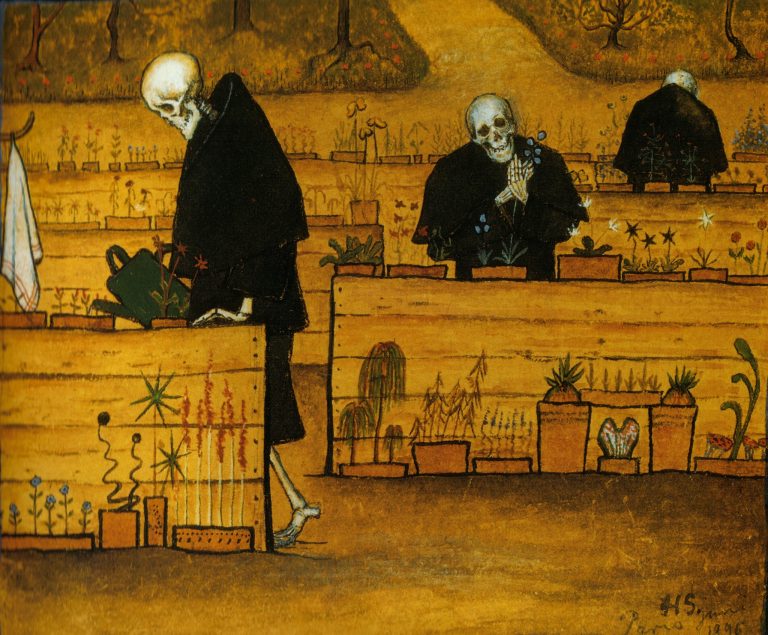
1896 · Watercolour and gouache on paper · Finnish National Gallery / Ateneum Art Museum, Helsinki
Save articles to your collection
Log in or create a free account, and this article will be waiting in your Private Collection.
Log in or sign up Explore the artistHugo Simberg →
The skeleton at the centre does something we do not expect. It brings a flowering plant close to its face and holds it between two careful hands. Another skeleton bends over a watering can. A third continues working farther back. Nobody is being chased, carried away or struck down.
In The Garden of Death, painted in 1896, Hugo Simberg gives the familiar figure of Death a different occupation. Death is looking after a garden. The flowers are small, the work is ordinary, and the scene feels strangely patient.
The Finnish title is Kuoleman puutarha. The original belongs to the Finnish National Gallery / Ateneum Art Museum in Helsinki and measures only 15.8 by 17.5 centimetres. It is watercolour and gouache on paper, rather than an oil painting. Its modest size makes the fine hands, tiny blossoms and individual pots particularly important.
The question is not simply why skeletons are among the flowers. It is why the things we associate with the end of life have become responsible for helping fragile things survive.
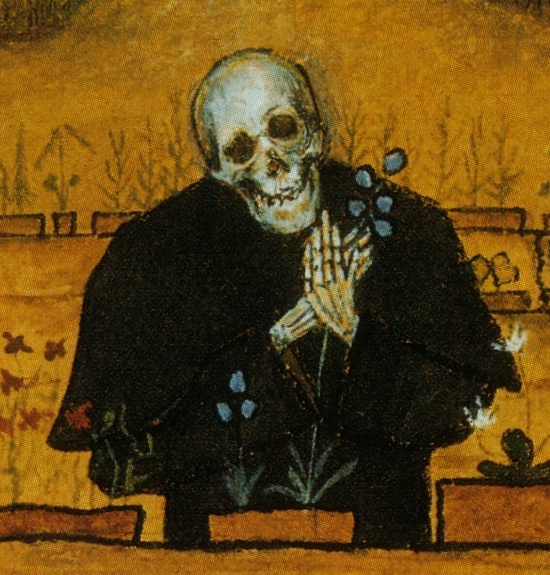
Look first at the central figure. Its skull tilts towards the plant, while both hands meet around the thin stems. The pale fingers are almost the same colour as the skull. Small blue flowers rise beside its cheek and continue down towards the pot.
We cannot read a skeleton’s expression as we would a living face. There are no soft cheeks or moving lips to tell us how it feels. Instead, Simberg gives the gesture that task. The bowed head, gathered hands and closeness of the flower make the figure appear attentive.
Calling it a tender embrace is a reading of that posture, not a literal account of an emotion we can prove. What we can see is the care taken with something much smaller than the figure holding it. The skeletal hands seem capable of support.
That small adjustment changes the whole image. Once we notice it, the black robes no longer function only as threatening costumes. They also become the clothing of figures occupied with a quiet responsibility.
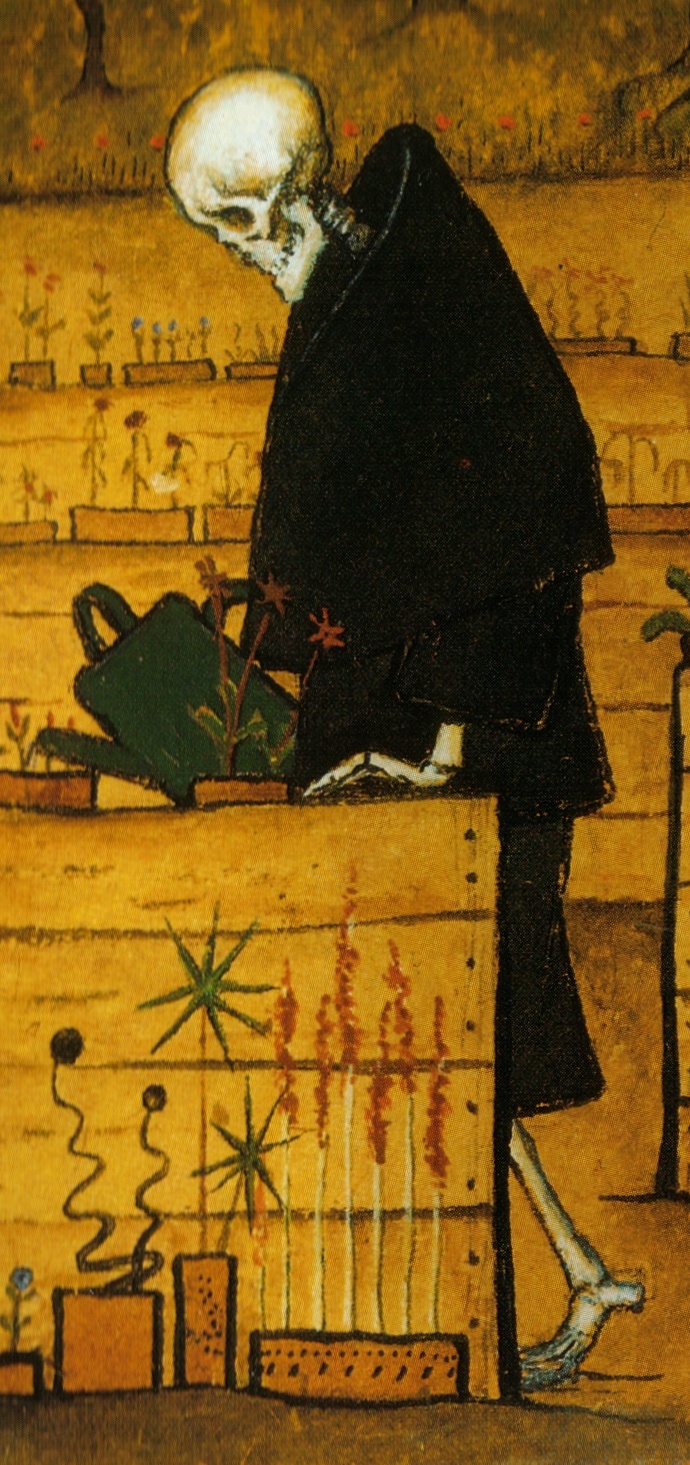
The figure at the left is larger and nearer. Its head inclines towards the bench, and its body leans into the work. A green watering can sits among the plants. A pale hand rests along the wooden edge, while a bony foot appears below the robe.
The can matters because it belongs to an ordinary routine. A garden needs water, attention and repeated visits. Giving Death this equipment places it within the maintenance of life, rather than only at the moment life ends.
Simberg keeps the physical awkwardness of the task. The robe folds over the bent body; the head projects forward; the visible foot supports the figure’s stance. This is not a floating apparition placed above the world. It has to occupy the narrow space between the benches.
There is also a cloth hanging at the left edge. Alongside the can and timber boards, it helps the setting resemble a place where work happens. The supernatural figures have entered a recognisable environment of tools and daily chores.
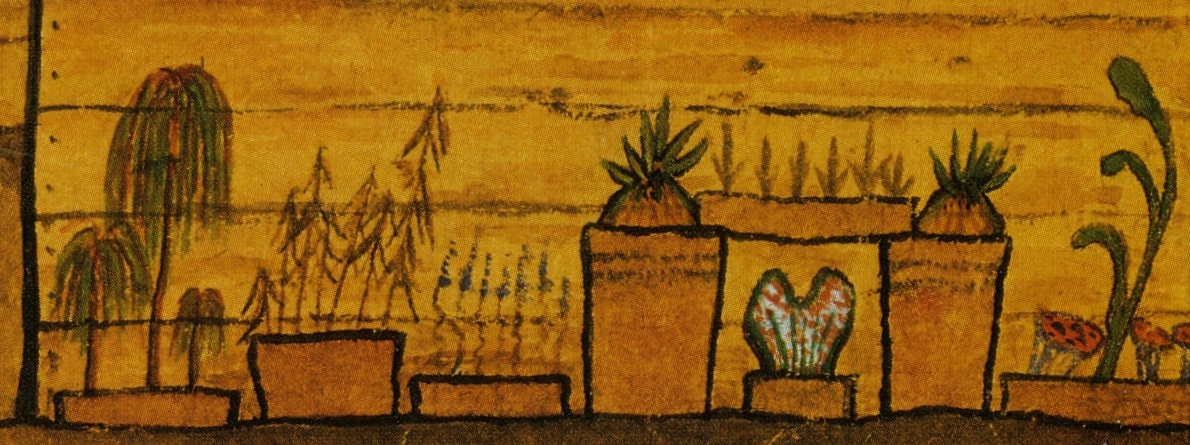
The garden is not a uniform bed of healthy flowers. Some stems rise straight; others twist or droop. Spiky leaves sit beside soft, hanging shapes. A patterned, heart-like form grows between two taller pots, while smaller containers hold only a few thin shoots.
The differences invite us to look at the plants individually. Their separate pots give each one a small place of its own. Even when a row reads as a decorative pattern, a particular stem or leaf interrupts the repetition.
The Ateneum’s interpretation, published through Google Arts & Culture, connects the plants with human souls waiting before heaven. On that reading, the gardeners are caring for souls in a place of transition. The museum also notes what the picture leaves unresolved: it does not explain every soul’s eventual destination or the reason for the waiting.
That distinction is useful. The painting supports the idea of an afterlife garden, but it does not offer a complete map of the afterlife. Nor does it identify a specific person behind each flower. Its power comes partly from allowing many different, vulnerable forms to remain together under the same care.
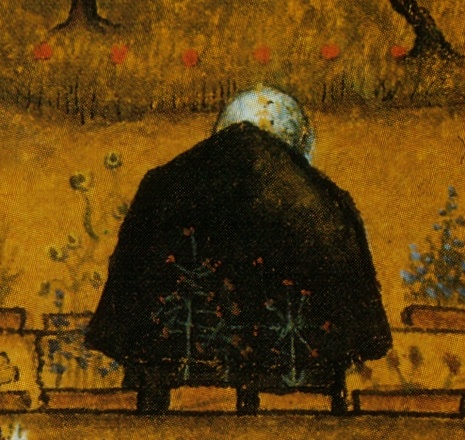
Farther back, the third skeleton shows us its shoulders and the back of its head. Its face is hidden. Small stems overlap the dark robe, drawing our attention towards the work immediately in front of it.
The turned figure prevents the three gardeners from becoming a performance arranged for us. One is absorbed in a plant, another bends over a task, and the last continues working out of our direct view. Their different orientations make the activity feel ongoing.
The long benches organise that activity. Their horizontal boards divide the garden into layers, while the paths leave room to move between them. Beyond the pots, a pale path opens between the trees. The scene extends past the nearest gardener instead of ending at a wall.
Warm ochre joins the ground, timber and distant landscape. Against it, the robes form three dark masses. The flowers provide smaller interruptions of blue, red, white and green. These contrasts make the skeletons conspicuous without turning the entire garden into darkness.
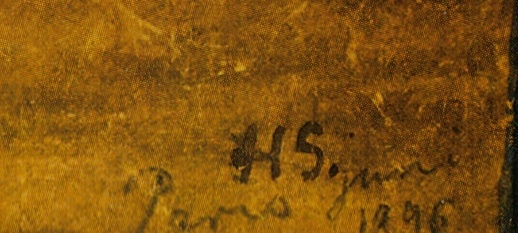
Near the lower-right corner, the inscription includes Simberg’s initials and the words Paris Juni 1896. The imaginary garden was made during a real journey.
Ateneum’s teaching material places the work in the context of Simberg’s 1896 travels. In London, he studied Hans Holbein’s Dance of Death prints at the British Museum. He then travelled to Paris, where he painted this small composition.
The connection helps explain the mixture of the everyday and the macabre. In the older Dance of Death tradition, skeletons meet people amid ordinary life. Simberg keeps the recognisable skeleton but gives the encounter a different pace. Here, the work of Death involves tending rather than interruption.
The Ateneum also draws attention to the painting’s fine lines and their relationship to older printmaking. Look at the thin stems, the outlined fingers and the marks across the wooden boards. The image depends on small, deliberate distinctions. Its strangeness does not require a huge canvas or a crowded supernatural spectacle.
There is more than one Garden of Death. Simberg returned to the subject in a fresco at Tampere Cathedral, completed in 1906. A Finnish National Gallery archive photograph records him beside the developing fresco that year.
The distinction matters when looking up the work. The 1896 Ateneum picture discussed here is a small work on paper. The cathedral version belongs to a later architectural setting. Their dates, materials, dimensions and locations should not be combined.
Simberg also brought The Wounded Angel into the cathedral’s decorative programme. In our story of The Wounded Angel, a supernatural figure is carried by two boys. Here, skeletal figures look after plants. The two subjects invite different questions, but both make care visible through the work of bodies and hands.
For a wider context, explore our guide to Symbolist paintings. Simberg’s garden shows how an imagined setting can carry a serious question without providing a single explanation for every detail.
It is tempting to turn the painting into an uncomplicated promise that death is harmless. The bare skulls and black robes resist that reassurance. These figures still belong to the imagery of mortality. The fragile plants do not all look equally strong.
Yet the scene also resists pure horror. No figure threatens the others. The central plant is held carefully. The watering can implies that the work will continue. Simberg allows the frightening appearance of Death and the sustaining act of gardening to exist in the same image.
Return to the flower beside the central skull. The title tells us whose garden this is, but the gesture asks us to reconsider what its owner does there. Death has become a keeper of fragile things.
The Finnish artist Hugo Simberg painted the Ateneum version in 1896. Its Finnish title is Kuoleman puutarha.
The Ateneum’s published interpretation identifies the plants with human souls waiting before heaven. The picture leaves the details of that waiting unexplained.
The 1896 work belongs to the Finnish National Gallery / Ateneum Art Museum, Helsinki, accession A II 968:16. A later fresco version is in Tampere Cathedral.
No. It is watercolour and gouache on paper. It measures 15.8 cm high by 17.5 cm wide. An oil-on-canvas reproduction uses a different medium from the historical original.
Its black-robed skeletons recall traditional personifications of Death. Simberg changes their role by showing them tending plants, with no harvesting or attack taking place.
Hugo Simberg, The Garden of Death (1896), Finnish National Gallery / Ateneum Art Museum. Source: Wikimedia Commons, File:Hugo Simberg Garden of Death.jpg, the exact image selected by the owner. Public-domain artwork and faithful reproduction (PD-Art / Public Domain Mark).
Enjoyed this story?
Save articles to your collection
Log in or create a free account, and this article will be waiting in your Private Collection.
Log in or sign up
Man Writing a Letter
Gabriel Metsu, c. 1664
The gallery list
Every painting is already 50% off. Join the list and we will send you an extra $15 code, plus first access to new collections.
No spam. Unsubscribe anytime. · Privacy Policy
Welcome
Your $15 code is on its way. Explore the gallery while you wait.