Loading cart…
No products in the cart.

1884 · Oil on canvas · Art Institute of Chicago
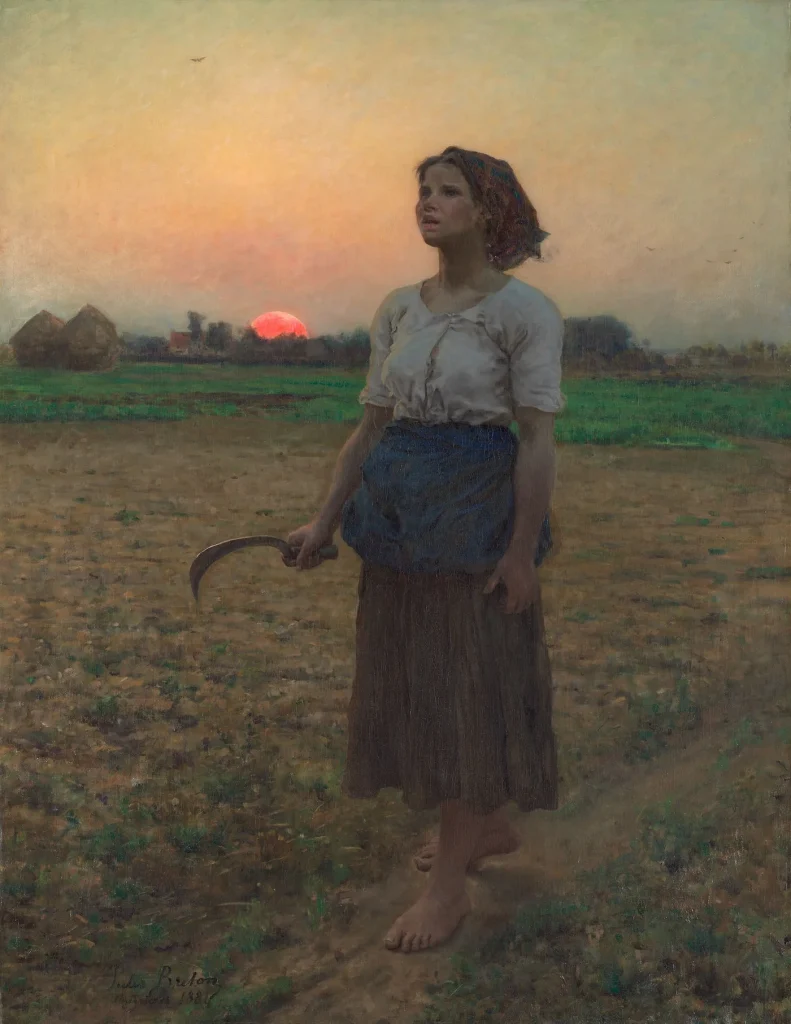

A barefoot girl stands in a field at sunrise with a sickle in her hand. She was on her way to work. She has stopped, and her head is up, and her lips are parted, because somewhere above her a lark has started to sing. You cannot see the bird. You can see her hearing it.
That is the whole painting, and it is enough. Jules Breton painted it in 1884 in his home village of Courrières in northern France, and it became, without anyone quite planning it, one of the most loved paintings in America.
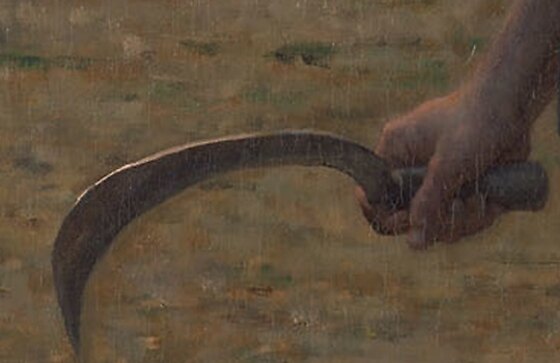
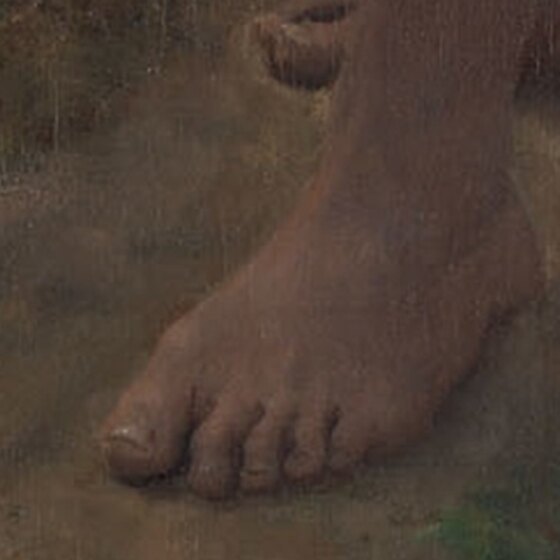
Everything in the picture tells you what her life is. The sickle is for the harvest. The feet are bare because shoes cost money. The blouse is patched and the apron is faded, and the field is stubble because it has already been cut once. She is not a shepherdess in a pastoral. She is a labourer, seventeen or so, at the start of a long day.

Behind her the sun is a red disc on the horizon, just clear of a haystack, and the sky above it goes from orange through green to the last blue of the night. Breton was a painter of dawns and dusks; he liked the ten minutes when the light is strange. Here it does two things at once. It says the day is beginning, and it puts a halo of colour behind a girl with dirt on her feet.
Thirty years earlier Millet had painted The Gleaners and frightened the Paris Salon with three peasant women bent to the ground. Breton, who came from the same countryside and admired Millet, painted the peasant standing up. His girl is not bowed. She is upright, alert and, for a moment, transported. Where Millet's people are the weight of the earth, Breton's are the earth's dignity.
That made him, in his lifetime, far more popular than Millet. The Salon gave him medals, the state bought his work, and American collectors, who were building the new museums of Chicago, Boston and Philadelphia, bought it by the crate. To the critics of the next century this made him a sentimentalist. To the people who stood in front of the painting, it made him the man who had seen them.
The picture went to Chicago in 1894 with the collection of Henry Field, and at the Art Institute it found its public. In 1934, during the World's Fair, the Chicago Daily News asked its readers to vote for their favourite painting in the museum. The Song of the Lark won. When the result was announced, Eleanor Roosevelt, the President's wife, said it was her favourite too.
Willa Cather had already borrowed its title. Her 1915 novel The Song of the Lark, about a girl from a Colorado railway town who becomes an opera singer, is named for the painting, which her heroine sees in the Art Institute and cannot forget: a girl in a field, hearing something nobody else can hear, and knowing she has to follow it.
And in the 1970s, by his own account, a young man who had just failed an audition in Chicago and was thinking of walking into the lake instead walked into the Art Institute, saw this painting, and decided that if a girl with no shoes could keep going, so could he. His name was Bill Murray. He has told the story in public more than once.
It means that a hard life has moments in it. The girl has a sickle and no shoes and a day of work in front of her, and for the length of a bird's song none of that is what she is thinking about. Breton does not make the moment religious, though the light behind her invites it. He makes it ordinary, which is harder. Anyone who has stopped on the way to work because of something in the air knows what her face is doing.
That is why it has been loved by people who never saw a French field: an opera singer's origin story, a First Lady's favourite, a comedian's reason to live. It is a painting about attention, and about the fact that beauty arrives on its own schedule and does not check whether you are busy.
In the Art Institute of Chicago, where it has hung since 1894 and where it is still, by the museum's own reckoning, one of the pictures visitors ask for most. It is oil on canvas, 110 by 86 centimetres, so the girl is about two thirds life size.
It is a painting for a kitchen, a hallway, a bedroom, or the wall you see first in the morning. Our hand-painted reproduction of The Song of the Lark is painted in oil on canvas from the Chicago original, with the dawn sky graded by hand the way Breton graded it. A simple wood frame, and a place where the light changes through the day.
More Breton in our Jules Breton collection, and the wider Realism archive.
Visible details, documented facts and interpretation are kept separate throughout this article.


