Loading cart…
No products in the cart.

c. 1817 · Oil on canvas · Hamburger Kunsthalle, Hamburg
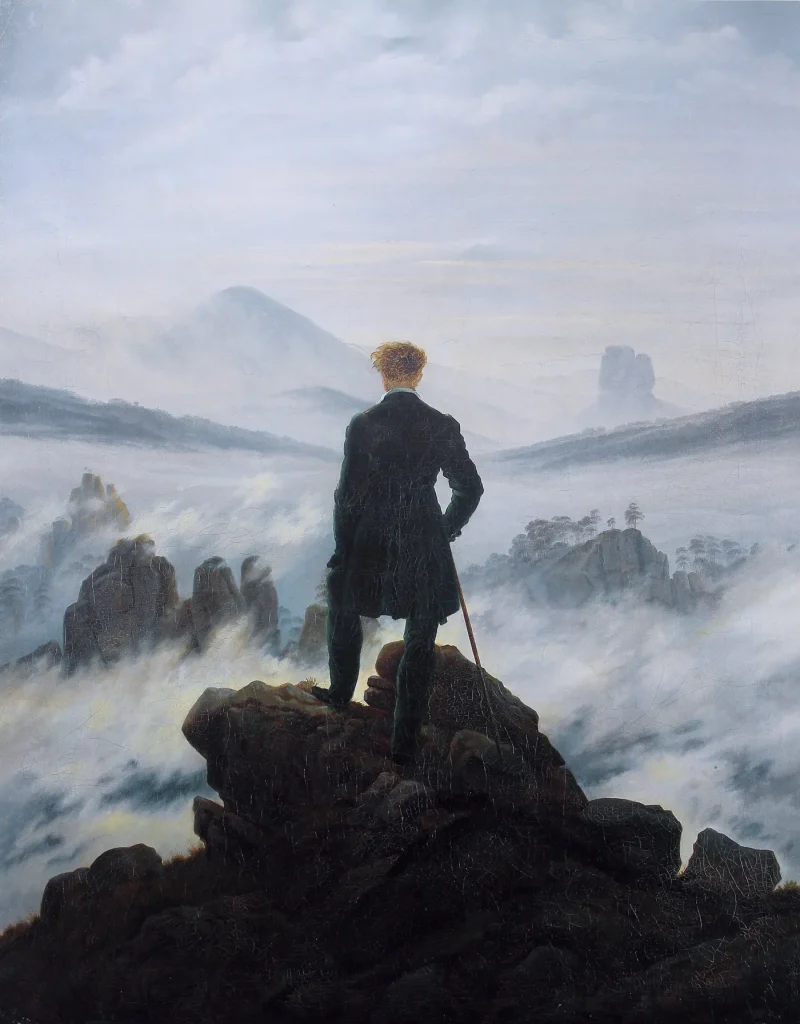
A man in a dark green coat stands on a spur of rock with his back to us. Below him a sea of fog fills the valleys. Rock towers break through it like islands, and beyond them a pale mountain rises into a sky that is almost the same colour as the fog.
He holds a cane in his right hand. His hair is red-blond and the wind has caught it. We cannot see his face, and Friedrich never intended us to.
That is the whole picture. There is no story from the Bible or Homer to decode, no other figure to react to. The painting asks a simpler and harder question: what is it like to stand there?
The German title is Der Wanderer über dem Nebelmeer. Older English books sometimes call it The Wanderer above the Mists. It is the same painting.
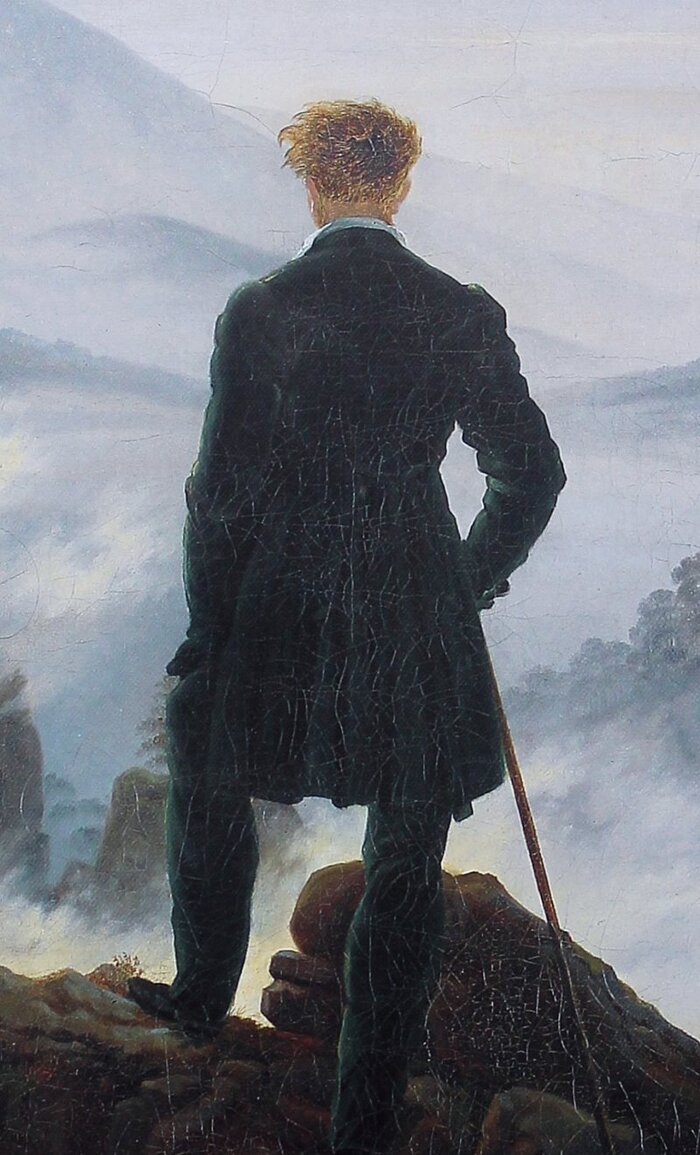
Friedrich used the figure seen from behind so often that it has a name in German art history: the Rückenfigur. In most paintings a figure looks out at us, or at something in the scene, and we read the picture through their expression. Here that route is closed.
Instead we are placed directly behind him, sharing his line of sight. We do not watch him look at the view. We look at it with him. The painting turns the viewer into a second wanderer standing a few steps back.
Look at how he stands. One knee is bent, one foot planted higher than the other. His left hand rests loosely; the right grips the cane. It is the posture of someone who has stopped, not someone posing. Friedrich gives him no hat and no pack, nothing to suggest a long journey or a destination.

Who is he? Nobody knows for certain. The red hair has led some writers to suggest a self-portrait, and Friedrich did have reddish hair. Others have proposed a Saxon officer, painted as a memorial after his death. The Hamburger Kunsthalle, which owns the painting, does not name him. The honest answer is that he is anonymous, and that the anonymity is part of the design.
His coat is worth a second look. The dark green frock coat and the cut of the collar match what was called altdeutsche Tracht, the "old German" dress adopted by students and patriots after the wars against Napoleon. Wearing it was a political statement in the years around 1817, and the Prussian authorities banned it in 1819. Whether Friedrich meant the coat as a message or simply painted what educated young men were wearing, a viewer in Dresden at the time would have noticed it.
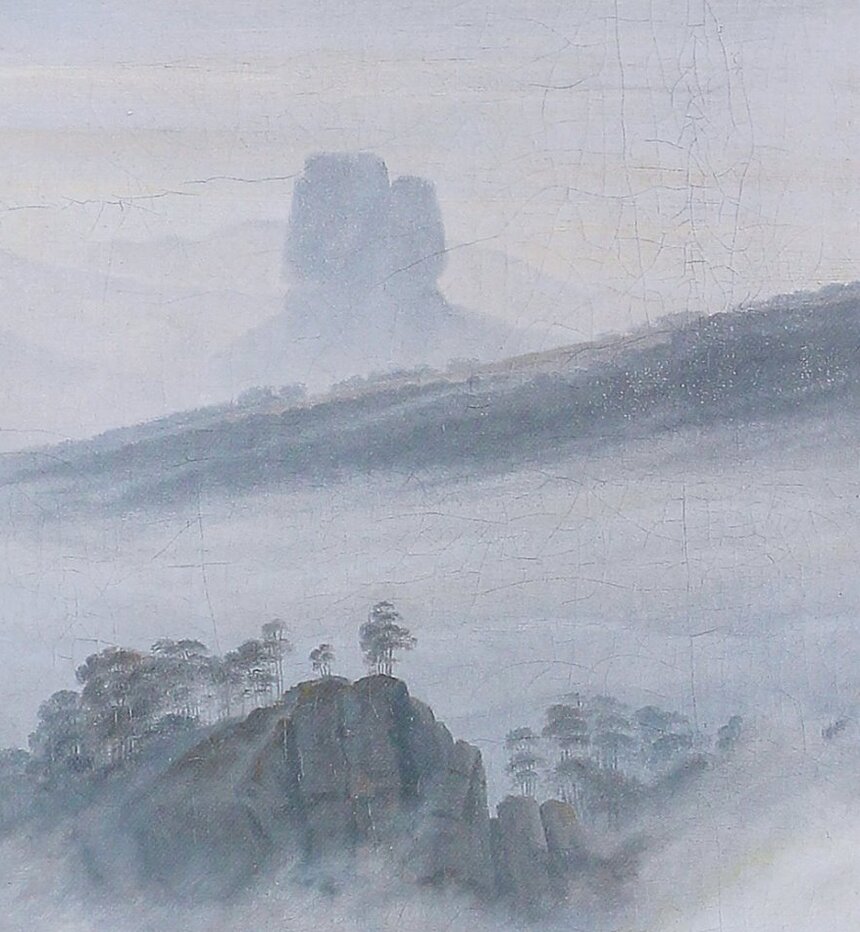
The rocks and mountains are real, but the view is not. Friedrich walked the Elbe Sandstone Mountains south-east of Dresden, the area known as Saxon Switzerland, and filled sketchbooks with individual rocks and ridges. In the studio he combined them.
The flat-topped tower on the right is generally identified as the Zirkelstein. The rock outcrop under the wanderer's feet resembles the Kaiserkrone, and the jagged rocks to the left of him have been linked to the Gamrig near Rathen. The big mountain on the left is usually read as the Rosenberg, across the border in Bohemia, though the Kaltenberg has also been suggested.
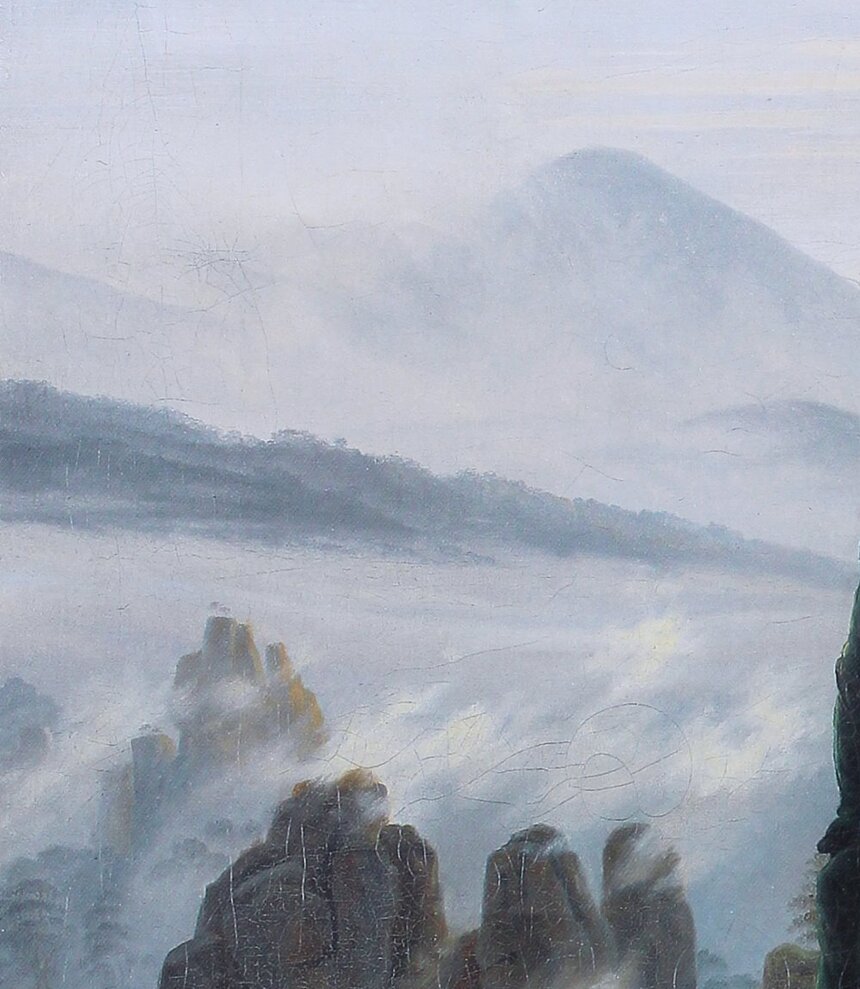
None of these places can be seen together from one spot. Friedrich moved them into a single frame and put the wanderer where no real path leads. That matters for how we read the picture. It is not a record of a hike. It is a landscape built to carry a feeling.
The fog does the rest. It hides the valleys, the villages and the roads, everything that would tell you how far the drop is or how to get down. What is left is rock, air and distance.
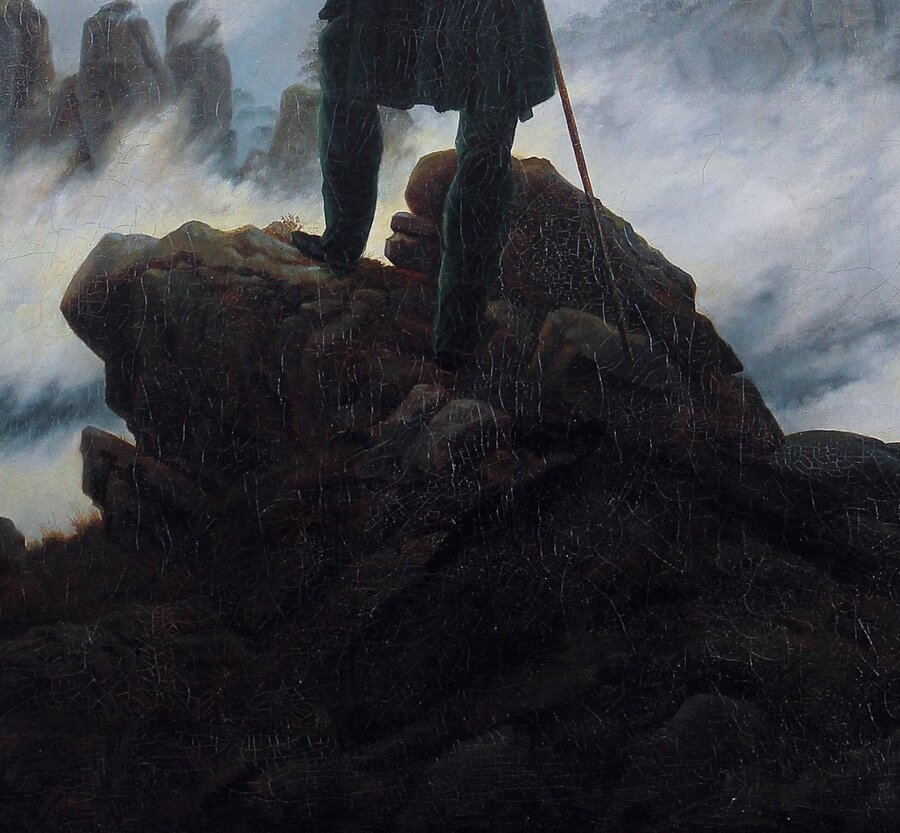
The picture is built in three bands of tone. The rock in the foreground is almost black. The middle band, fog and rock towers, is a broken grey. The far mountains and sky are pale and nearly flat. Friedrich is using the oldest trick in landscape painting, aerial perspective, but he pushes it hard enough that the far distance barely exists.
The wanderer sits exactly where those bands meet. His dark coat belongs to the foreground rock; his head breaks into the pale sky. He is the only vertical form in a painting that is otherwise horizontal layers, and the only thing that connects the near and the far.
Notice also that the horizon sits at roughly the level of his chest. He is not looking up at the mountains. He is looking across at them, and slightly down into the fog. That makes him large in relation to the world, not small. Friedrich could have shrunk him to a speck, as he does in other paintings. He chose not to.
The brushwork is quiet. Friedrich was trained as a draughtsman and painted with a smooth, careful hand. The fog is built from thin, blended layers with almost no visible strokes, and the drama comes from the design rather than from paint handling. That is one reason the image survives reproduction so well: its power is in the shapes.
Two readings have followed the painting for a century, and they pull in opposite directions.
The first sees mastery. A man has climbed above the clouds and surveys the world at his feet. The pose is confident, the cane is planted, the view is his. Read this way, the painting is about the individual standing over nature, and it is easy to see why it became a favourite image for book covers about ambition, philosophy and self-reliance.
The second sees the opposite. The man is alone on a rock with nothing but fog around him. He cannot see the ground. The mountains ahead are unreachable and half dissolved. Read this way, the painting is about how small a person is in front of the world, and the confident pose is a way of holding steady in front of something overwhelming.
Both readings come from the same source: the Romantic idea of the sublime, the mixture of awe and fear felt in front of nature at its largest. Friedrich's paintings are full of it. Ruined abbeys, ice floes, moonlit shores, and always the small human presence trying to take it in.
The painting does not settle the argument, and the Rückenfigur is why. Because we cannot see his face, we cannot know whether he feels triumph or vertigo. We have to supply that ourselves, from our own experience of standing somewhere high and quiet. That is the real subject: not the wanderer's feeling, but yours.
Friedrich's own writings support this. He believed a painter should close his physical eye and look first with the spiritual eye, then bring into the light what he saw in the dark. The landscape is the vehicle. The inner experience is the point.
Surprisingly little for such a famous image.
The Hamburger Kunsthalle dates it to around 1817. Many books give 1818, and either date is defensible; Friedrich did not sign or date the canvas, and there is no record of it being exhibited in his lifetime. We list it as c. 1817, following the museum that owns it.
Its whereabouts through the nineteenth century are unknown. It surfaces with a Berlin dealer, Wilhelm August Luz, by 1939, passed through private hands, and was bought by the Hamburger Kunsthalle in 1970.
Its fame is also recent. Friedrich's reputation faded after his death in 1840 and was only rebuilt in the twentieth century. The Wanderer was not considered one of his major works until well after the Second World War. By the 1970s it had become the image most people picture when they hear his name, and it now appears on more covers, posters and album sleeves than almost any other German painting.
The original hangs in the Hamburger Kunsthalle in Hamburg, Germany. It is oil on canvas and measures 94.8 by 74.8 cm, smaller than most people expect: about the size of a large poster, not a wall-filling canvas.
It rarely travels. For the 250th anniversary of Friedrich's birth in 2024 it anchored the Kunsthalle's own exhibition, and in 2025 it crossed the Atlantic for the Metropolitan Museum of Art's Caspar David Friedrich: The Soul of Nature in New York, the first major Friedrich exhibition in the United States.
If you want the image on your own wall rather than a museum visit, our hand-painted reproduction of Wanderer above the Sea of Fog is painted in oil on canvas from the original composition, in the original proportions or larger.
Caspar David Friedrich was born in Greifswald on the Baltic coast in 1774 and spent most of his working life in Dresden, where he died in 1840. He is the central painter of German Romanticism, and almost everything he painted is landscape: coasts, mountains, ruins, winter forests, usually with a small figure or none at all.
He worked slowly and sold modestly. He was admired by Goethe for a time, collected by the Russian court, and largely forgotten by the end of the century. The twentieth century brought him back, and today he is treated as one of the most important European painters of his era.
You can browse all of our Caspar David Friedrich reproductions, including The Monk by the Sea, The Sea of Ice and Two Men Contemplating the Moon.
The painting works at almost any size because its design is so simple: one dark vertical against layers of light. On a wall it reads from across a room, and up close the fog rewards slow looking.
It suits quiet rooms, studies, hallways and anywhere someone stops to think. Most of our customers choose it in the original portrait format. Wider frames in dark wood or black pick up the rock; pale oak or a plain white frame lets the fog do the work.
Whichever reading you bring to it, mastery or vertigo, the man on the rock will keep his back turned. That is why people keep looking.
Visible details, documented facts and interpretation are kept separate throughout this article. Where the sources disagree, as with the date and the identity of the figure, we say so.