Loading cart…
No products in the cart.

Original price was: $518.00.$259.00Current price is: $259.00.
An old hound lifts his ears for the last time as a disguised Ulysses leans close in this Briton Riviere reunion scene. Order a hand-painted Ulysses and Argus reproduction in oil on canvas.
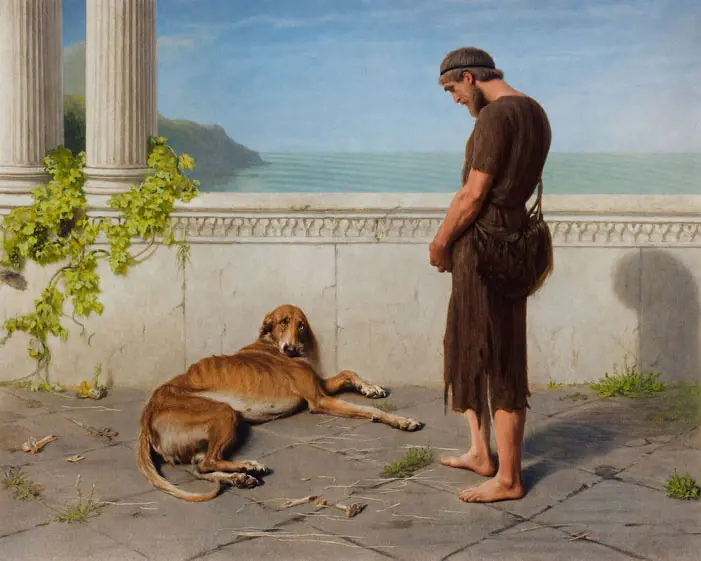
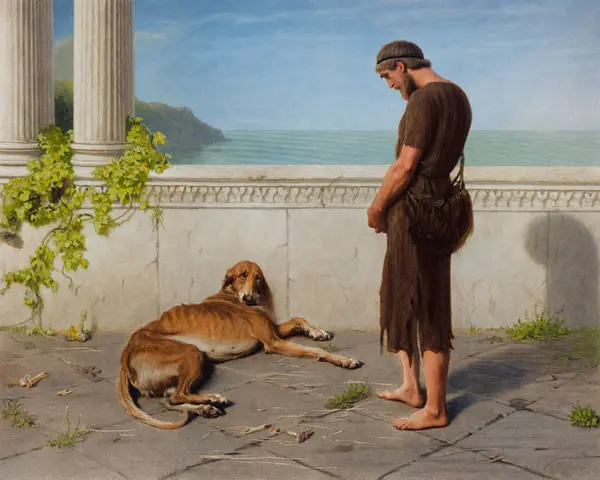
An old dog lies low against sunlit ground, ears lifting, eyes fixed on a ragged stranger who leans toward him with a caution that fights against love. This Ulysses and Argus reproduction reproduces that single charged moment, where a hero disguised as a beggar meets the one creature in Ithaca who still knows his true shape. The scene asks for a wall where someone will actually stop and look.
Briton Riviere painted the work in 1902, late enough in his career that his gift for animal subjects had long been settled and sure. The story comes from Homer: Ulysses returns after twenty years away, hidden behind the guise of a wanderer so that no man will betray him before he is ready. Only Argus, the hound he raised and left behind, recognizes him at once. Riviere sets the two figures on a diagonal across a bare patch of ground, warriors and courtiers absent, so that nothing competes with the exchange between them. Argus cannot rise. Ulysses cannot speak. The whole picture holds itself in that impasse.
The light is warm and low, the kind that falls late in the day, and it settles across earth tones, the browns and tans of the beggar cloak, the dust, the fading coat of the dog. Riviere separates each surface through the handling of paint alone: coarse cloth built from short dragged strokes, the ground scumbled thin and dry, the fur of Argus laid in with softer, closer marks that catch the last of his strength. Nothing in the brushwork is loud, yet the differences are exact, and they carry the emotional weight of the story without a single gesture that could be called theatrical.
ByMuseum artists paint each order as a hand-painted oil painting reproduction rather than any kind of print, working in oil on canvas and rebuilding the picture layer by layer the way Riviere did. This is handmade oil painting, produced by a trained painter who studies the original palette, the fall of that late gold light, and the separate textures of cloth, ground, and coat before a single stroke goes down. The aim is not a flat copy but a surface with its own depth: visible brushwork, raised paint where the original called for it, the same restraint in colour that keeps the scene from tipping into sentiment. What survives the crossing from the 1902 original to your canvas is the relationship between the two figures, held at exactly the distance Riviere gave it.
| artists |
|---|
Artwork guide
Explore the painting’s history, composition and meaning in the ByMuseum art guide.
Read the history and meaning of Ulysses and ArgusEmpty walls flatten a room. A classical artwork restores structure and visual hierarchy. One painting defines the space, anchors furniture, and establishes identity.
Worldwide shipping included. Each painting is produced to order and safely packed for international transport.
All payments are encrypted and processed through trusted payment providers.
Real brushwork, layered oil paint, and durable pigments on museum-quality canvas.
If the result does not meet expectations, return it for a full refund.


Your artwork is painted on premium cotton canvas, then shipped safely rolled in a rigid tube with extra blank canvas border — ready for stretching or framing locally.
Select a handcrafted frame and we’ll deliver your painting fully assembled, protected, and ready to hang.
For safe shipping, framing is available up to a maximum size. Larger sizes will automatically disable the frame option.


Choose “Stretched” to receive your canvas mounted on wooden stretcher bars — perfect if you’ll frame it later or display it as-is.
Gallery Wrap is a deeper, 1.5" style stretcher. The canvas wraps around the sides and is stapled on the back for a clean, modern, frameless look.
We ship with UPS, FedEx, or DHL straight to your door. You’ll receive a tracking number as soon as your order leaves our studio. Typical delivery is 4–5 business days after dispatch; large, framed, or stretched pieces may take longer depending on the safest shipping route.


Unframed canvases are protected with a film, carefully rolled, and secured inside a rigid shipping tube.

Stretched, Gallery Wrapped, and Framed paintings are wrapped, cushioned with foam protection, and boxed for safe transit.
Reviews
There are no reviews yet.