Loading cart…
No products in the cart.

1890 · Oil on canvas · Manchester Art Gallery, Manchester, United Kingdom
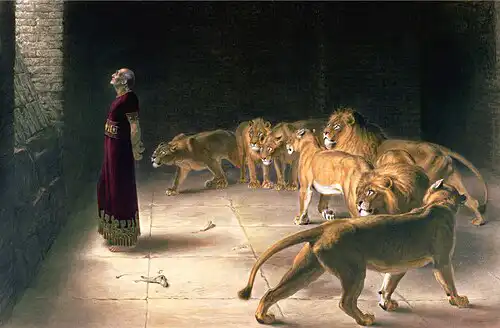
Painted in 1890, this work is one of Briton Riviere's most celebrated contributions to Victorian biblical painting. The artist had a longstanding fascination with the Book of Daniel, having explored related subject matter as early as 1872 with his earlier lions den composition. By 1890, Riviere had refined both his understanding of lion anatomy and his approach to narrative drama, and this painting reflects the full maturity of those skills. The work was exhibited at the Royal Academy and received wide acclaim from critics who admired the balance between religious reverence and naturalistic animal rendering. Riviere was known to study lions directly at the London Zoo, spending considerable time sketching the animals in various postures and lighting conditions to ensure anatomical accuracy. The commission history of the work ties it to the broader Victorian appetite for grand biblical scenes that combined moral instruction with visual spectacle, a combination the Royal Academy audiences responded to enthusiastically. The painting entered the collection of Manchester Art Gallery, where it has remained a centerpiece of the Victorian holdings.
The composition is structured around a powerful diagonal tension between Daniel, who stands upright in the center of the canvas, and the pride of lions arranged around him in various states of repose and alertness. Riviere places the figure of Daniel in warm light that separates him from the shadowy den behind, creating a strong focal contrast that draws the eye immediately to the human subject. The lions themselves are rendered with extraordinary anatomical detail, their musculature, fur texture, and facial expressions studied from life rather than from artistic convention. Riviere employs a relatively subdued palette of ochres, warm browns, and muted golds that unifies the scene without flattening it. The king and his court are visible in the upper background, framed by the architecture of the Babylonian palace, lending a sense of spatial depth and narrative context. The figure of Daniel is painted with a serene dignity, his posture communicating faith rather than fear, and his gaze directed upward rather than at the lions or the king.
The painting engages with one of the most enduring stories of faith and divine protection in the Hebrew Bible. Daniel, condemned by jealous rivals and cast into a den of lions by the Babylonian king Darius, emerges unharmed the following morning, an outcome the biblical text attributes to divine intervention. Riviere uses this moment of vindication to explore themes of steadfast belief, the limits of earthly authority, and the moral courage required to remain faithful under persecution. For Victorian audiences, the imagery carried additional resonance as a parable about integrity in public life. The lions, which in another context would symbolize mortal danger, here become passive witnesses to a higher order, their subdued behavior functioning as evidence of miraculous protection. Riviere reinforces this reading through the posture of Daniel, whose calm demeanor and upward gaze communicate a man in dialogue with the divine rather than a man saved by luck. The painting thus operates simultaneously as biblical illustration, moral allegory, and technical showpiece.