Loading cart…
No products in the cart.

1892 · Oil on canvas · Lady Lever Art Gallery, Port Sunlight, United Kingdom
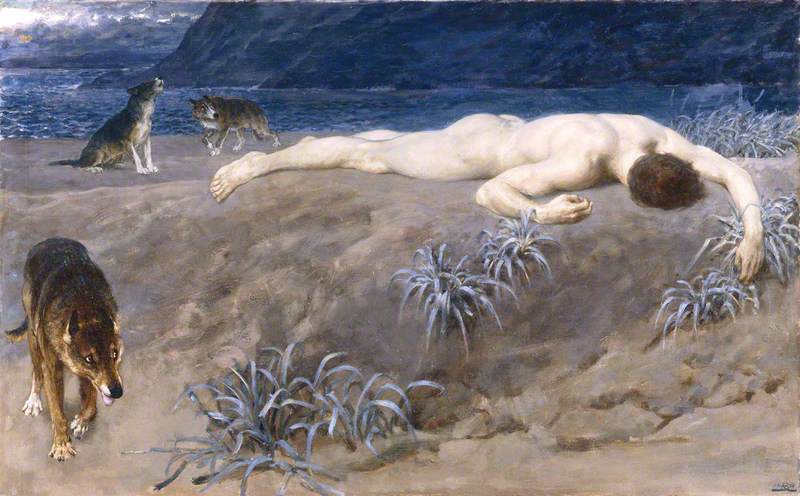
Dead Hector was exhibited at the Royal Academy in 1892 and represents one of Riviere's most emotionally restrained treatments of a classical subject. The painting draws on the Iliad, specifically the aftermath of the duel between Hector and Achilles in which the Trojan champion is killed and his body dragged behind Achilles' chariot before eventually being returned to his father Priam. Riviere, however, chooses not to depict the violence or the triumph of Achilles but instead focuses on the quiet aftermath, showing Hector's body in a moment of stillness attended by his dogs. The choice to include animals rather than human mourners is characteristic of Riviere's approach, allowing him to express grief through the instinctive loyalty of animals rather than through the potentially theatrical emotions of human figures. The work was acquired for the Lady Lever Art Gallery at Port Sunlight, where it remains part of a collection that emphasizes Victorian figurative painting and the classical tradition. The painting reflects the Victorian interest in Homer as a source of both moral instruction and artistic inspiration.
The composition centers on the horizontal form of Hector's body, which stretches across much of the canvas width, creating a strong recessional line from foreground to background. Riviere places the dogs in close physical proximity to their master, their postures conveying grief through gesture rather than expression, heads lowered, bodies pressed close, limbs curled inward. The figure of Hector is painted with considerable attention to anatomical detail, the musculature of a warrior made visible even in the relaxation of death. The background is spare, suggesting a rocky, open plain without architectural detail, which focuses attention entirely on the human and animal subjects in the foreground. Riviere uses a relatively cool palette here, with greys, pale ochres, and muted earth tones dominating, a choice that reinforces the elegiac quality of the subject. The lighting is even and diffuse, without the dramatic contrasts that characterize some of his other works, giving the scene an atmosphere of quiet solemnity rather than theatrical grief.
The decision to present Hector through the lens of his relationship with his dogs rather than through the grief of his family or the triumph of his enemy is a significant interpretive choice. Dogs in classical antiquity, as in the Victorian period, were understood as emblems of loyalty, fidelity, and unconditional attachment, and by making them the primary mourners, Riviere emphasizes the personal rather than the epic dimensions of Hector's death. The painting invites viewers to consider the private cost of heroism, the lives and relationships ended by the grand violence of war. For Victorian audiences, who were deeply familiar with Homer through both classical education and popular culture, this reframing would have been immediately legible as a meditation on loss rather than on glory. Riviere effectively domesticates an epic subject, grounding the grandeur of the Trojan War in a moment of intimate bereavement that any viewer who had loved and lost an animal could understand on an emotional level.