Loading cart…
No products in the cart.

1894 · Oil on canvas · Tate Britain, London, United Kingdom
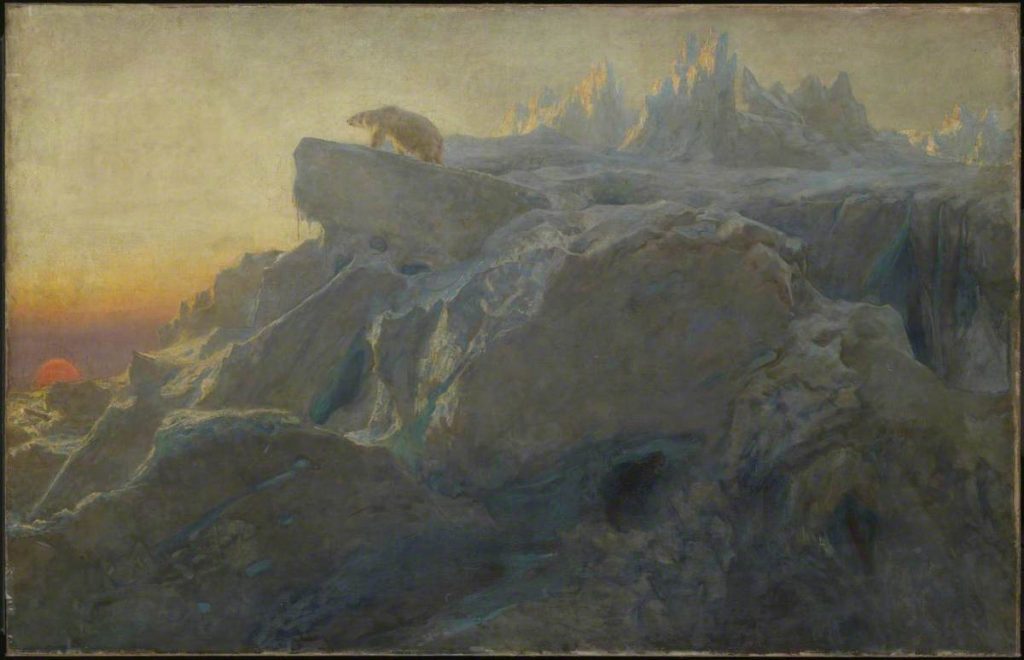
Briton Rivière painted Beyond Man's Footsteps in 1894 and exhibited it at the Royal Academy, where it was received with the admiration that had by then become customary for his large-scale animal compositions. By the 1890s, Rivière had long since demonstrated his ability to paint domestic animals with empathy and precision, but in this work he turned his attention to a creature of the wild and to a landscape of radical remoteness. The painting reflects the Victorian and Edwardian fascination with polar exploration, a subject that captured the public imagination throughout the latter half of the nineteenth century as expeditions pushed further into the Arctic and Antarctic regions. The idea of places beyond the reach of human settlement, landscapes that existed entirely outside human history and human concern, held a powerful philosophical and aesthetic appeal for Victorian viewers schooled in the tradition of the sublime. Rivière responded to this cultural moment by placing a polar bear in a composition of vast, empty ice and open sky, creating an image that communicated the scale and indifference of the natural world with quiet authority. The work entered the collection of Tate Britain, where it stands as one of the more unusual and striking works in a collection that encompasses the full breadth of British art. Its presence in a national collection confirms its status as one of the significant works of Rivière's mature period. For those who feel the pull of this image, ByMuseum offers the opportunity to own this as a hand-painted oil reproduction, bringing the atmosphere of the arctic into any interior space.
The compositional ambition of Beyond Man's Footsteps is immediately apparent in its scale and in the distribution of pictorial weight across the canvas. Rivière positions the polar bear in the middle ground rather than the foreground, allowing the icy landscape to assert its presence as a subject in its own right rather than merely as a backdrop. This choice is significant: it places the animal within the landscape rather than in front of it, and it communicates the relationship between creature and environment as one of belonging rather than dominance. The palette is extraordinary in its restraint, built almost entirely from whites, pale blues, and cool grays, with only the warm tawny tones of the bear providing a counterpoint to the surrounding cold. Rivière renders the ice with careful attention to its optical properties, capturing the way frozen surfaces reflect and diffuse light rather than simply bouncing it back in a uniform glare. The sky occupies a substantial portion of the upper canvas, and its pale luminosity creates a sense of openness and distance that reinforces the feeling of immense, unpeopled space. The bear itself is painted with the same anatomical care that Rivière brought to his domestic animal subjects, yet the creature feels entirely at home in its environment in a way that a dog in a drawing room does not, which sharpens the painting's meditation on wildness and belonging. The brushwork in the snow and ice passages is loose and expressive by comparison with Rivière's usual precision, suggesting the formlessness of frozen terrain. Those who respond to this image can own this as a hand-painted oil reproduction through ByMuseum, where skilled painters recreate the full tonal range of the original.
Beyond Man's Footsteps carries a meaning that extends well beyond the depiction of a single animal in a specific landscape. The title itself is a philosophical statement, evoking spaces that exist outside human jurisdiction, outside human memory, and outside the networks of meaning that human civilization has constructed over millennia. For a Victorian audience accustomed to thinking of the natural world as something to be mapped, catalogued, and brought within the sphere of human understanding, a painting that celebrated the existence of territory genuinely beyond that reach carried a charge of both wonder and humility. The polar bear in the painting is not performing for the viewer; it is simply present, going about the business of its existence in a world that has no need of human observers. This quality of radical self-sufficiency gives the animal a dignity that is distinct from the loyalty and devotion that Rivière celebrated in his domestic animal subjects. The painting can be read as a meditation on the limits of human power and knowledge, a reminder that the natural world is vaster and older than any human project. It also participates in a tradition of sublime landscape painting, though Rivière anchors his sublime in a living creature rather than in pure topography. In the contemporary moment, the image acquires additional resonance in the context of environmental concern, as the habitats depicted in the painting have become the subject of urgent conversation about preservation and loss. The work asks viewers to contemplate what is at stake when the places that are beyond human footsteps begin to contract. Own this as a hand-painted oil reproduction from ByMuseum and keep this vital image present in your daily life.