Loading cart…
No products in the cart.

The Odyssey in Paintings · Part 3 of 3
The last third of the Odyssey happens in one house. Odysseus is home, disguised as a beggar, and the poem slows down to watch him find out what twenty years have done: to his dog, his nurse, his son, his wife, and the hundred and eight men who are eating his food and courting her. Then he picks up his bow.
Athena meets him on the beach, tells him what has happened, and disguises him: she wrinkles his skin, dims his eyes, dresses him in rags. He goes first to the hut of his swineherd Eumaeus, who does not know him and feeds him anyway, and there meets his son Telemachus, who was a baby when he left and is now twenty. Athena lets him show himself to the boy. They weep, then plan.
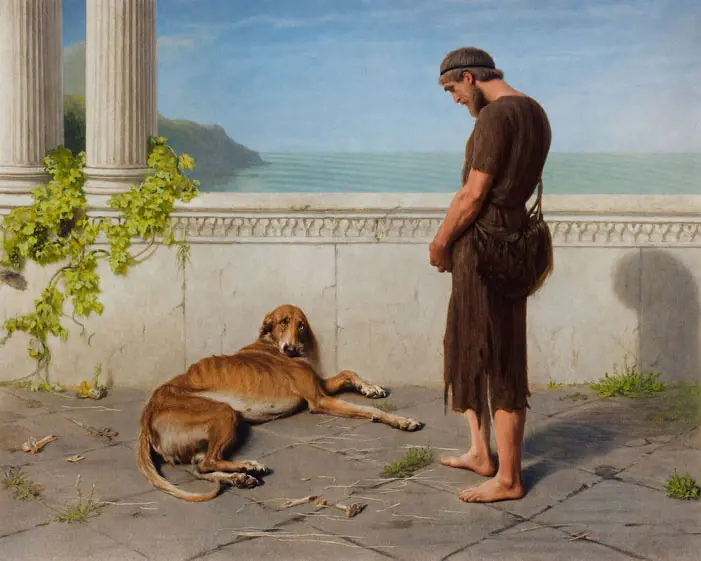
Then he walks up to his own house as a beggar, and at the door an old dog lying on a dung heap lifts its head.
There lay the dog Argus, full of ticks. And when he knew that Odysseus was near he wagged his tail and dropped both his ears, but he could no longer come to his master. And Odysseus looked away and wiped a tear, and hid it from Eumaeus. And the fate of black death took Argus, as soon as he had seen Odysseus again, in the twentieth year.
Homer, Odyssey, translated for this article
It is the shortest episode in the poem and the one nobody forgets. Odysseus had raised the dog as a puppy and left before it could hunt. Twenty years later it recognises him under the disguise that has fooled everyone else, and dies. He cannot even stroke it without giving himself away. Briton Rivière, the Victorian who painted animals with more feeling than most painters give people, made it his subject in 1885 and it is his best picture.
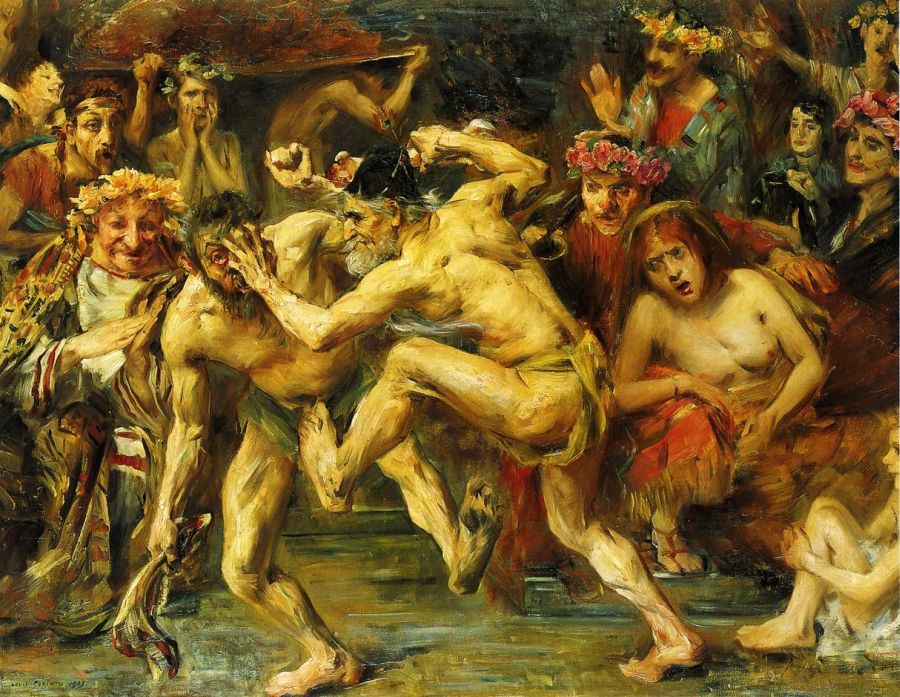
In the hall the suitors are feasting. They mock the beggar, throw a stool at him, and set him to fight another beggar, Irus, for their entertainment. Odysseus, who could kill the whole room, breaks Irus's jaw with one careful punch and drags him outside. Lovis Corinth painted the fight as a brawl in a Berlin beer hall, which is not far wrong.
That night Penelope, who does not know him, orders the old nurse Eurycleia to wash the stranger's feet. Eurycleia had nursed Odysseus as a baby. As she washes she finds the scar on his thigh from a boar hunt in his youth, and knows him, and drops his foot in the basin.
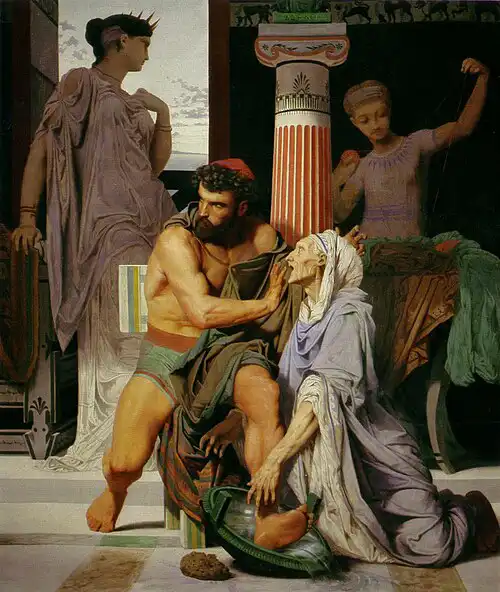
The old woman took the scar in the flat of her hands and knew it as she felt it, and let his foot fall, and his leg struck the basin and the bronze rang and the water spilled on the floor. Joy and grief seized her heart at once.
Homer, Odyssey, translated for this article
He takes her by the throat and swears her to silence. Gustave Boulanger, an academic painter of the Second Empire, chose that instant, and it is a small masterpiece of a scene that most painters skipped as undignified. It is the most intimate moment in the poem: the first person in his own house to know him is the woman who changed his nappies.
And Penelope. For twenty years she has held the house against a hundred and eight suitors by a trick: she promised to choose one when she finished weaving a shroud for Odysseus' old father, and every night for three years she unpicked what she had woven by day, until a maid betrayed her. She is the cleverest person in the poem after her husband, and possibly before him.
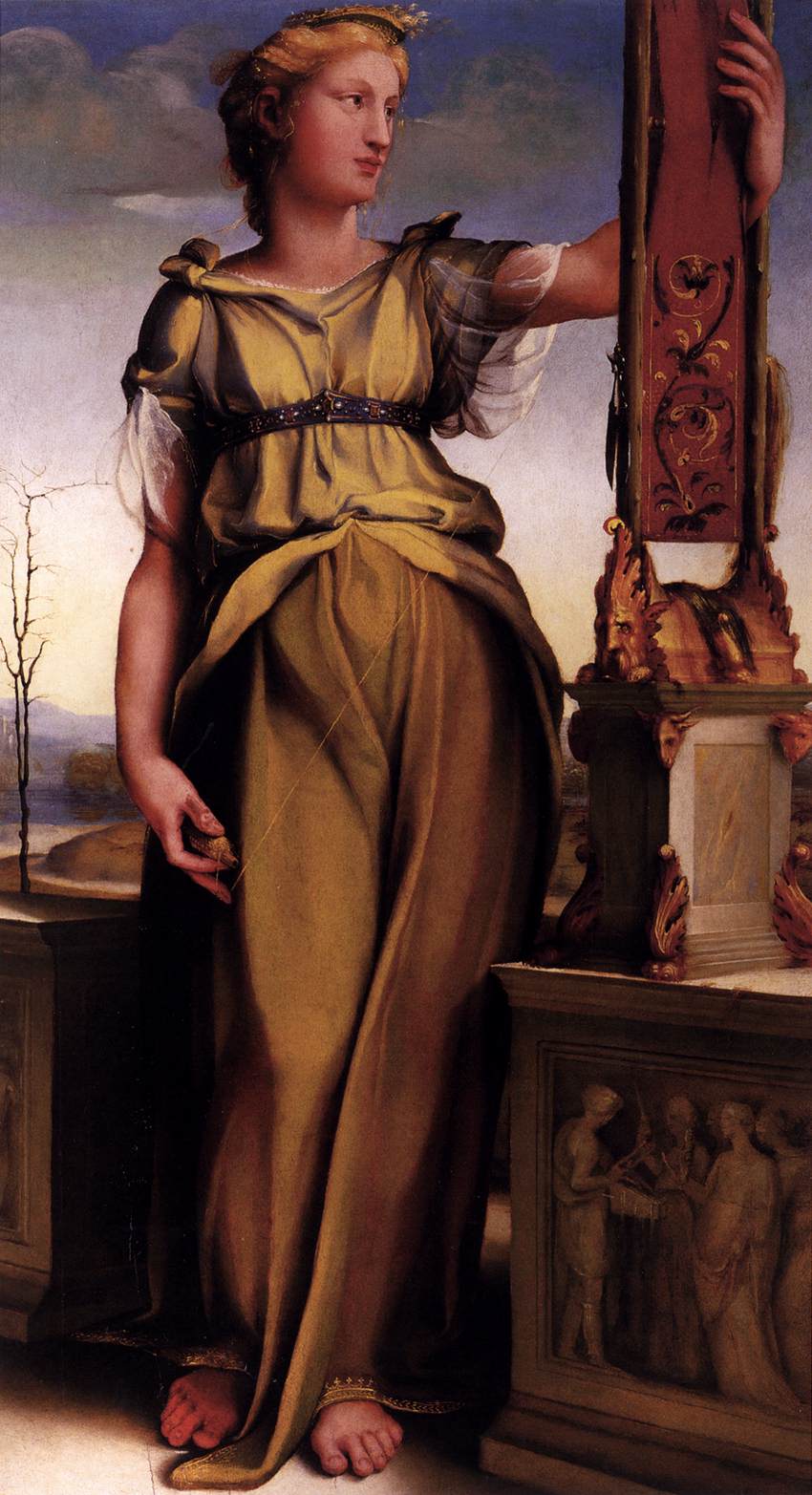
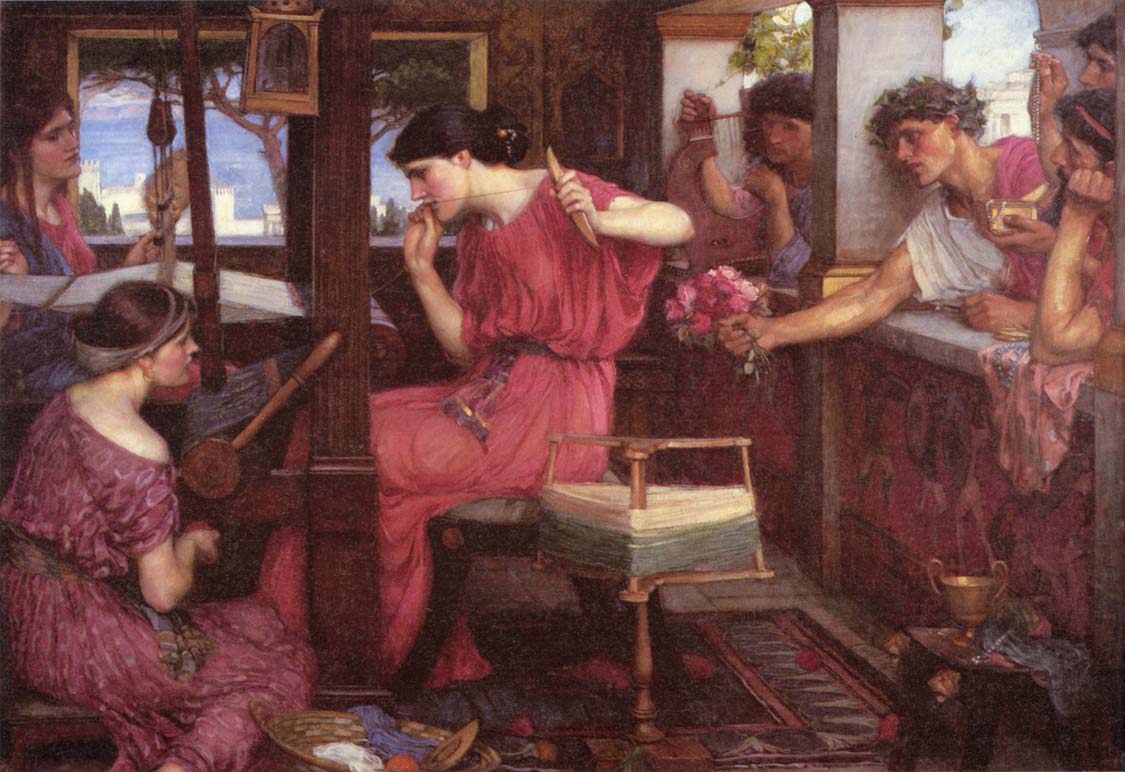
Painters from the Renaissance on have shown her at the loom, and Waterhouse, in 1912, painted the whole scene: the suitors leaning in through the window with gifts, the maids, the loom, and Penelope with her back to all of them. Beccafumi, four centuries earlier, gave her a spindle and nothing else and let her face do the work.
Homer gives her the last trick. She tells the suitors that she will marry whichever of them can string Odysseus' great bow and shoot an arrow through twelve axe heads in a line. Whether she has guessed who the beggar is when she does it, the poem does not say. Readers have argued for three thousand years.
None of them can string it. They warm it, they grease it, they fail. The beggar asks for a turn and they jeer, but Telemachus insists. Odysseus turns the bow in his hands like a musician with a lyre, strings it without rising from his stool, plucks the string so that it sings like a swallow, and sends the arrow through the twelve axes.
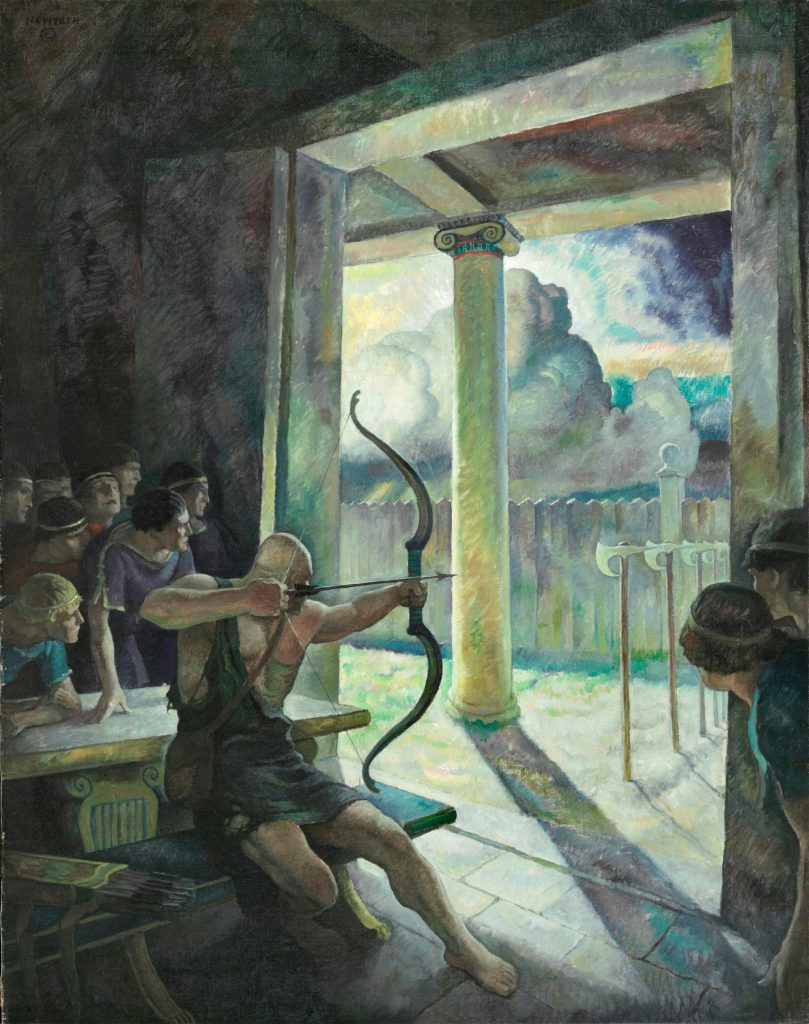
Then he took the bow and strung it easily, and with his right hand tried the string, and it sang sweetly under his touch, with a voice like a swallow's. And great grief came on the suitors, and the colour of their faces changed.
Homer, Odyssey, translated for this article
Then he stands up, strips off the rags, and shoots Antinous, the worst of them, through the throat while he is lifting a cup. The doors have been locked. It takes the rest of the book. When it is over the hall is a slaughterhouse, and Odysseus, standing among the bodies like a lion, forbids Eurycleia to cry out in triumph, because it is wrong to boast over the dead.
Painters have almost entirely avoided the massacre, which is strange, since it is the climax, and not strange at all, since it is a hundred and eight men being killed in a dining room. Wyeth, who painted the whole poem for a 1929 edition, stops at the moment before the first arrow, which is the right moment. Homer did not stop. It is the most violent passage in Greek literature, and it is written with complete control.
Penelope will not believe it is him. She has been lied to for twenty years by men claiming to bring news of Odysseus, and she tests him with the one thing only he could know: she tells the nurse to move their bed out of the bedroom. Odysseus explodes. The bed cannot be moved. He built it himself around a living olive tree that grows through the floor of the room, and only he and she and one maid know it.
So he spoke, and her knees and her heart went weak, as she recognised the sure signs that Odysseus gave her, and she wept and ran to him and threw her arms around his neck and kissed his head.
Homer, Odyssey, translated for this article
That is the end of the journey: not the bow, but the bed. Athena holds back the dawn so that they can talk all night, and he tells her everything in this article, from the Cicones to Calypso, in a few lines, the way you would.
The poem goes on a little: the suitors' families come for revenge, there is a last fight, and Athena stops it. Later poets could not leave the ending alone. Fénelon, in 1699, wrote a whole novel about Telemachus, and Gérard painted the son refusing a crown; Tennyson sent the old Odysseus back to sea; Joyce gave him a day in Dublin. But Homer stops at the olive tree.

Fifty-one paintings appear in this series, from Beccafumi in 1519 to Wyeth in 1929, and every one is in our Odyssey paintings collection, available as a hand-painted oil reproduction. If you want one picture that holds the whole story, buyers most often choose the dog: Ulysses and Argus. If you want the sea, the Sirens. If you want the woman who won, Penelope.
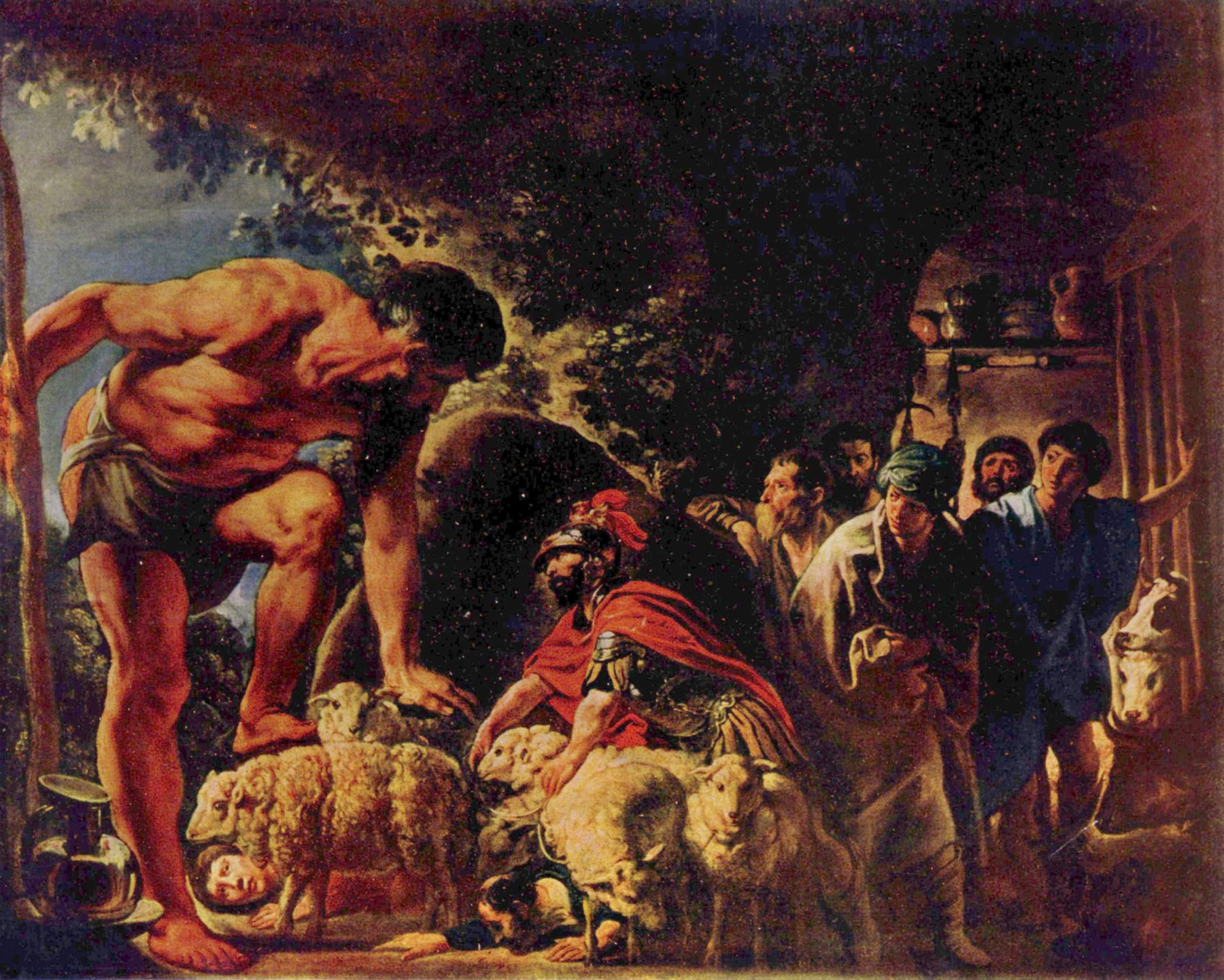
Every painting shown is available as a hand-painted oil reproduction; click any image.