Loading cart…
No products in the cart.

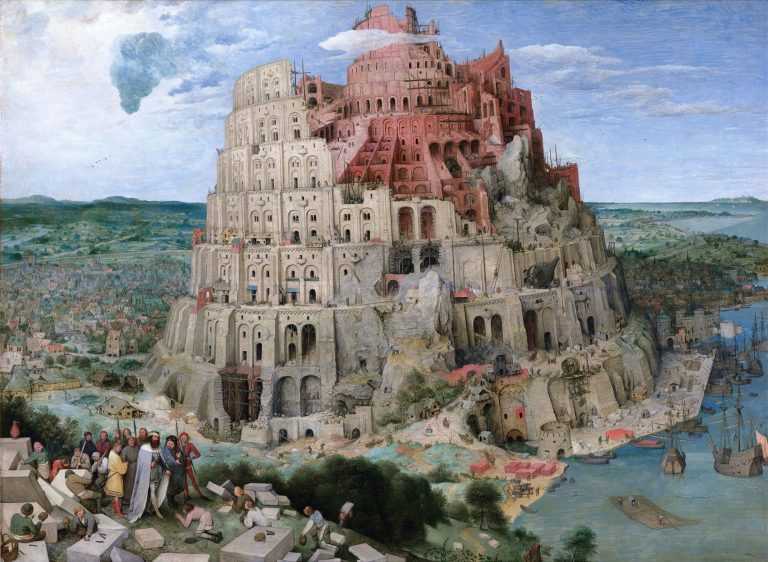
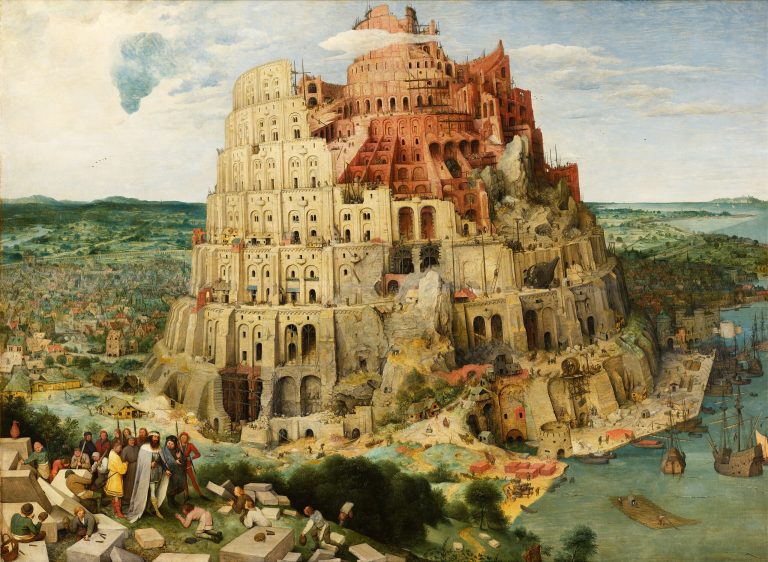
1563 · Oil on oak panel · Kunsthistorisches Museum, Vienna
Save articles to your collection
Log in or create a free account, and this article will be waiting in your Private Collection.
Log in or sign up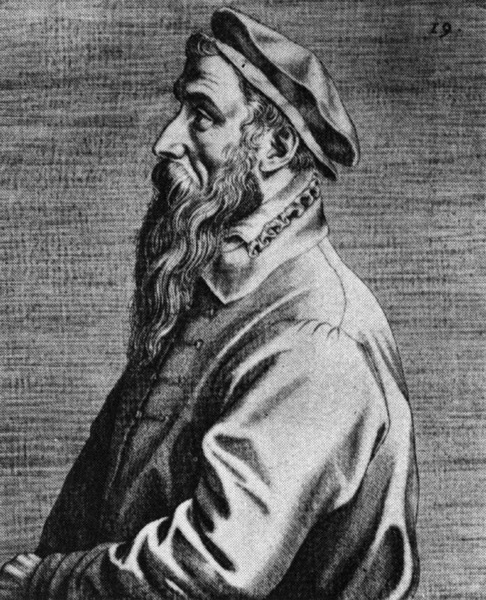 Explore the artistPieter Bruegel the Elder →
The Tower of Babel is Pieter Bruegel the Elder’s 1563 painting of humanity’s attempt to build toward heaven, told through an immense construction site. It belongs to the Kunsthistorisches Museum in Vienna and is painted in oil on oak, 114.4 × 155.5 cm. This is the larger of his two surviving Babel paintings.
The tower dwarfs the houses and ships around it. Near the lower left, a king and his attendants inspect a site where stonecutters, carriers, sailors and builders keep working. The biblical story predicts the failure of their common purpose, but the painting lets us examine what they have already managed to achieve.
Look beyond the broad silhouette and the structure becomes surprisingly intimate. People have made homes on its terraces. A cart follows the road below. A man bends over a stone. Bruegel gives this impossible project the routines of an ordinary working town.
In Genesis 11, people sharing one language build a city and a tower to establish their name and prevent their dispersal. God confuses their language, they lose the ability to understand one another, and the building project stops as they scatter.
The biblical account does not describe a dramatic collapse of the tower. It also does not name Nimrod as the ruler of this particular undertaking. His association with Babel belongs to the wider interpretive tradition, and the richly dressed foreground ruler is usually identified with him.
Bruegel does not show God descending or a crowd visibly abandoning the site. Work continues in many separate places. Knowing the ending changes our response to those small activities: we can admire their coordination while wondering how easily it could be lost.
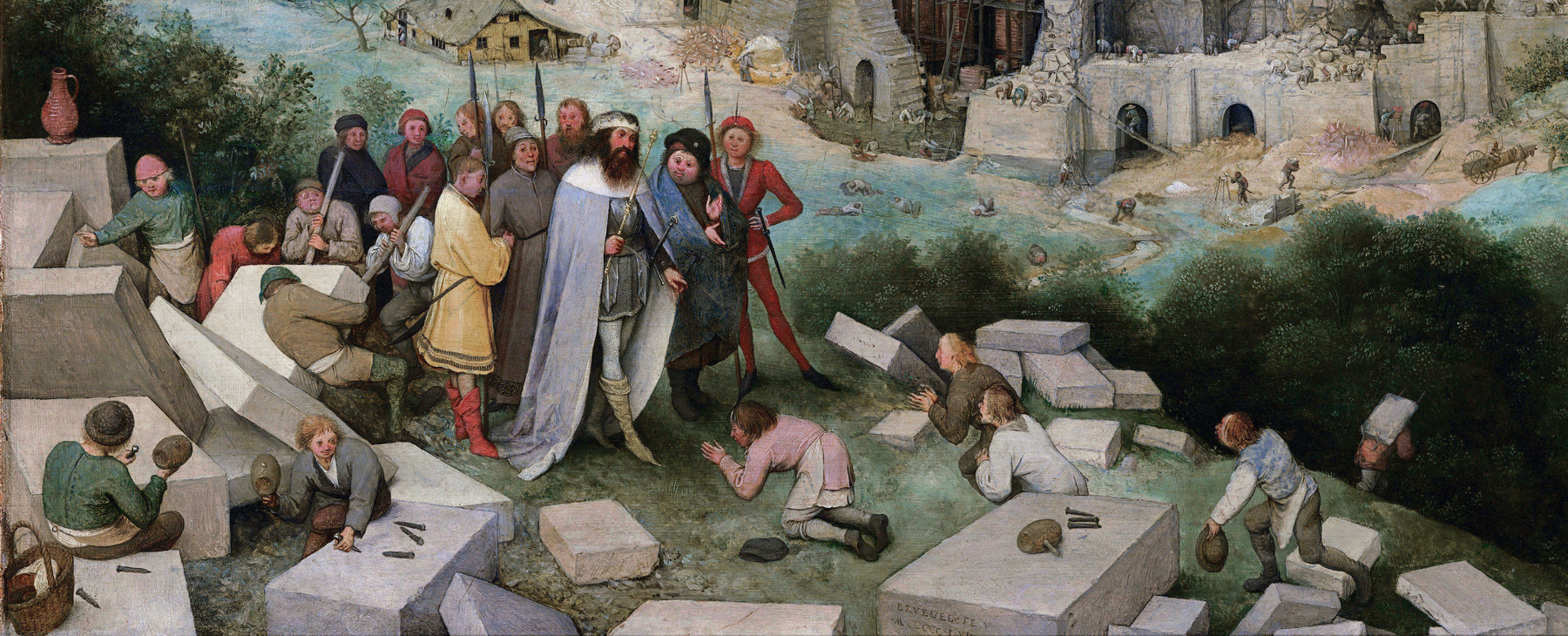
The bearded ruler wears a crown, armour and a pale cloak. Around him stand attendants carrying weapons, while several workers kneel and remove their caps. Their complete figures make the difference in posture unmistakable: the royal party stands upright among men close to the ground.
The figure is conventionally identified as Nimrod. In its collection commentary, the Kunsthistorisches Museum connects this identification with the account of Flavius Josephus, rather than with a named king in Genesis 11. Bruegel dresses the entourage in clothing familiar to a Renaissance viewer.
The visit has interrupted the work nearest us. Hats are held in hands and tools lie on the blocks, yet the much smaller labourers around the tower continue their tasks. The king occupies the foreground without commanding every corner of the picture.
Across the foreground, rectangular blocks sit beside men shaping the stone. Dark chisels and a broad-headed mallet lie on a pale upper surface. One worker holds his cap while kneeling on the stone itself. These are recognisable tools and gestures, painted at a scale large enough for us to inspect them.
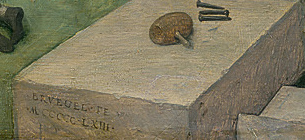
On the front of one block, Bruegel places his own name and the date, 1563, in Roman numerals. The inscription belongs to the surface of a material waiting to enter the building. It is an apt place for a painter to mark his work in a picture so concerned with making things.
Notice the change in distance. Nimrod is already small in relation to the tower, but these chisels make him seem large again. The painting repeatedly moves between a landscape, a human body and an object held in a hand.
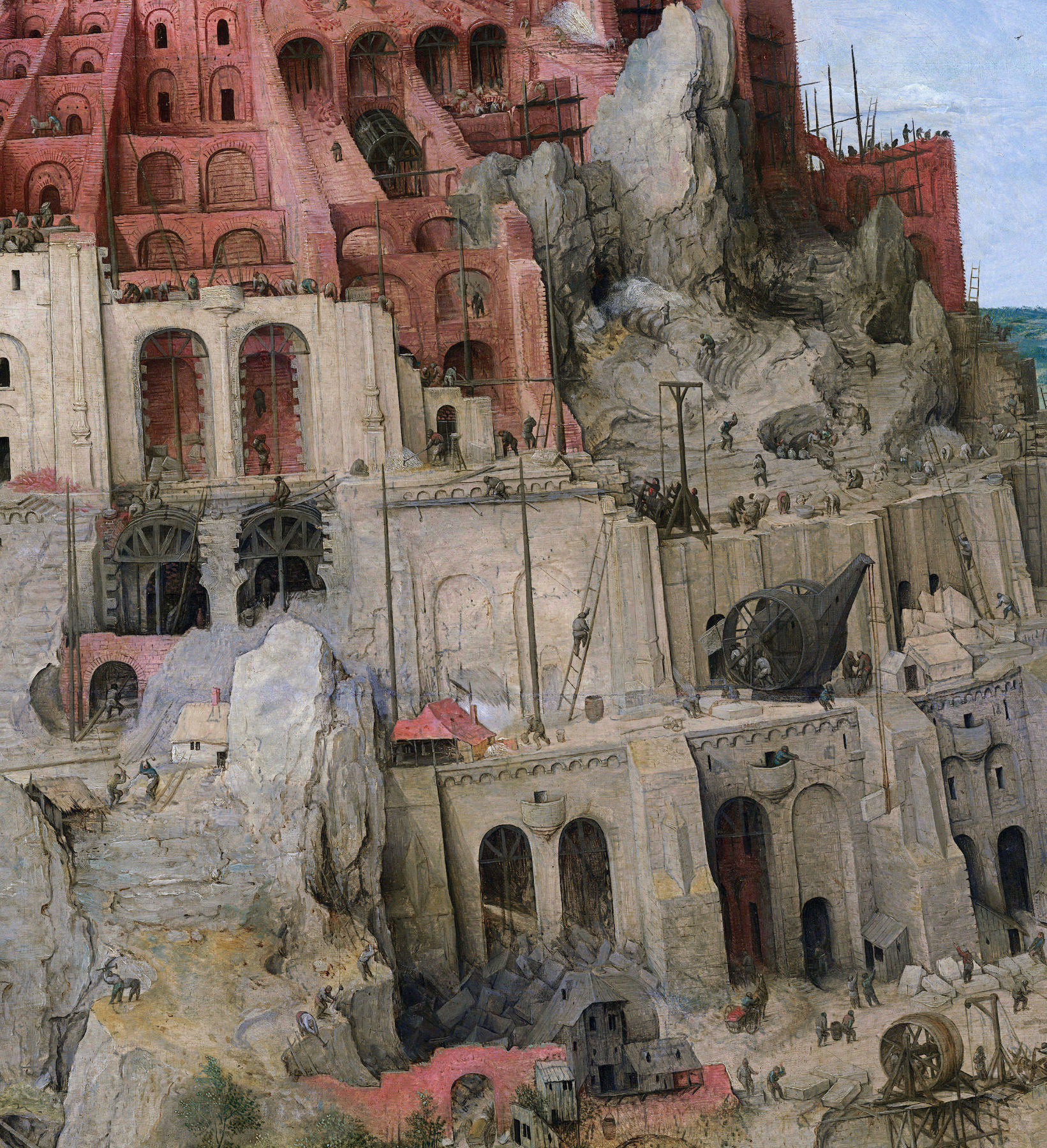
On the exposed side, the tower does not read as a neat stack of finished rooms. Pale rock interrupts the structure. Built openings and irregular natural surfaces meet without a clean boundary.
This makes the tower seem less like an object placed on the landscape than an attempt to consume and reorganise it. A mountain has become part of the construction site.
The architecture mixes familiar forms in an impossible accumulation. The museum notes its combination of ancient and Romanesque elements. Repeated arches give it something of an antique monument’s authority, while the unfinished core prevents that authority from feeling secure.
This is an invented architecture, not an archaeological reconstruction of ancient Babylon. Its rounded galleries, repeated arches and attached dwellings belong to Bruegel’s assembled vision of how such a vast undertaking might look.
The curved exterior and stacked rows of arches recall the Colosseum, which Bruegel could study during his journey to Rome. Here those repeated openings rise around a tapering mountain of construction, so an ancient amphitheatre’s familiar forms become part of an unfamiliar tower.
The Kunsthistorisches Museum describes the architecture as a mixture of classical and Romanesque elements. Its commentary also points to an optical distortion: the left side appears to sink, even as the building is anchored into rock. Following the bands of masonry around the curve makes that uneasy balance more apparent.
The result is convincing enough to explore and strange enough to distrust. A builder may understand the next arch, while the viewer struggles to make sense of the whole.
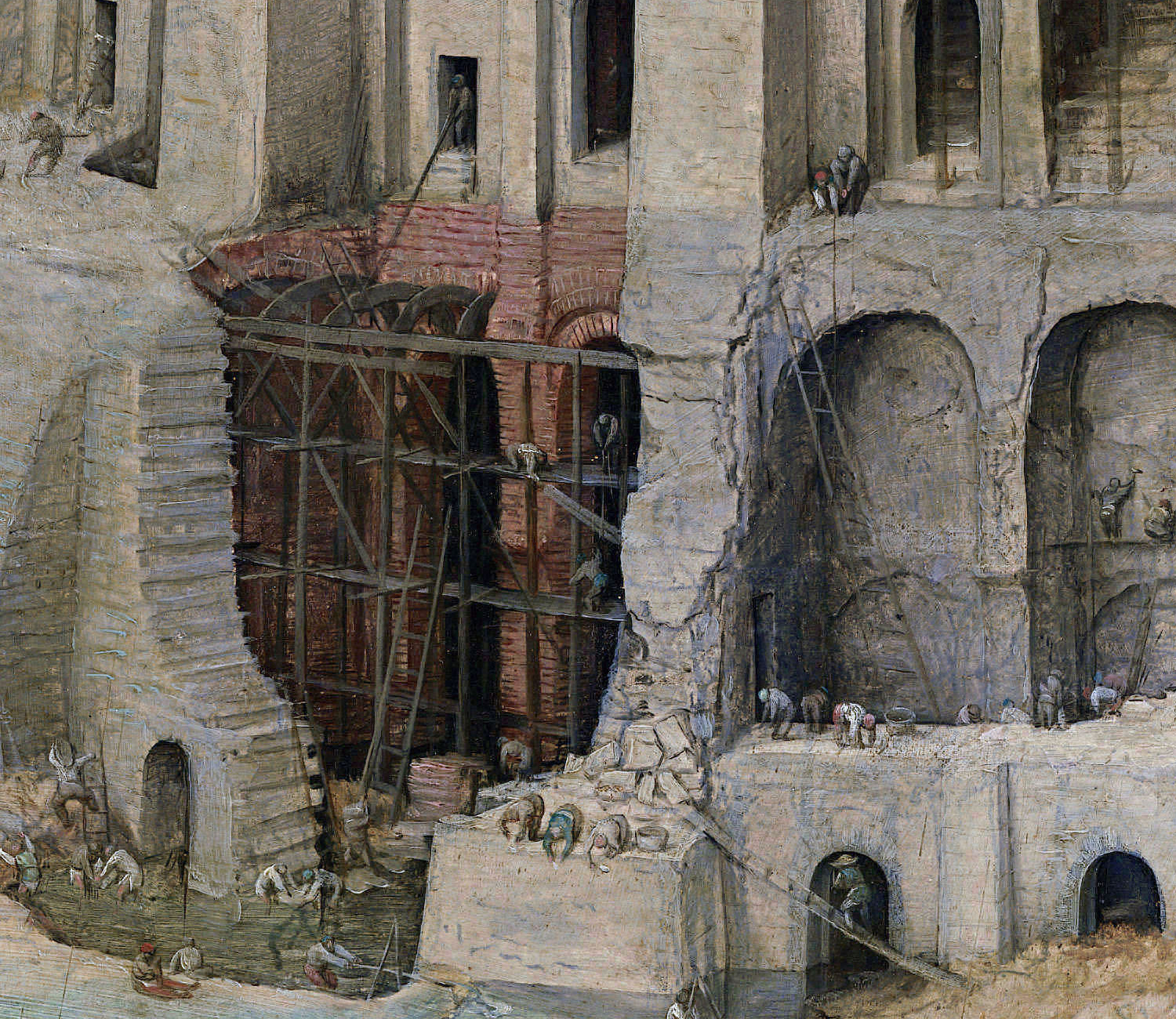
A large opening near the lower front reveals an interior of red brick and dark timber. Long posts and crossing braces fill the gap. Curved wooden supports sit under the masonry above, exposing a stage of construction that a finished facing would hide.
Small figures work beside these supports, with ladders, baskets and ropes close at hand. Their presence helps us read the opening’s extraordinary height. It is already larger than the neighbouring homes, yet it remains only one part of the tower.
Moving from one opening to the next, we encounter different states of completion. Some have finished-looking pale surrounds; others expose brickwork, scaffolds or bare rock. The building contains its own construction history.
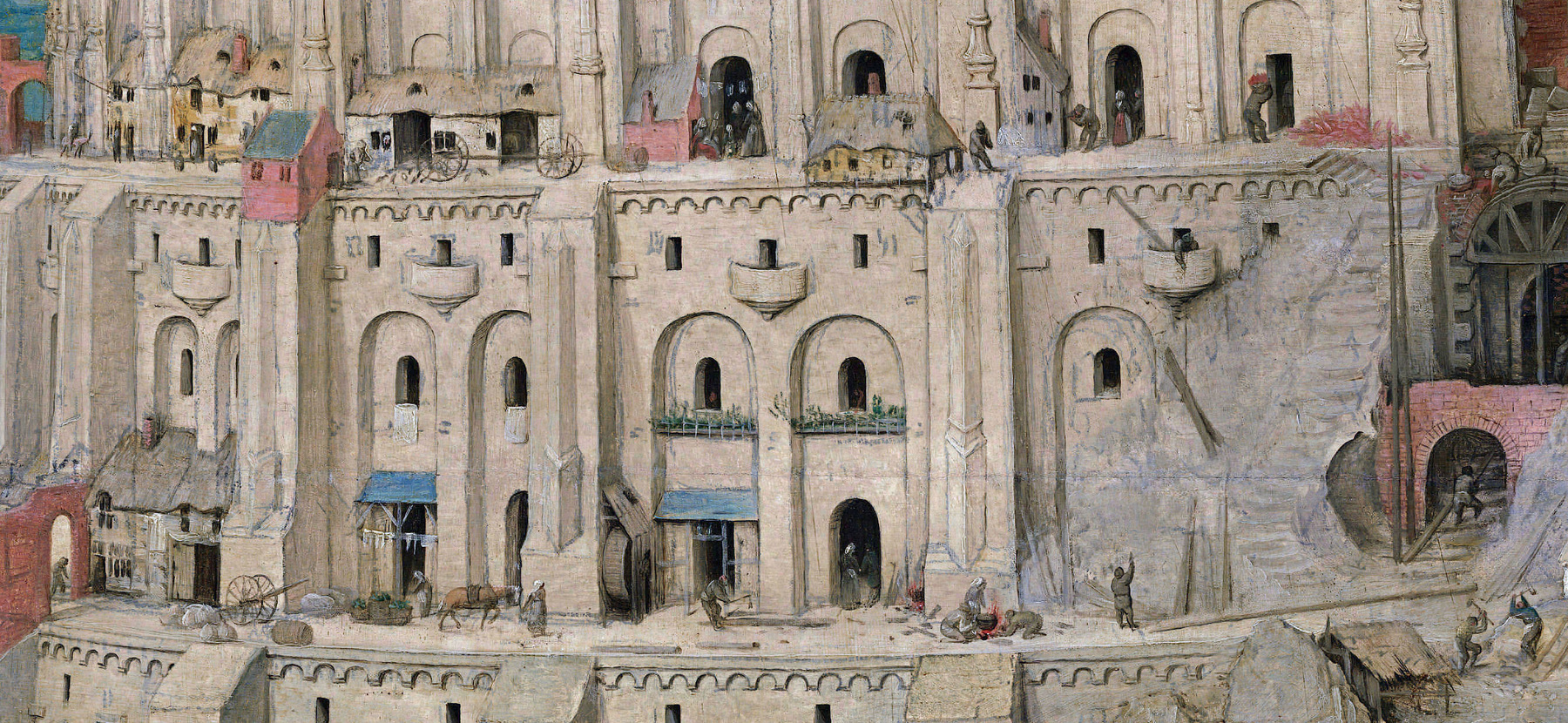
Small houses attach themselves to the lower galleries. A red wall stands beside a timber front; blue awnings project over openings, and planted ledges soften the massive stonework. Carts and people use the terrace as a street.
These features change the tower from a distant monument into an inhabited place. Someone can come through a doorway or tend a plant while the upper storeys are still rising. The unfinished project already contains a neighbourhood.
Art historian Barbara A. Kaminska draws attention to the flowers and drying laundry in her study of the painting. Those domestic details complicate a reading based entirely on doomed ambition: people are building lives here as well as a tower.
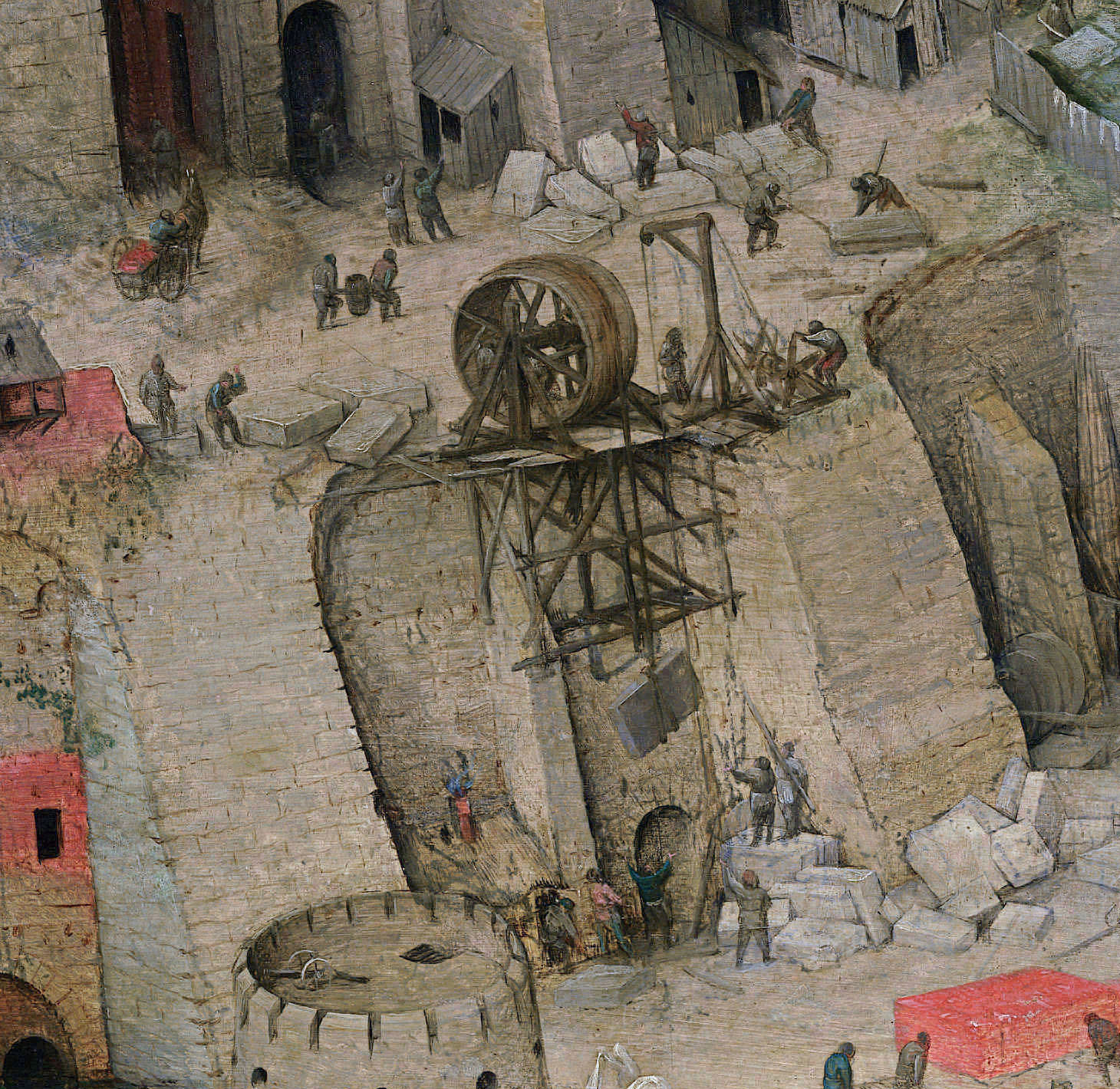
The lower treadwheel stands on a projecting timber platform. Its wheel and bracing are clearly separate from the masonry behind it, and workers gather around the lifting equipment. Below, more figures handle blocks along the quay.
The wheel provides a human measure of the task. Stone must be lifted from one level to another before it can become part of an arch. Even a building this vast depends on the repeated movement of individual loads.
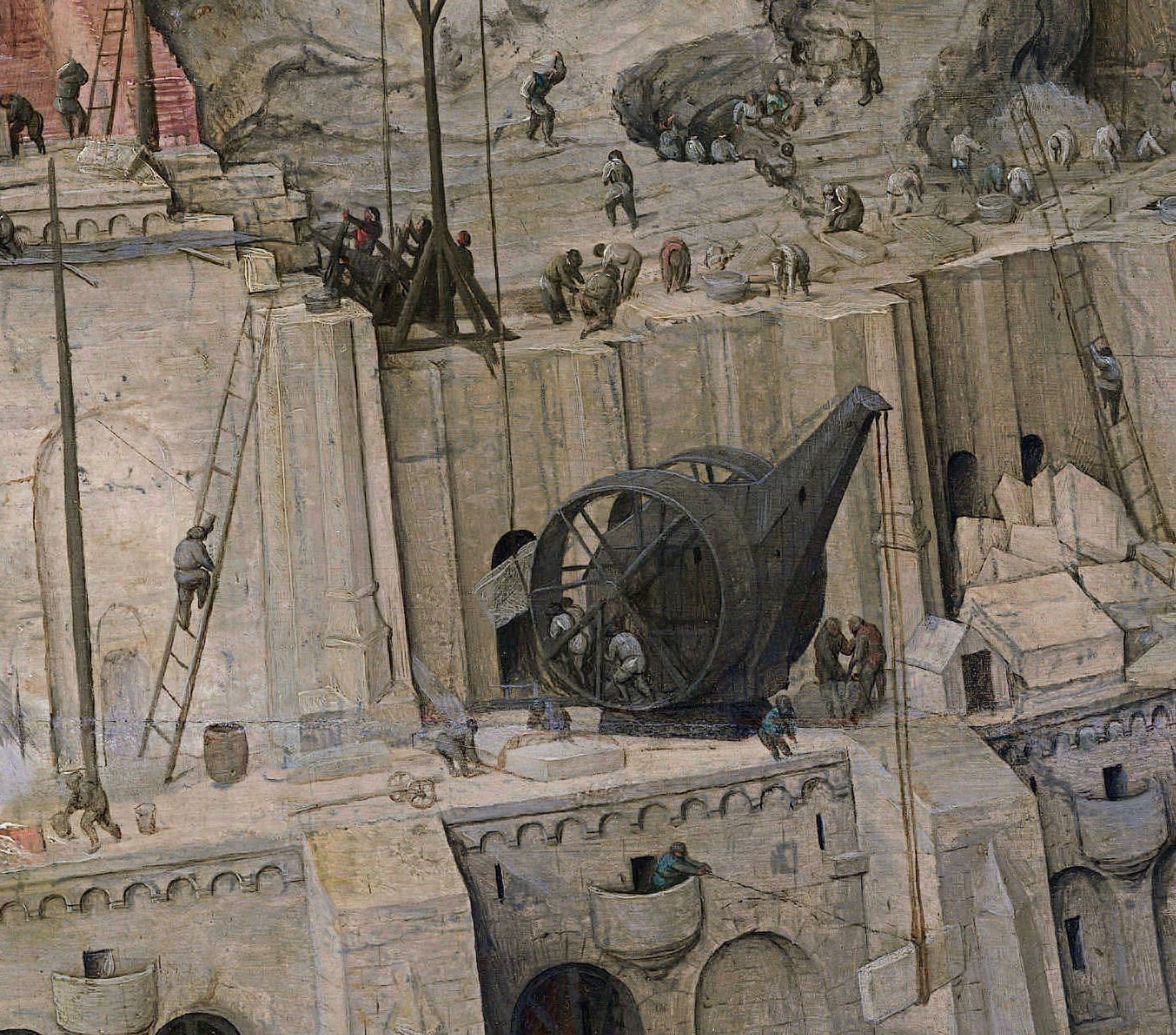
Higher up, another machine projects beyond the terrace. A large wheel sits within its dark framework; nearby ropes, a ladder and a simple upright hoist offer other ways of moving people and materials.
Bruegel does not give every device the same silhouette. This variety makes the site feel observed, with different solutions fitted to different positions on the building.
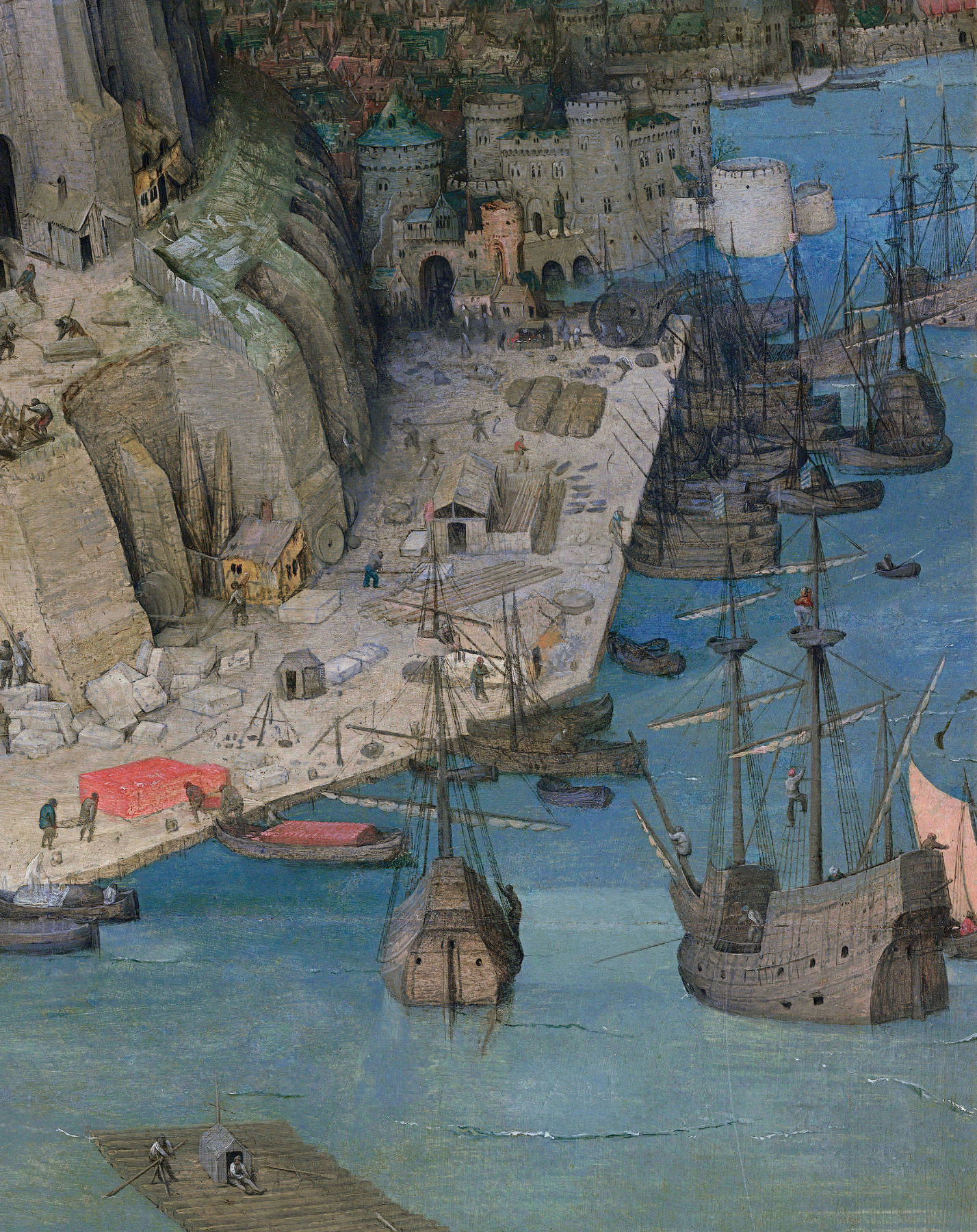
The harbour is crowded with rigging, hulls and small boats. Along the pale quay, workers move among stacked blocks, planks and bright red piles of building material. The ships connect the enormous structure with places beyond the painted horizon.
Masts form a second forest of thin lines beside the scaffolds. Against the huge buttresses, the vessels look small; at closer range, their decks and rigging restore a familiar working scale.
The blue water also gives the eye somewhere to rest. Its flatter surface sets off the dense, warm-coloured brickwork above. The river continues through the landscape, reminding us that this crowded building site occupies only part of a much wider world.
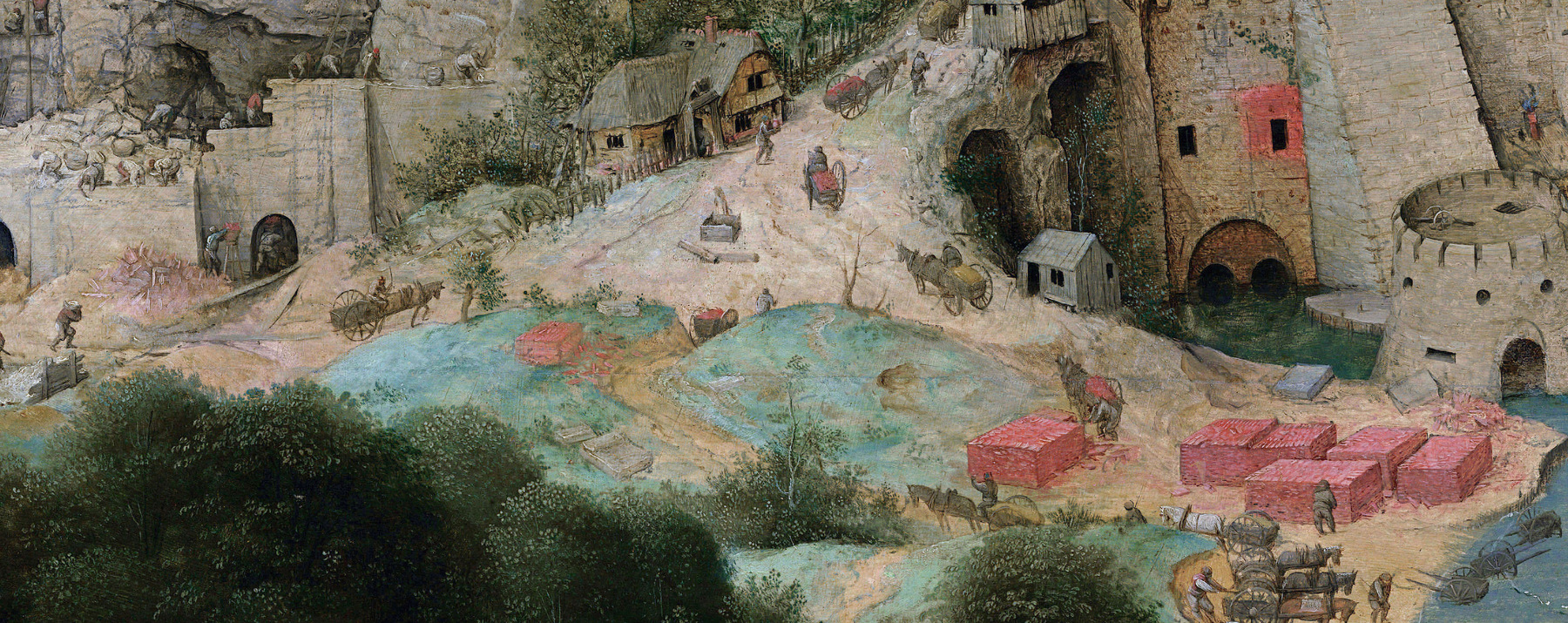
Land transport meets the waterfront below the tower. A loaded cart rounds the approach, pack animals climb beside the masonry, and figures carry burdens along the path. The route bends around small buildings at the base instead of running straight toward a grand entrance.
Follow it with your eye and the abstract idea of construction becomes a sequence of journeys. A block has to reach the site, pass through a working space and be raised to the place where someone needs it. The tower’s finished-looking walls depend on this less conspicuous movement below.
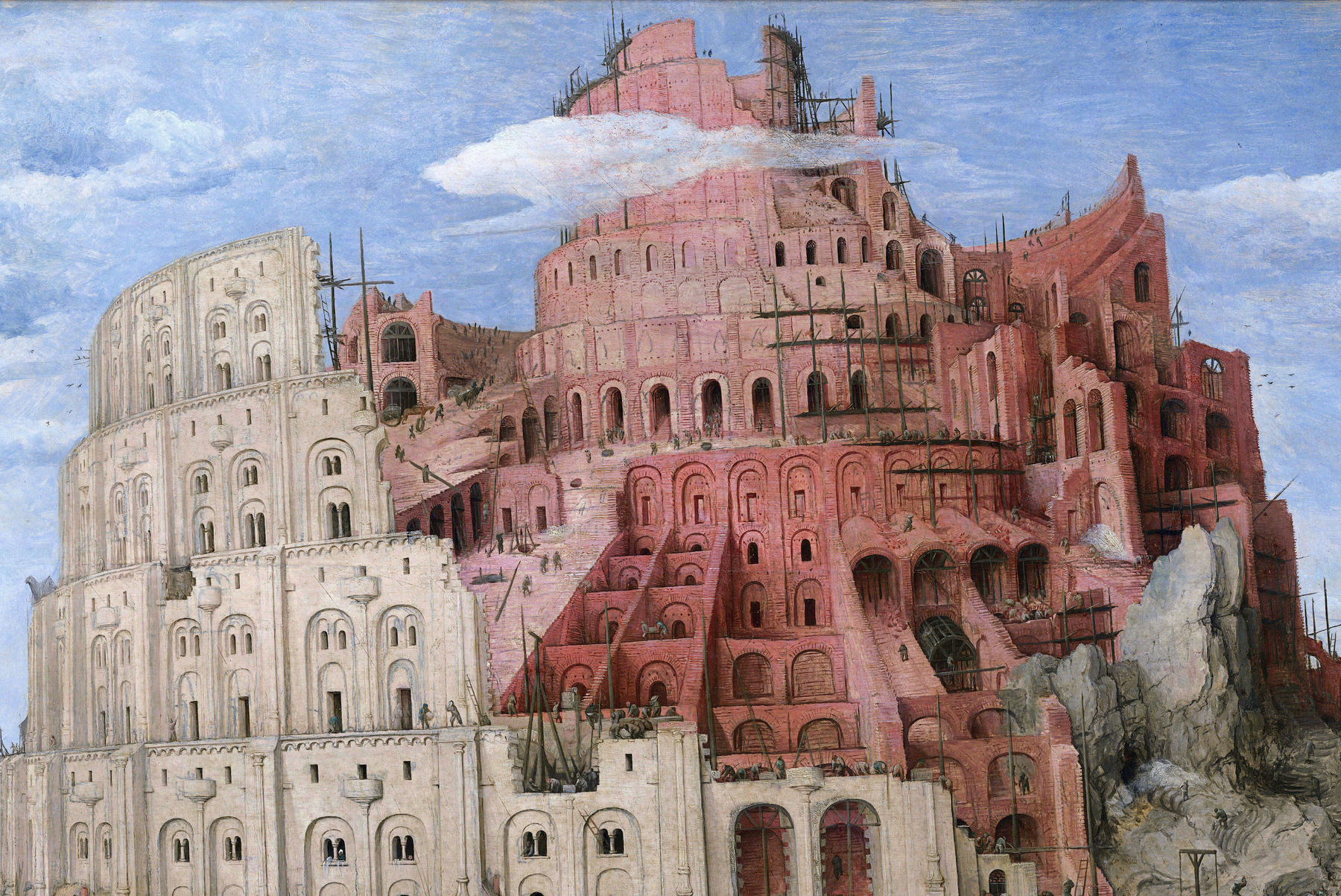
A low white cloud crosses the red upper walls. Above and beside it, narrow poles and scaffolds rise against the sky. A line of tiny figures on an exposed upper edge helps us recognise how far the building has carried them from the ground.
The contrast between red brick and pale exterior masonry reveals different layers and stages of work. Doors and arches open into shadow, while incomplete walls leave the upper structure exposed. Bruegel gives us the tower’s outside and something of its inside at once.
The cloud makes the biblical aspiration visible without supplying a measurable height. We can see the building reaching into the sky, but the painting gives no scale from which to calculate a reliable height in metres.
The harbour, dense houses and low countryside bring the biblical undertaking close to Bruegel’s own world. Antwerp was an international trading city whose prosperity depended on people with different languages working together. A story about the failure of shared speech could therefore prompt questions about a contemporary community.
The Vienna painting belonged to the Antwerp merchant Niclaes Jonghelinck. In her Journal of Historians of Netherlandish Art study, Kaminska proposes that it encouraged discussion among guests at his villa. This is a scholarly interpretation of its setting and use, rather than a documented quotation from Bruegel.
That possibility suits the experience of looking. One guest might notice the king, another a crane, another the houses already occupied. The painting supplies plenty of evidence for a conversation that need not end with everyone agreeing.
Two paintings of the subject by Bruegel survive. The large Vienna panel discussed here is signed and dated 1563. Its foreground inspection party, open landscape and pale lower exterior are useful identifying features.
The smaller painting in Museum Boijmans Van Beuningen, Rotterdam, has a darker, more compact-looking tower and a different arrangement of people and machinery. The date of that work is debated; the Rotterdam museum’s collection discussion places it around 1568.
Details described for one should not automatically be transferred to the other. For example, the red and white transport trails and a small religious procession highlighted in the Rotterdam museum’s guide belong to its own painting. They are not the same as Vienna’s royal visit.
The biblical story makes human pride an obvious starting point. Yet the painting allows us to admire the builders’ skill, the transport network and the domestic life already established. The details resist reducing everyone here to a fool.
Some interpretations stress the building’s imbalance and the impossibility of its ambition. Others, including Kaminska’s reading, give more weight to the cooperation already taking place. The image can sustain both questions: what makes a community productive, and what threatens to break it apart?
The labourers cannot see the whole project as we do. We, in turn, know its ending from a story that they appear to be living before it has finished. That difference in knowledge gives each small, purposeful action a particular poignancy.
Bruegel’s Netherlandish Proverbs similarly builds a large world from many small actions. In that village, people pursue private follies. At Babel, their effort is gathered into one overwhelming project.
The 1563 painting discussed here is in the Kunsthistorisches Museum, Vienna, inventory GG 1026.
Yes. The smaller surviving version is in Museum Boijmans Van Beuningen, Rotterdam. It is a different painting, not a detail cut from this one.
Genesis 11 describes the confusion of language, dispersal of the builders and abandonment of the project, rather than a collapse.
He is traditionally identified as Nimrod, although Genesis 11 itself does not name the tower’s ruler.
Bruegel’s building is imaginary. It combines the biblical subject with architecture, machinery and surroundings familiar from Europe. It is not a measured record of an ancient tower.
The little homes, awnings and planted ledges show people living on the terraces while construction continues. The tower is already part of the town.
Pieter Bruegel the Elder, The Tower of Babel, 1563, Kunsthistorisches Museum, Vienna. Full composition and most details use the public-domain Google Art Project reproduction via Wikimedia Commons. The signature detail uses the museum’s full-image reproduction, also via Commons. All details are faithful crops, without reconstruction or upscaling.
Enjoyed this story?
Save articles to your collection
Log in or create a free account, and this article will be waiting in your Private Collection.
Log in or sign up
Man Writing a Letter
Gabriel Metsu, c. 1664
The gallery list
Every painting is already 50% off. Join the list and we will send you an extra $15 code, plus first access to new collections.
No spam. Unsubscribe anytime. · Privacy Policy
Welcome
Your $15 code is on its way. Explore the gallery while you wait.