Loading cart…
No products in the cart.

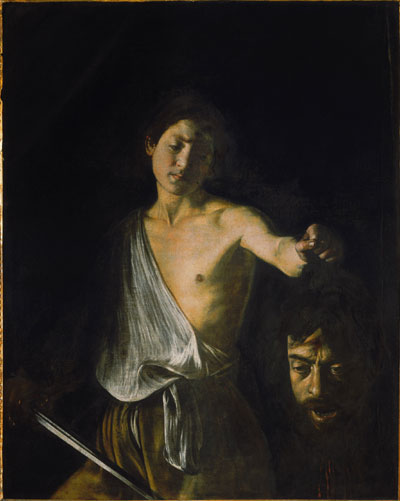
1610 · Oil on canvas · Galleria Borghese, Rome, Italy
Save articles to your collection
Log in or create a free account, and this article will be waiting in your Private Collection.
Log in or sign upThis version of David with the Head of Goliath, housed in the Galleria Borghese in Rome, is considered the most significant of the several treatments Caravaggio gave to this subject. It was painted around 1610, in the final months of the artist life, during a period of intense personal crisis. Caravaggio had been living in exile after killing a man in Rome in 1606, and he was seeking a papal pardon that would allow him to return to the city. Some scholars believe the painting was sent to Cardinal Scipione Borghese, a powerful figure at the papal court, as a kind of petition or gift intended to secure that pardon. The identification of the severed head as a self-portrait of Caravaggio is supported by comparison with other works and has been widely accepted by art historians. The painting entered the Borghese collection and has remained there, providing an extraordinary record of a painter reflecting on his own guilt and mortality in the final chapter of a turbulent life.
The composition is strikingly simple, with two figures occupying the foreground against a near-total darkness. David is rendered as a young man of quiet, almost melancholy demeanor, holding the giant head at arm length by the hair. There is none of the triumphant posturing typical of earlier Renaissance treatments of this subject. The sword David holds bears a Latin inscription that translates roughly as humility kills pride, a phrase laden with moral and autobiographical weight. The head of Goliath, with its slack jaw and half-open eyes, carries the specific facial features Caravaggio used for self-portraiture elsewhere, making the identification compelling. The paint handling in this late work is notably looser and more urgent than in earlier paintings, reflecting both the emotional intensity of the subject and the circumstances under which it was created. Light falls from an unseen source at the upper left, illuminating David face and the grotesque trophy with equal clarity while leaving the surrounding space in deep shadow.
The symbolic meaning of this painting operates on several levels simultaneously. At the most straightforward level it illustrates the biblical account of the shepherd boy David defeating the Philistine warrior Goliath. However, by inserting his own face onto the defeated giant, Caravaggio transforms the narrative into a meditation on sin, punishment, and the hope for mercy. The young David can be read as an agent of divine justice, while the Goliath head represents the sinful self that must be overcome or cast off. For a man who had committed homicide and lived in fear of both legal punishment and spiritual damnation, this imagery carried unmistakable personal resonance. The inscription on the blade reinforces the moral framework, suggesting that pride, here embodied by violent transgression, must yield to humility. The painting also reflects broader Baroque themes of vanitas and the confrontation with death, encouraging the viewer to contemplate mortality and the fleeting nature of worldly power. It stands as a profoundly self-aware document of an artist reckoning with his own legacy.
Enjoyed this story?
Save articles to your collection
Log in or create a free account, and this article will be waiting in your Private Collection.
Log in or sign up