Loading cart…
No products in the cart.

1888-1890 · Oil on canvas · National Gallery of Art, Washington D.C., United States
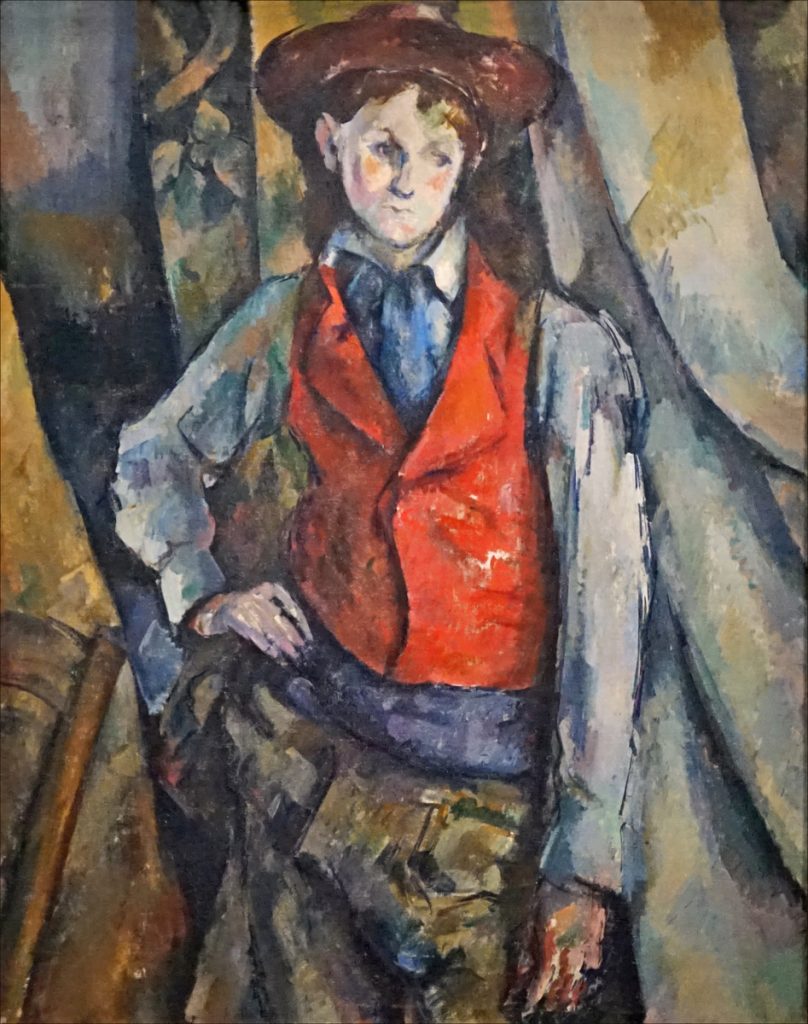
Paul Cezanne produced this portrait during the late 1880s, a period when he was working in Paris and its surroundings and actively seeking models who could hold long, patient poses. The subject is believed to be a young Italian boy named Michelangelo di Rosa, who served as a model for Cezanne on multiple occasions. This was not uncommon practice for the artist, who preferred models he could return to repeatedly, allowing him to study the figure at length without the pressure of brief sittings. The painting belongs to a small group of works featuring this same model in different poses and arrangements, and together they represent some of the most sustained figurative work Cezanne undertook during this decade. The work entered prominent collections and has been exhibited widely, earning recognition as one of the more fully realized figurative paintings in the entire body of work Cezanne left behind. It was once part of the collection of Paul Mellon before entering the National Gallery of Art in Washington D.C., where it remains today. The painting has been studied extensively by art historians who regard it as a pivotal example of how Cezanne approached portraiture differently from his Impressionist contemporaries, favoring structure and solidity over fleeting atmospheric effects. Its provenance is well documented, and its authenticity has never been in question among scholars.
Cezanne constructs the figure of the boy using his characteristic method of applying paint in small, directional strokes that build up form through color modulation rather than traditional tonal shading. The vivid red of the waistcoat anchors the composition visually and creates a strong chromatic contrast with the cooler blues and greens of the background and the neutral tones of the fabric draped over the chair. The boy is shown in a three-quarter pose with his head tilted slightly downward and to the side, giving him an introspective, withdrawn quality that is entirely consistent with the psychological distance Cezanne maintained in his portraits. There is no attempt at idealization or narrative; the figure simply exists in a state of quiet, self-contained presence. The spatial construction of the painting is equally deliberate. Cezanne allows the background to remain loosely defined, keeping the viewer focused on the relationship between the figure and the picture plane rather than on any sense of deep recession. The elongation of the model left arm has been noted by critics and scholars, and many interpret this as a conscious or semi-conscious distortion used to reinforce the two-dimensional integrity of the canvas surface. This tension between observed reality and pictorial structure is central to Cezanne broader project as a painter, and this work illustrates that tension with particular clarity.
The painting carries significance that extends well beyond its role as a straightforward portrait study. In choosing a working-class Italian boy as his subject and treating him with the same rigorous formal attention he gave to landscapes and still lifes, Cezanne implicitly challenged the hierarchies of subject matter that had long governed European painting. The boy is neither idealized nor sentimentalized; he is treated as a formal problem of equal weight to any arrangement of apples or stretch of hillside. This democratic approach to subject matter was both a personal statement and a conceptual position that would influence generations of painters who followed. The mood of the painting, quiet and withdrawn, also speaks to themes of solitude and interiority that recur throughout Cezanne work. The boy does not engage the viewer; he is absorbed in his own world, and the viewer observes from a respectful distance. This sense of separation between subject and observer reflects Cezanne own famously reclusive temperament and his preference for a meditative, almost philosophical engagement with the act of looking. The painting invites sustained contemplation rather than immediate emotional response, asking the viewer to slow down and attend to the subtle relationships of color, form, and space that Cezanne has so carefully constructed across the surface of the canvas.